-
Sony Gets It Wrong with "Meatballs" Promotion
On Monday, Sony Electronics announced a holiday promotion in which buyers of select Internet-connected Sony Bravia TVs and Blu-ray players would receive a free 24 hour rental of the Columbia/Sony Pictures film
 "Cloudy with a Chance of Meatballs." In addition, current owners of these devices would be able to rent the film for $24.95. For all of these consumers, the film would be available from Dec. 8th to Jan 4th, the month leading up to the film's DVD release.
 Ordinarily I would applaud any move by Hollywood to modify its rigid release "windows" to benefit broadband delivery of films. Yet in this case I think Sony's promotion is ill-conceived and is extremely unlikely to contribute any real momentum to studios' future broadband delivery plans. In fact, it may actually have the opposite effect and further stunt the broadband medium's emergence. Here's why:
The release window is too tight - Release windows allow Hollywood studios to mine new value from the same content given each successive distribution medium's unique attributes and audience. But by trying to squeeze in this promotional window, Sony is exacerbating an already very tight windowing plan for "Meatballs" that called for DVD release less than 2 months following its theatrical run. Remarkably, even as Sony is trumpeting this new promotion, the film is actually still playing in theaters nationwide. Given it's already only 27 days until Dec 8th, there will be virtually no gap between theatrical and promotional windows. That undermines the theatrical value proposition, in turn ticking off exhibitors who are threatening to pull the film early, according to The Hollywood Reporter.
Theatrical to DVD windows have been getting progressively tighter as studios have sought to bolster sagging DVD sales. The problem is that like a good wine, lengthy windows allow a film to age and increase in value for both those consumers who saw the movie and those who did not. With this promotion, Sony is giving consumers an in-home opportunity to see the film immediately adjacent to the DVD's availability. That can do nothing but also hurt the DVD's sales.
The promotional offer isn't strong enough - For Sony Electronics, trying to differentiate its devices in a brutally competitive landscape is key. But do the marketing pros at Sony really believe that giving away a 24 hour rental is going to have a big impact? Personally I doubt it. The prices of the Sony TVs in the promotion are in the $1,000-$2,000 range, so a $25 incentive is easily swamped by the rampant deep discounts found in Sunday circulars (not to mention even deeper online deals). Further, I don't see any retailer incentives included in the promotion that would influence the sales process.
The "Meatballs" offer might have a stronger effect on sales of Sony's Blu-ray players, though here too, it's unlikely to be profound. With Blu-ray player sales lagging, manufacturers and retailers have largely decided that hitching their wagons to Netflix's Watch Instantly streaming is the best way to bump up sales. But with sub-$100 Netflix-capable Blu-ray players now available, a "Meatballs" rental valued at $25 on a $200-250 Sony player will have a hard time breaking through. Last but not least, it's important to remember, Sony's promotion is for a 24 hour rental. Not offering consumers ownership of "Meatballs" makes the promotional value ephemeral. And with Walmart, Target and Amazon now offering top DVDs for just $10 apiece, a 24 hour rental valued at $25 is underwhelming, not to mention somewhat specious, given it is Sony that's setting the "price." Given all of this, I suspect Sony would have done better by just offering a free "Meatballs" DVD with purchase.
Device audience too small to prove broadband delivery's appeal - Looked at differently, the small base of connected Sony Bravia and connected Blu-ray players, plus the new device sales over the promotional period, is unlikely to generate a large volume of "Meatballs" streaming anyway. That means that the promotion will do little to encourage Sony or other studios to more strongly embrace broadband delivery of their films. In fact, when the weak results of the promotion come in (as I expect they will), "Meatballs" could become future industry shorthand for "broadband delivery isn't ready for prime-time." That would be a shame, because I believe consumers very much want on-demand access to films in their homes. Netflix's success with Watch Instantly certainly proves that, as does the success VOD is having.
From my perspective, rather than setting up half-baked promotions like this one, studios should take a step back and think through how to do broadband delivery (for both rental and download-to-own) correctly. There are a lot of moving pieces, but clearly addressing what to do about the DVD window is critical. Studios are rightfully worried about killing off this cash cow. But compressing the DVD window and then trying to insert a new broadband delivery window isn't going to be the answer. Rather than seeing more "Meatballs" like promotions, I'd prefer to see a cohesive strategy out of Hollywood for how it can fully tap into broadband delivery's potential.
What do you think? Post a comment now.
Categories: Devices, FIlms, Studios
-
4 Items Worth Noting for the Nov 2nd Week (Q3 earnings review, Blu-ray streaming, Apple lurks, "Anywhere" coming)
Following are 4 items worth noting for the Nov 2nd week:
1. Media company and service provider earnings underscore improvements in economy - This was earnings week for the bulk of the publicly-traded media companies and video service providers, and the general theme was modest increases in financial performance, due largely to the rebounding economy. The media companies reporting - CBS, News Corp, Time Warner. Discovery, Viacom and the Rainbow division of Cablevision - showed ongoing strength in their cable networks, with broadcast networks improving somewhat from earlier this year. For ad-supported online video sites, plus anyone else that's ad-supported, indications of a healthier ad climate are obviously very important.
Meanwhile the video service providers reporting - Comcast, Cablevision, Time Warner Cable and DirecTV all showed revenue gains, a clear reminder that even in recessionary times, the subscription TV business is quite resilient. Cable operators continued their trend of losing basic subscribers to emerging telco competitors (with evidence that DirecTV might now be as well), though they were able to offset these losses largely through rate increases. Though some people believe "cord-cutting" due to new over-the-top video services is real, this phenomenon hasn't shown up yet in any of the financial results. Nor do I expect it will for some time either, as numerous building blocks still need to fall into place (e.g. better OTT content, mass deployment of convergence devices, ease-of-use, etc.)
2. Blu-ray players could help drive broadband to the TV - Speaking of convergence devices, two articles this week highlighted the role that Blu-ray players are having in bringing broadband video to the living room. The WSJ and Video Business both noted that Blu-ray manufacturers see broadband connectivity as complementary to the disc value proposition, and are moving forward aggressively on integrating this feature. Blu-ray can use all the help it can get. According to statistics I recently pulled from the Digital Entertainment Group, in Q3 '09, DVD players continue to outsell Blu-ray players by an almost 5 to 1 ratio (15 million vs. 3.3 million). Cumulatively there are only 11.2 Blu-ray compatible U.S. homes, vs. 92 million DVD homes.
Still, aggressive price-cutting could change the equation. I recently noticed Best Buy promoting one of its private-label Insignia Blu-ray players, with Netflix Watch Instantly integrated, for just $99. That's a big price drop from even a year ago. Not surprisingly, Netflix's Chief Content Officer Ted Sarandros said "streaming apps are the killer apps for Blu-ray players." Of course, Netflix execs would likely say that streaming apps are also the killer apps for game devices, Internet-connected TVs and every other device it is integrating its Watch Instantly software into. I've been generally pessimistic about Blu-ray's prospects, but price cuts and streaming could finally move the sales needle in a bigger way.
3. Apple lurks, but how long will it stay quiet in video? - The week got off to a bang with a report that Apple is floating a $30/mo subscription idea by TV networks. While I think the price point is far too low for Apple to be able to offer anything close to the comprehensive content lineup current video service providers have, it was another reminder that Apple lurks as a major potential video disruptor. How long will it stay quiet is the key question.
While in my local Apple store yesterday (yes I'm preparing to finally ditch my PC and go Mac), I saw the new 27 inch iMac for the first time. It was a pretty stark reminder that Apple is just a hair's breadth away from making TVs itself. Have you seen this beast yet? It's Hummer-esque as a workstation for all but the creative set, but, stripped of some of its computing power to cost-reduce it, it would be a gorgeous smaller-size TV. Throw in iTunes, a remote, decent content, Apple's vaunted ease-of-use and of course its coolness cachet and the company could fast re-order the subscription TV industry, not to mention the TV OEM industry. The word on the street is that Apple's next big product launch is a "Kindle-killer" tablet/e-reader, so it's unlikely Steve Jobs would steal any of that product's thunder by near-simultaneously introducing a TV. If a TV's coming (and I'm betting it is), it's likely to be 2H '10 at the earliest.
4. Get ready for the "Anywhere" revolution - Yesterday I had the pleasure of listening to Emily Green, president and CEO of tech research firm Yankee Group, deliver a keynote in which she previewed themes and data from her forthcoming book, "Anywhere: How Global Connectivity is Revolutionizing the Way We Do Business." Emily is an old friend, and 15 years ago when she was a Forrester analyst and I was VP of Biz Dev at Continental Cablevision (then the 3rd largest cable operator), she was one of the few people I spoke to who got how important high-speed Internet access was, and how strategic it would become for the cable industry. 40 million U.S. cable broadband homes later (and 70 million overall) amply validates both points.
Emily's new book explores how the world will change when both wired and wireless connectivity are as pervasive as electricity is today. No question the Internet and cell phones have already dramatically changed the world, but Emily makes a very strong case that we ain't seen nothing yet. I couldn't help but think that TV Everywhere is arriving just in time for video service providers whose customers increasingly expect their video anywhere, anytime and on any device. "Anywhere" will be a must-read for anyone trying to make sense of how revolutionary pervasive connectivity is.
Enjoy your weekends!
Categories: Aggregators, Books, Broadcasters, Cable Networks, Cable TV Operators, Devices
Topics: Best Buy, Bl, Cablevision, CBS, Comcast, DirecTV, Netflix, News Corp, Rainbow, Time Warner Cable, Time Warner. Discovery, Viacom
-
Seeking Cable's Formula for Success in Broadband Video
Yesterday VideoNuze hosted a breakfast at the annual CTAM Summit where I moderated a discussion titled, "How Cable Succeeds in the Broadband Video Era." Panelists included Ian Blaine, CEO, thePlatform, Rebecca Glashow, SVP, Digital Media Distribution, Discovery Communications, Bruce Leichtman, President & Principal Analyst, Leichtman Research Group and Chuck Seiber, VP, Marketing, Roku. Following are some of my observations from the discussion.
Against a backdrop of rapidly rising broadband video consumption, cable operators and networks are trying to strike a balance between preserving their traditional, and highly profitable business model, while still keeping pace with consumers' desire for more flexible and on-demand viewing options. A nagging question is whether full-length cable programs should be made available online for free, solely supported by advertising (the Hulu model), or if the cable industry's dual subscription/advertising model should be extended online (the TV Everywhere concept).
On the panel, Rebecca likely reflected many cable networks' current thoughts, saying, "We are in an ecosystem with our distribution partners that works....It (the free model) is going to kill all of our business; it's certainly going to kill our ability to produce high quality programming." These sentiments echo concerns I've raised about the viability of ad-supported long-form video. Even as Rebecca was critical of the free model, she noted that Discovery is taking a measured approach to TV Everywhere.
Chief among Rebecca's concerns regarding TV Everywhere is the need to accurately measure online viewership, crucial for ensuring that if viewership were to shift to online, that Discovery's ratings would not be hurt in the process. As Rebecca further pointed out, measurement issues have limited the appeal of cable operators' Video-on-Demand offerings.
Bruce went a step further to suggest that cable operators should learn from VOD's shortcomings when crafting their TV Everywhere plans. Bruce said that VOD rollouts "were led by engineers on a node-by-node basis" when they should have been led by marketers, and that "some operators introduced VOD only with trepidation." He believes that the problems that VOD had in the early days, "are still impacting consumers' perception of the on-demand platform."
Another VOD lesson I would add is that operators must also make TV Everywhere monetizable for their content partners. VOD has suffered significantly from operators not investing in dynamic ad-insertion capabilities, making VOD a marginal opportunity for ad-supported cable networks. A day earlier on another CTAM Summit panel, Steve Burke, Comcast's COO highlighted the fact that Comcast is now generating 300 million VOD sessions/month. But he also noted that Comcast has only just launched a dynamic ad-insertion capability, and in just one of its operations. It continues to bewilder me why Comcast wasn't investing in dynamic ad insertion when it was doing 10 million VOD sessions/month, years ago. How much further along might the VOD platform be, had robust advertising been possible?
As a result, it's fair to wonder whether operators will invest in TV Everywhere sufficiently to make it attractive as a new distribution platform, or alternatively will leave critical components unresolved as they've done with VOD. The answer could well determine whether TV Everywhere is a killer app (as I believe it has the potential to be) or if just becomes a half-baked nice-to-have for consumers and content providers alike. For Comcast at least, thePlatform and other technologies are important building blocks to success. As Ian pointed out, the key is being able to "quickly ascertain" the networks and programs that subscribers should have access to, a challenge that gets more complicated as content available through TV Everywhere-type offerings grows over time.
If cable doesn't get TV Everywhere quite right another implication is that certain gaps in consumers' experiences will persist - gaps that companies like Roku are seeking to fill with video they're bringing into the home solely over broadband connections. Today the $99 Roku device offers users the ability stream Netflix, Amazon and MLB video. It's tempting to see Roku as a potential cable competitor down the road, yet Chuck was quick to clarify that Roku sees itself as augmenting the cable experience, not supplanting it. In fact, he added that Roku is talking to cable operators about how it can partner with Roku to extend their viewer experiences.
Coming away from the session I'm reminded that while broadband is causing significant shifts in consumer behavior and expectations, fully capitalizing on them will take time as business requirements and technologies evolve.
What do you think? Post a comment now.
(Note: Steve Donohue contributed to this post.)
Categories: Cable Networks, Cable TV Operators, Devices
Topics: Comcast, Discovery, Hulu, Roku, TV Everywhere
-
4 Items Worth Noting from the Week of August 31st
Following are 4 news items worth noting from the week of August 31st:
1. Nielsen "Three Screen Report" shows no TV viewing erosion - I was intrigued by Nielsen's new data out this week that showed no erosion in TV viewership year over year. In Q2 '08 TV usage was 139 hours/mo. In Q2 '09 it actually ticked up a bit to 141 hours 3 minutes/mo. Nielsen shows an almost 50% increase in time spent watching video on the Internet, from 2 hours 12 minutes in Q2 '08 to 3 hours 11 minutes in Q2 '09 (it's worth noting that recently comScore pegged online video usage at a far higher level of 8.3 hours/mo raising the question of how to reconcile the two firms' methodologies).
I find it slightly amazing that we still aren't seeing any drop off in TV viewership. Are people really able to expand their media behavior to accommodate all this? Are they multi-tasking more? Is the data incorrect? Who knows. I for one believe that it's practically inevitable that TV viewership numbers are going to come down at some point. We'll see.
2. DivX acquires AnySource - Though relatively small at about $15M, this week's acquisition by DivX of AnySource Media is important and further proof of the jostling for position underway in the "broadband video-to-the-TV" convergence battle (see this week's "First Intel-Powered Convergence Device Being Unveiled in Europe" for more). I wrote about AnySource earlier this year, noting that its "Internet Video Navigator" looked like a content-friendly approach that would be highly beneficial to CE companies launching Internet-enabled TVs. I'm guessing that DivX will seek to license IVN to CE companies as part of a DivX bundle, moving AnySource away from its current ad-based model. With the IBC show starting late next week, I'm anticipating a number of convergence-oriented announcements.
3. iPhone usage swamps AT&T's wireless network - The NY Times carried a great story this week about the frustration some AT&T subscribers are experiencing these days, as data-centric iPhone usage crushes AT&T's network (video is no doubt the biggest culprit). This was entirely predictable and now AT&T is scrambling to upgrade its network to keep up with demand. But with upgrades not planned to be completed until next year, further pain can be expected. I've been enthusiastic about both live and on-demand video applications on the iPhone (and other smartphones as well), but I'm sobered by the reality that these mobile video apps will be for naught if the underlying networks can't handle them.
4. Another great Netflix streaming experience for me, this time in Quechee VT courtesy of Verizon Wireless - Speaking of taxing the network, I was a prime offender of Verizon's wireless network last weekend. While in Quechee, VT (a pretty remote town about 130 miles from Boston) for a friend's wedding, I tethered my Blackberry during downtime and streamed "The Shawshank Redemption" (the best movie ever made) to my PC using Netflix's Watch Instantly. I'm happy to report that it came through without a single hiccup. Beautiful full-screen video quality, audio and video in synch, and totally responsive fast-forwarding and rewinding. I've been very bullish on Netflix's Watch Instantly, and this experience made me even more so.
Per the AT&T issue above, it's quite possible that occupants of neighboring rooms in the inn who were trying to make calls on their Verizon phones while I was watching weren't able to do so. But hey, that was their problem, not mine!
Enjoy the weekend (especially if you're in the U.S. and have Monday off too)!
Categories: Aggregators, Deals & Financings, Devices, Mobile Video
Topics: AnySource, Apple, AT&T, comScore, DivX, Intel, iPhone, Netflix, Nielsen, Verizon Wireless
-
First Intel-Powered Convergence Device Being Unveiled in Europe
Convergence devices that bring broadband video and Internet applications to the TV (e.g. Roku, Xbox, Apple TV, Vudu, etc.) are a white-hot area of interest as many industry participants - including me - believe their eventual mass adoption will provide a major catalyst to broadband video usage and prompt further disruption in the value chain.
Intel has eyed a big role in this emerging market for a while, becoming a strong public proponent of the "digital home" concept. Building momentum over the past year, Intel has made announcements with Yahoo (for the "Widget Channel" framework), Adobe (to port and optimize Flash for TV viewing) and with a number of large content providers (demonstrating enhanced viewer experiences).
At the heart of Intel's early initiatives is the company's much-heralded Media Processor CE3100, the first in a family of "system on a chip" convergence-oriented processors. Next week the first CE3100-powered device, the "Mediaconnect TV" will be shown at the IBC show in Amsterdam. The box is a collaboration between a Dutch company, Metrological Media Innovations and a British interactive services provider, Miniweb (a spinoff of BSkyB). This has been previewed recently and is sure to gain more visibility next week. To learn more about Intel's convergence vision, yesterday I spoke to Wilfred Martis, the GM of Connected AV Products for Intel's Digital Home Group.
Intel sees 4 different types of home products that can be fitted with its media processor chips: set-top boxes, digital TVs, optical players (e.g. Blu-ray devices) and "connected AV" products, which are defined as standalone boxes that connect broadband to the TV, but without any guaranteed quality of service (QoS) for the video. This segmentation actually closely follows a slide I've been presenting lately which maps the various efforts for bringing broadband to the TV.
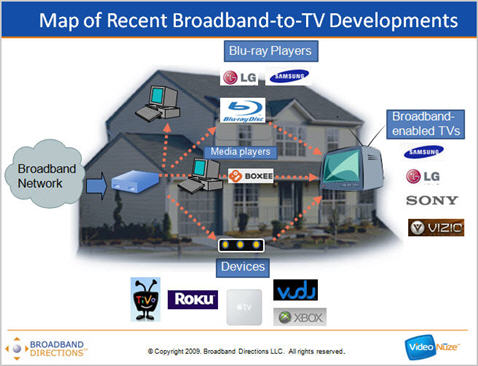
The connected AV devices are of course what "over-the-top" providers like Netflix, Amazon, iTunes, YouTube, etc. are counting on to deliver their services into the home over open broadband connections. On the one hand, Intel seems to be looking to empower these providers. As Wilfred says, Intel is trying to create a standard toolset and app environment akin to what we've seen on leading smartphones (mainly the iPhone) that helps drive creative new TV-based applications. Yet at the same time, as Wilfred notes, Intel wants to be a friend to incumbent video service providers, allowing them to deliver broadband content side-by-side with their walled-garden channels in their set-top boxes.
While Intel is clearly in this for the long haul, and has the resources to cultivate the market, other non-Intel devices continue to get a foothold. It's interesting to contrast, for example, the success that Roku is enjoying to date and ponder how the convergence device market will develop over the next several years. As I detailed a few weeks ago, Roku is successfully pursuing a classic "Crossing the Chasm" strategy, leveraging low pricing and loyalty to its content partners' brands to move lots of its product.
Still, integrating with Roku - and other current convergence devices - requires a one-off integration that assumes resources and prioritization (even when APIs exist). Some content providers will determine integrating is worthwhile, while others will not.
Intel's strategy is meant build on existing technologies and applications, making it more straightforward for content providers and applications developers to deploy on its devices (it's worth noting that Amazon, Blockbuster, Facebook and others plan to launch Widget Channel apps imminently). As Wilfred explains, when Intel's architecture is in convergence devices, incumbent software like browsers, plug-ins, drivers and the like are intended to work seamlessly. In addition, by providing abundant processing power, developers don't have to go through the arduous task of de-optimizing their apps for slower environments. And they get the performance headroom to continuously add updates.
The price for all this is of course, price. I don't know what the unit cost of the CE3100 is at volume, but my guess is that whatever it is would quickly sink any manufacturer's prospects of selling their box at anything close to a $99 price point, as Roku is. It's an age-old computing dilemma: beneficial as it is to have lots of processing power, there's a cost to it.
This raises the fundamental question of how the convergence device market will shape up over the next several years: will low-cost, "powerful-enough" devices continue to gain, or will boxes with robust processing render them obsolete at some point soon? My guess is that in the short term at least, low cost is going to lead the way. However, over the long term, it's hard to avoid the idea of significant computing power sitting next to the TV. However the business model for who pays to get it there remains in question.
What do you think? Post a comment now.
Categories: Devices, International
Topics: Adobe, Intel, Metrological Media Innovations, Miniweb, Roku, Yahoo
-
4 Items Worth Noting from the Week of August 24th
Following are 4 news items worth noting from the week of August 24th:
1. Time Warner Cable, Verizon launch TV Everywhere trials - Little surprise that Time Warner Cable announced its own TV Everywhere trial yesterday, given that former sister company Time Warner has been one of its biggest proponents. More interesting was Verizon launching a TV Everywhere initiative, which I regard as a pretty strong indicator that most or all service providers will eventually get on board. (The Hollywood Reporter has a story that DirecTV is in talks too for online distribution of TBS and TNT to start).
I have to give credit to Time Warner CEO Jeff Bewkes, TV Everwhere's key champion, who's clearly generated a groundswell of support. While some critics see TV Everywhere as being at odds with the "open Internet" ethos, I continue to think of it as a big win for consumers eager to get online access to their favorite cable programs. Assuming authentication is proven in during the trials I expect a speedy rollout.
2. Conde Nast distributes through boxee - I was intrigued by news that Conde Nast Digital will begin distributing video from its Wired.com and Style.com sites through boxee. boxee and others who connect broadband to TVs are valuable for magazines and other content providers who have long been shut out of the cable/satellite/telco distribution ecosystem, thereby unable to reach viewers' TVs. Years ago special interest magazines missed big opportunities to get into cable programming, allowing upstart cable networks to grow into far larger businesses (consider ESPN vs. Sports Illustrated, Food Network vs. Gourmet or CNBC vs. Forbes). Broadband gives magazines, belatedly, an opportunity to get back into the game.
3. Amazon announces 5 finalists in UGC ad contest - Have you seen the 5 finalists' ads in Amazon's "Your Amazon Ad" contest, announced this week? They're quite clever, with some amazing special effects. The contest is another great example of how brands are tapping users' talents, posing new competition to ad agencies. I haven't written about this in a while, but I continue to be impressed with how different brands are pursuing this path. Doritos has been the most visible and successful with its user-generated Super Bowl ads.
4. Microprojectors open up mobile video sharing opportunities - Maybe I've been living under a rock because I just read about "microprojectors" for the first time this week (I have a decent excuse since as I non-iPhone owner I wouldn't have a use for one, yet). As the name suggests, these are pocket-size projectors that allow you to output the video from your iPhone to project onto a large surface like a wall or ceiling. According to this NY Times review the quality is quite respectable, and is no doubt only going to improve. The mind boggles at what this could imply for sharing mobile video. Imagine bringing a kit - consisting of an iPhone, portable speakers and microprojector - to your friend's house, then plugging in and projecting either a live stream or an on-demand program for all to see.
Enjoy your weekend!
Categories: Cable Networks, Cable TV Operators, Commerce, Devices, Magazines, Telcos, UGC
Topics: Amazon, Comcast, Conde Nast, Time Warner Cable, Verizon
-
4 Items Worth Noting from the Week of August 17th
Following are 4 news items worth noting from the week of August 17th:
CBS's Smith says authentication is a 5 year rollout - I had a number of people forward me the link to PaidContent's in-depth coverage of CBS Interactive CEO Quincy Smith's comments at the B&C/Multichannel News panel in which he asserted that TV Everywhere/authentication won't gain critical mass until 2014.
I was asked what I thought of that timeline, and my response is that I think Smith is probably in the right ballpark. However, these rollouts will happen on a company by company basis so timing will vary widely. Assuming Comcast's authentication trial works as planned, I think it's likely to expect that Comcast will have its "On Demand Online" version of TV Everywhere rolled out to its full sub base within 12 months or so. Time Warner Cable is likely to be the 2nd most aggressive in pursuing TV Everywhere. For other cable operators, telcos and satellite operators, it will almost certainly be a multi-year exercise.
NFL makes its own broadband moves - While MLB has been getting a lot of press for its recent broadband and mobile initiatives, I was intrigued by 2 NFL-related announcements this week that show the league deepening its interest in broadband distribution. First, as USA Today reported, DirecTV will offer broadband users standalone access to its popular "Sunday Ticket" NFL package. The caveat is that you have to live in an area where satellite coverage is unattainable. The offer, which is being positioned as a trial, runs $349 for the season. With convergence devices like Roku hooking up with MLB.TV, it has to be just a matter of time before the a la carte version of Sunday Ticket comes to TVs via broadband as well.
Following that, yesterday the NFL and NBC announced that for the 2nd season in a row, the full 17 game Sunday night schedule will be streamed live on NBCSports.com and NFL.com. Both will use an HD-quality video player and Microsoft's Silverlight. They will also use Microsoft's Smooth Streaming adaptive bit rate (ABR) technology. All of this should combine to deliver a very high-quality streaming experience. But with all these games available for free online, I have to wonder, are NBC and the NFL leaving money on the table here? It sure seems like there must have been some kind of premium they could have charged, but maybe I'm missing something.
Metacafe grows to 12 million unique viewers in July - More evidence that independent video aggregators are hanging in there, as Metacafe announced uniques were up 67% year-over-year and 10% over June (according to comScore). I've been a Metacafe fan for a while, and their recent redesign around premium "entertainment hubs" has made the site cleaner and far easier to use. Metacafe's news follows last week's announcement by Babelgum that it grew to almost 1.7 million uniques in July since its April launch. Combined, these results show that while the big whales like YouTube and Hulu continue to capture a lot of the headlines, the minnows are still making swimming ahead.
Kodak introduces contest to (re)name its new Zi8 video camera - It's not every day (or any day for that matter) that I get to write how a story in a struggling metro newspaper had the mojo to influence a sexy new consumer electronic product being brought to market by an industrial-era goliath, so I couldn't resist seizing this opportunity.
It turns out that a review Boston Globe columnist Hiawatha Bray wrote, praising Kodak's new Zi8 pocket video camera, but panning its dreadful name, prompted Kodak Chief Marketing Officer Jeffrey Hayzlett to launch an online contest for consumers to submit ideas for a new name for the device, which it intends to be a Flip killer. Good for Hayzlett for his willingness to change course at the last minute, and also try to build some grass roots pre-launch enthusiasm for the product. And good for the Globe for showing it's still relevant. Of course, a new name will not guarantee Kodak success, but it's certainly a good start.
Enjoy your weekend!
Categories: Aggregators, Broadcasters, Cable TV Operators, Devices, Indie Video, Sports
Topics: Babelgum, Boston Globe, CBS, Comcast, Kodak, MetaCafe, MLB, NFL, Roku, Time Warner Cable
-
A Deep Dive Into Why the iPhone is Going to Unleash Mobile Video Streaming
VideoNuze readers will recall that back in Dec '08, my 2nd prediction for 2009 was that mobile video was finally going to take off. Among the drivers I identified, the main one was clearly the massive, and growing, popularity of the iPhone. But despite all of its gee-whiz capabilities, the iPhone 3G, which was then the latest one on the market, and was running the iPhone OS 2.0, still wasn't really optimized for video.
Flash forward to June '09 and the release of the iPhone OS 3.0, which is downloadable to iPhone 3G, and pre-installed on the iPhone 3GS, and we can see that Apple now has the architecture in place to fuel a massive takeoff of mobile video streaming.
Following is a deep dive explanation of why that is, based on a detailed conversation I had John Bishop, SVP of Business Development & Strategy at Inlet Technologies, an encoding company that's involved with recent iPhone video apps, an excellent new white paper from Akamai, "HTTP Streaming for iPhone Best Practices" and other research I conducted. (For those that want to get further into the weeds, note also that Akamai, Inlet and Turner Sports have an upcoming webinar on this topic.) If you're a video provider looking to capitalize on mobile video distribution, and the iPhone in particular, all of this is crucial to understand.
The most important video-related elements Apple has released are support for HTTP streaming, a new protocol for adaptive bit rate (ABR) streaming and a new iPhone media player that can handle both. In
 addition, a significant increase in battery life (especially important to retain phone functionality) is enabled by a hardware-based video decoder. And the iPhone supports "HSDPA," an enhanced 3G protocol AT&T is rolling out, which provides up to 7.2 megabit per second delivery, guaranteeing outstanding video quality. All of these elements, when combined with the iPhone's open (well, relatively at least) App Store and web browsing, offer video providers a breakthrough mobile video environment.
HTTP-based streaming is particularly key because CDNs already have massive deployments of HTTP (the web delivery standard) servers. That means they avoid significant capex to support proprietary video streaming protocols like RTSP and RTMP, and can instead focus just on hardening their HTTP infrastructure to scale video distribution.
Apple's new ABR streaming protocol means a far superior user experience that obviates disruptive buffering and users having to make confusing choices like "hi res" or "low res." ABR streaming was pioneered by Move Networks. Microsoft and Adobe now each have their own ABR streaming approaches.
Importantly, because the iPhone supports H.264, video providers can use existing encoding vendors like Inlet to simply create multiple iPhone-compatible video files encoded at different bit rates that are then delivered to their CDN for iPhone distribution. No intermediary "encapsulation" step needs to be taken to support Flash for example. As the iPhone's media player auto-detects available mobile bandwidth, it continuously re-selects the optimal video file to stream. Inlet makes a key contribution in this process by doing "key frame alignment" - essentially allowing the new file being streamed to start at the same frame where the old file left off. Pretty cool stuff.
From the content provider's standpoint, iPhone-directed video can either be embedded in a web page, or as part of an app, for distribution in the iPhone's gigantic app store. The open web approach of course means it's available for all to see. On the other hand, the app route means greater control of the brand, user experience and business model (e.g. free, paid, authenticated, etc.), though it will involve time and money is needed for development.
This whole paradigm is still so new that we've only begun seeing the first iPhone video apps come to market. Examples include the updated version of MLB.com's At Bat app, the live Aug. 7th concert from Underworld, the PGA Championship app from Turner Sports and the PGA, and yesterday, the launch of the HSN "shop app." I can relate to the value of the PGA app - I was in a car on my way back to Boston on Sunday afternoon, furiously - and unsuccessfully - trying to follow the Yang-Woods showdown shot-by-shot on my Blackberry (I'm a Verizon sub, so no iPhone for me, grrrr....). If I'd had an iPhone, would I have spontaneously paid $1.99 for the PGA app so I could watch the action? In a heartbeat.
Mobile video is an incredibly exciting extension of the broadband experience users have come to love, except with the additional benefit of being untethered. The iPhone is the first environment that brings all the necessary elements together and will, in my view, drive an explosion of mobile video streaming apps (though I concede to being uncertain what AT&T will think of all this). Think about video apps that are yet to come from folks like Hulu, Netflix, and others. No doubt we'll see Android, Palm and Blackberry further fuel the addressable market. Add it all up and there's a lot of growth ahead in the mobile video space.
What do you think? Post a comment now.
Categories: Devices, Mobile Video, Telcos
Topics: Akamai, Apple, HSN, Inlet Technologies, iPhone, MLB, PGA, Turner Sports
-
Interview with boxee Investors Bijan Sabet and Neil Sequeira
When boxee announced it raised a $6M second round last week it caught my attention for two reasons. First, it was further evidence that broadband video-related companies are continuing to raise money right through the current economic meltdown (industry companies raised at least $64M in Q2 '09, $75M in Q1 '09 and $78M in Q4 '08).
Second, and more noteworthy to me was how much industry experience and insight now backs boxee. The new lead investor in the round was Boston venture firm General Catalyst Partners (joining prior investors Spark Capital and Union Square Ventures), whose portfolio includes broadband video companies like Brightcove, DECA, EveryZing, Maven Networks (acquired by Yahoo), ScanScout, ViTrue and Visible Measures.
Spark also has many investments in the industry, including 5Min, Adap.tv, EQAL, KickApps, Next New Networks, thePlatform (acquired by Comcast) and Veoh. And Union Square is one of the most active firms in the online media/advertising industry with stakes in MeetUp, OddCast, Twitter (with Spark), Tacoda (acquired by AOL) and others.
Beyond the firms themselves are the individuals helping steer boxee. Joining its board from GC is Neil
 Sequeira, a veteran of the cable industry, who was most recently Managing Director, Technology of AOL Time Warner Ventures. Already on the board is Spark's Bijan Sabet who knows the cable/satellite ecosystem equally well, having done stints at Moxi, WebTV and Apple and Union Square's Fred Wilson, who is deeply immersed in online media and writes a hugely popular blog.
 I corralled Neil and Bijan (two old friends) for a phone interview late last week to explain boxee's future and where it fits into the current video ecosystem. Following is an edited transcript.
VideoNuze: What attracted you to invest in boxee?
Neil Sequeira: Three things. The boxee team, the market opportunity and our ability to be a great partner. We think boxee has the potential to be the next generation "Firefox for media," a widely- used consumer platform. That's incredibly exciting to us.
Bijan Sabet: We've been involved with boxee for a while now, and we're convinced the time is right for something like this. boxee has the right ingredients: it is open source and includes social media capabilities, an app store and a huge community of users/developers.
VideoNuze: boxee has gained a loyal following, but it doesn't have a business model yet. What do you see as boxee's business model and it what time frame must it develop it in order to succeed?
BS: boxee's still a very young company, but we have a number of ideas around business models. But the key is patience. The company has a very low burn rate, with around 16 people or so , most of whom are in Israel. The focus for now is building the product and the user base. And the company's been very successful doing that. Last year boxee had 10,000 users, now it has 600,000.
NS: It also has a very excited developer community. But I agree - patience is needed here. Too often companies can get themselves focused to early on a specific business model, which then constrains them. With the new funding, box has room to see how things evolve.
VideoNuze: Hulu recently told boxee to remove its content. What do you think boxee needs to do to win Hulu (and others) onto its platform?
NS: At a high level boxee we believe boxee is an incredible friend to content providers, and we want to work with everyone. We're big believers that consumers want access to everything and that's where the market will go over time.
 BS: All of us are Hulu fans and of course would love to have Hulu on boxee. But each content provider has its own business model, and has to decide what works best for them. boxee will continue to be a content provider-friendly platform, where different business models can be used and different technologies integrated. We think that's powerful.
 VideoNuze: How should established video service providers (i.e. cable/satellite/telco) regard boxee - as friend, foe, or something else?
NS: We want boxee to be regarded as friend and we think boxee can add a lot of value to the ecosystem. Consider for example, the case of TiVo. Early on it looked like a foe. But now see how Comcast is integrating TiVo into its set-top boxes and driving incremental revenue. boxee brings great search, apps and context to the broadband viewing experience. All that will drive usage of broadband Internet connections, which in turn helps "fill the pipe" making cable and telco Internet access services that much more valuable to users - and to their providers.
BS: Agreed. We believe that in an IP world, these things aren't either/or, mutually exclusive. Again look at Comcast, which has great assets like Fancast, and is now working on entitlements with TV Everywhere. boxee can help drive more value from them. This is especially true for certain user segments, like new college grads, for whom the Internet is now far more important than is traditional TV. The point is traditional service providers need to figure out how to delight a variety of user segments. We believe boxee can help.
VideoNuze: You guys and your firms have deep relationships in the cable/satellite/telco industries. How are those folks reacting to boxee?
NS: People in the ecosystem are taking a "wait-and-see" approach. There's a certain amount of fascination, and though we don't see any impending deals, Avner (Ronen, boxee's founder/CEO) has multiple conversations ongoing with the industry.
VideoNuze: Who are boxee's primary competitors?
BS: What Apple and Microsoft are doing is most competitive, though their approaches include both hardware and software. We think of boxee like Android (Google's mobile OS), sort of the "inside-out" version of Apple TV. And we believe convergence device/hardware providers want alternatives.
VideoNuze: How about Roku?
NS: We believe Roku should be partners with boxee. Hardware companies have core competencies and typically those don't include open source media platforms. So boxee can help devices like Roku be even better. We'll have a number of device deals to announce soon.
VideoNuze: A lot has been written about "over-the-top" services. Are they starting to succeed, and if so, what must happen for them to gain further success?
NS: Well, yes, when we look at what Netflix and others are doing already, we do believe over-the-top services are starting to succeed. And we think this isn't necessarily a bad thing for cable operators for example. That's because the video business has had margin compression due to rising programming costs, whereas broadband Internet service has been incredibly profitable for them.
Consider that that cable operators didn't offer DVR or voice services just 10-11 years ago, but now they are a significant driver of ARPU (average revenue per unit). There's a lot more that cable operators can derive from broadband services than they currently are, considering the IP connection is now - for many - the most important connection they have. Content providers know this and are looking for more, not fewer, ways to distribute their content.
BS: Agreed, look at an example like CNBC, whose ratings are down something like 30% year-over-year. What's causing this? Is there demo changing? Is the web providing alternatives? Some of both? The point is content providers need to figure out how to control their destiny. That doesn't mean they have to give their stuff away for free. But it does mean they need to figure out how to distribute as effectively as possible. We want to help them do that. You can't go backwards here. Broadband is too interesting and too important to too many people.
VideoNuze: Thanks guys.
Categories: Cable TV Operators, Deals & Financings, Devices, Satellite, Telcos
Topics: Boxee, General Catalyst, Spark Capital, Union Square Ventures
-
4 Items Worth Noting from the Week of August 10th
Following are 4 news items worth noting from the week of August 10th:
Discovery Channel signs onto Comcast On Demand Online trial - Comcast added yet another cable programmer this week to the roster of those participating in its TV Everywhere trial. Discovery will make available episodes of "Man vs. Wild," "Swords," "Stormchasers" and "Verminators" though with some delayed windows that take a little edge off their appeal. Comcast has made a ton of progress corralling networks for its trial, but 4 of the big 5 cable network owners - Disney, Fox, NBCU and Viacom - remain holdouts. No coincidence that the first 3 are Hulu's owners.
Swarmcast powers MLB.TV on Roku, introduces "Autobahn Live for CE" - Following on Roku's announcement this week that it is offering MLB.TV, Swarmcast announced it was powering the service through a new offering called "Autobahn Live for CE." Swarmcast's COO Chad Tippin explained to me that integrating with CE devices that drive broadband/TV convergence is a key company goal. Chad is confident that Swarmcast's high-quality, scalable HTTP streaming service will work on these various CE devices, and that as the number of them deployed swells, a new "long tail of live sports" will flourish. Live sports and events (e.g. concerts) could be a significant contributor to device adoption. For example, picture getting a coupon for $50 off the purchase of a Roku when you buy a pay-per-view of a streaming blockbuster concert.
Babelgum grows to nearly 1.7 million unique visitors in July, 2009 - I heard from Michael Rosen, EVP and Chief Revenue Officer at Babelgum this week, with news that the site has grown to nearly 1.7 million unique visitors in July (comScore), following its U.S. launch in April. I profiled Babelgum back in April and was cautiously optimistic about its approach to curate high-quality, independently-produced video into 5 channels (music, film, comedy, Our Earth and Metropolis). The site is fully ad-supported. Babelgum's growth comes on top of a slew of made-for-broadband video initiatives I detailed recently. The NY Times also had a great story this week on how independent filmmakers are taking distribution into their own hands. Despite the recession, this corner of the broadband market seems to be hanging in there.
Zune HD coming Sept 15th - Microsoft at last announced this week that the Zune HD digital media player will be in retail on Sept 15th, with pre-orders now being accepted. Zune HD introduces a touch-screen interface, 720p video playback, HD radio and other goodies. It is sure to raise the visibility of high-quality portable video another notch. But I find myself wondering: as the iPhone and other smartphones incorporate video playback (and recording) into one device, how large is the market for standalone high-end media players like Zune? Related, the iPhone's risk of cannibalizing the iPod has become a hot topic recently. Things to ponder: will users want to carry 2 devices? Or might they appreciate the ability to drain their battery watching video without risking the loss of their cell phone? Lots of different things in play.
Categories: Aggregators, Cable Networks, Cable TV Operators, Devices, Indie Video, Sports, Technology
Topics: Apple, Babelgum, Comcast, Discovery, iPhone, iPod, Microsoft, MLB.TV, Roku, Swarmcast, Zune
-
MLB.TV Comes to Roku; 3 Key Takeaways
Roku has announced this morning that MLB.TV Premium subscribers will now be able to access the service on their TVs via the $99 Roku video player. MLB.TV joins Netflix, Amazon, and blip.tv programs already
 accessible via Roku. According to Brian Jaquet, Roku's director of corporate communications, who I spoke to last week, dozens of other partners will be added to the service by the end of '09. The MLB.TV integration is obviously an exciting value proposition for its subscribers and for Roku adds live programming for the first time.
 To go a level deeper than the headlines about the deal that you're likely reading elsewhere this morning, here are 3 key takeaways:
1. Roku's textbook "Crossing the Chasm" marketing strategy could make it a big-time winner - I've long said that as remarkable as the growth in broadband viewership has been over the past few years, what's more remarkable is that virtually all of this viewership has occurred not on consumers' primary viewing device - the TV - but rather on computers. As such, the last and most significant catalyst in broadband video's evolution and for its disruptive power to be realized is broadband connections bridging to the TV, for the masses.
The problem is that while avid market watchers and participants like you and me know what the above buzzword gobbledygook means, average consumers not only don't know, but they don't care. For technology marketers seeking to penetrate mainstream buyers, this is in fact the central challenge described in Geoffrey Moore's classic book, "Crossing the Chasm" (which I highly recommend if you want to understand the technology product marketing further). I have a lot of respect for Roku because it understands all of this and because it is following a textbook chasm-crossing marketing strategy tailored to the pragmatist mindset of its target market.
Roku's strategy reads right out of Moore's book: piggybacking off popular existing brands (Netflix, MLB, etc.), focusing on the "whole product," pursuing niche applications first and presenting its benefits "face-forward" as Moore says (e.g. see Roku's home page that blares "50,000+ videos to watch. INSTANTLY"). By doing all of the above and also pricing low ($99) and keeping the product radically simple, Roku is speaking strongly to its prospects and minimizing their purchase risk (a critical barrier in mainstream technology adoption). All of this means Roku could be a big-time winner in the convergence race.
2. Rapid technology changes are driving broadband video innovation - I asked Brian last week if Roku has any plans to add a hard drive to the box, which would allow both storage/downloading and possibly an ability to cache content for higher-quality delivery. His response, that "we believe streaming is robust enough to accomplish all of our objectives," dramatically illustrated for me how quick technology change is in the broadband market. I say this because just 6 short years ago, I consulted with Maven Networks, whose whole original value proposition was built around a desktop app for video downloading. The point of it was to work around streaming limitations to offer content providers and users a breakthrough experience. Streaming technology advances have quickly and completely eradicated Maven's whole initial reason for being.
This example illustrates how broadband market participants must never accept today's technologies as the defining parameters of future services (or as a wise CTO mentor of mine used to say, "Never fight technology progress. It's relentless and it will always win."). I try to constantly remind clients and other industry colleagues that it is crucial to understand the strands of technology progress - where key challenges lay, how quickly they might be resolved, what motivations are at work in fueling or stymying progress. What Roku is doing today would have been impossible just 5 years ago. The same goes for YouTube, the iPhone, etc, etc. To succeed in broadband it is crucial to acknowledge current technology limitations, but simultaneously look beyond them and stay aligned with technology's relentless progress.
3. A major video industry PR battle for consumers' hearts and minds is about to explode - As players like Roku bring well-loved brands like Netflix, Amazon and MLB to the TV, the degree of consumer awareness and interest in convergence or "over-the-top" services is going to grow considerably. It will be increasingly common to go to a cocktail party and hear 2 neighbors carry on about how cool it was to watch this show, or that game, or this movie, all without their incumbent video service provider involved. To be sure "cord-cutting" is not going to skyrocket any time soon, but what is going to happen is the kind of buzz-building that can lay the groundwork for major future change (e.g. remember when you first started hearing about how fast or accurate this new thing called "Google" was? Pretty soon everyone was using it for search).
Cable companies in particular know this, and are preparing an all-out response with TV Everywhere. I've been critical of Time Warner CEO Jeff Bewkes's hyping of TV Everywhere, though I'm beginning to appreciate more why he's doing it. The cable/satellite/telco ecosystem must not only stay relevant in the coming convergence era, they must remain consumers' preferred providers. The money at stake is in the tens of billions of dollars. All that means that as consumers we should anticipate a dramatic increase in the decibel level for promotion of various video alternatives. A pitched PR battle for our hearts and minds lies ahead.
What do you think? Post a comment now.
-
Blip.TV's New Deals Give Broadband Producers a Boost
Broadband-only producers got a boost yesterday as blip.tv, which provides technology, ad sales and
 distribution for thousands of online shows, announced a variety of new deals as well as product improvements. The deals offer blip's producers new distribution, new monetization and new access to TVs. In order:
Distribution: blip's new deal with YouTube means that producers using blip can deliver their episodes directly to their YouTube accounts, eliminating the two step process. With YouTube's massive traffic, getting in front of this audience is critical to any independent producer. Since my first conversation with blip's co-founder Mike Hudack several years ago, the company's mantra has been widespread syndication. Blip already distributed its producers' shows to iTunes, AOL Video, MSN Video, Facebook, Twitter, and others. Vimeo is another new distribution partner announced yesterday.
Monetization: A new integration with FreeWheel means that ads blip sells can follow the programs it distributes wherever they may be viewed. I've written about FreeWheel in the past, which offers essential monetization capability for the Syndicated Video Economy. With the blip deal, FreeWheel delivered ads can be inserted on YouTube. This follows news earlier this week that YouTube and FreeWheel had struck an agreement which allows content providers that use FreeWheel and distribute their video on YouTube can have FreeWheel insert their ads on YouTube (slowly but surely YouTube is opening itself up to 3rd parties).
Access to TVs - Last but not least is blip's integration with the Roku player which will help bring blip's shows directly to TVs (adding to deals blip already had with TiVo, Sony Bravia, Verizon FiOS, Boxee and Apple TV). While Roku's footprint is still modest, it is positioned for major growth given current deals with Netflix and Amazon, and others no doubt pending. At $100, Roku is an inexpensive and easy-to-operate convergence device that is a great option for consumers trying to gain broadband access on their TVs. Gaining parity access to TV audiences for its broadband producers is a key value proposition for blip.
In addition to the above, blip also redesigned its dashboard and work flow, making it easier for producers to manage their shows along with their distribution and monetization. An additional deal with TubeMogul announced yesterday allows second by second viewer tracking, providing more insight on engagement.
Taken together the new deals help blip further realize its vision of being a "next generation TV network" and provide much-needed services to broadband-only producers. This group has taken a hit this year, given the tough ad sales and funding environments, so they need every advantage they can get.
What do you think? Post a comment now.
Categories: Advertising, Aggregators, Analytics, Devices, Indie Video, Syndicated Video Economy
Topics: blip.TV, FreeWheel, Roku, TubeMogul, Vimeo, YouTube
-
Catching Up on Last Week's Industry News
I'm back in the saddle after an amazing 10 day trip to Israel with my family. On the assumption that I wasn't the only one who's been out of the office around the recent July 4th holiday, I've collected a batch of industry news links below so you can quickly get caught up (caveat, I'm sure I've missed some). Daily publication of VideoNuze begins again today.
Hulu plans September bow in U.K.
Rise of Web Video, Beyond 2-Minute Clips
Nielsen Online: Kids Flocking to the Web
Amid Upfronts, Brands Experiment Online
Clippz Launches Mobile Channel for White House Videos
Prepare Yourself for iPod Video
Study: Web Video "Protail" As Entertaining As TV
In-Stat: 15% of Video Downloads are Legal
Kazaa still kicking, bringing HD video to the Pre?
Office Depot's Circuitous Route: Takes "Circular" Online, Launches "Specials" on Hulu
Upload Videos From Your iPhone to Facebook Right Now with VideoUp
Some Claims in YouTube lawsuit dismissed
Concurrent, Clearleap Team on VOD, Advanced Ads
Generating CG Video Submissions
MJ Funeral Drives Live Video Views Online
Why Hulu Succeeded as Other Video Sites Failed
Invodo Secures Series B Funding
Comcast, USOC Eye Dedicated Olympic Service in 2010
Consumer Groups Push FTC For Broader Broadband Oversight
Crackle to Roll Out "Peacock" Promotion
Earlier Tests Hot Trend with "Kideos" Launch
Mobile entertainment seeking players, payment
Netflix Streams Into Sony Bravia HDTVs
Akamai Announces First Quarter 2009 State of the Internet Report
Starz to Join Comcast's On-Demand Online Test
For ManiaTV, a Second Attempt to be the Next Viacom
Feeling Tweety in "Web Side Story"
Most Online Videos Found Via Blogs, Industry Report
Categories: Advertising, Aggregators, Broadcasters, Cable Networks, Cable TV Operators, CDNs, Deals & Financings, Devices, Indie Video, International, Mobile Video, Technology, UGC
Topics: ABC, C, Clearleap, Clippz, Comcast, Concurrent, Hulu, In-Stat, Invodo, iPod, Kazaa, Nielsen, Office Depot, Qik, VideoUp, YouTube
-
VideoNuze Report Podcast #19 - June 5, 2009
Below is the 19th edition of the VideoNuze Report podcast, for June 5, 2009.
Daisy was in New York this week for the "NewFronts," a day-long meeting that Digitas sponsored, mainly for independent online video creators and media buyers/agencies. The goals were to educate the market and fuel advertiser interest. Daisy reports that despite the mixed news coming out of the independent video world this year, it was an upbeat gathering.
I provide additional detail on Microsoft's announcement this year of new entertainment-oriented features for XBox 360. The gaming console continues to take on more of a convergence positioning, with new instant-on 1080p video, live streams, Zune integration, etc. With an installed base of 30 million users, Microsoft has a prime opportunity to drive convergence and get a video foothold. The new Xbox 360 features coincide with last week's Hulu Desktop announcement and this week's YouTube XL unveiling.
Click here to listen to the podcast (14 minutes, 47 seconds)
Click here for previous podcasts
The VideoNuze Report is available in iTunes...subscribe today!
Categories: Advertising, Aggregators, Devices, Indie Video, Podcasts
Topics: Digitas, Hulu, Microsoft, NewFronts, Podcast, XBox, YouTube
-
YouTube XL Reflects Google's Browser-Centric Worldview
YouTube's announcement this week of "YouTube XL," an optimized version of its site meant for viewing on larger screens caught my attention as it appeared to be another building block in broadband-to-the-TV convergence. I spoke with Chris Dale, a YouTube spokesman to learn more.
On the one hand YouTube XL is a great offering for early adopters who have connected their computers directly to their TVs. XL offers large, easy-to-use navigation that scales depending on the size of your display and HD video quality. And Chris added that given Chrome and Android compatibility, XL creates some very cool functionality. Some video isn't yet rights-cleared, that will likely change over time. XL builds on the "YouTube for Television" initiative introduced in January for Sony PS3 and Nintendo Wii.
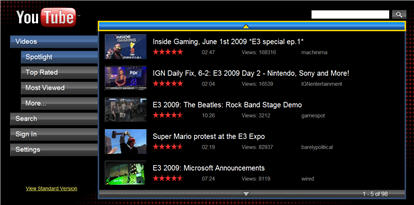
On the other hand, long-term, XL is a limited-appeal offering, because it reflects Google's browser-centric worldview. As Chris explained, from CEO Eric Schmidt on down, there's a conviction that the "browser as the platform" is going to dominate entertainment and information distribution. This is certainly the way the online world works today, as practically all of broadband-delivered video is consumed within a browser context. (In fact, this is one of the things that made last week's Hulu Desktop announcement so noteworthy, a large aggregator introducing an app that breaks the browser-only paradigm.)
The problem is that historically at least, the non-online, TV world hasn't been browser-based. Instead, various set top boxes (whether from cable/satellite/telco or from newer convergence players) rely on their own applications to present and manage video. Given this disconnect, new convergence devices and services will instead need to rely on YouTube APIs if they want to access YouTube's vast trove of content, unless they start building in browsers. This is how AppleTV, Sony Bravia, TiVo and others have worked with YouTube in the past. My concern is how much investment attention will convergence-oriented APIs be getting from YouTube when the company's emphasis is clearly on the browser.
Back in March '08, I wrote, "YouTube: Over-the-Top's Best Friend" in which I asserted that for emerging convergence devices and video service providers, YouTube would be the perfect partner. It has the best-known video brand, the largest catalog and the best promotional reach. I still believe that. YouTube could be a formidable disruptive force in over the top if it had a strategy to do so. With its browser focus though, it's hard to see that happening.
In these tough economic times, I don't blame YouTube, or others, from prioritizing. However, my sense is that by taking a more passive approach to convergence, YouTube is opening the door a little wider for others like Netflix who are more aggressively pursuing convergence opportunities, as well as incumbents like Comcast and Time Warner Cable who are just getting going on bridging broadband video to their set-top boxes. As the clear online video market share leader, YouTube has a pretty golden opportunity to aggressively chart new ground and cause likely market disruption. That it's choosing not to means others have a little less pressure on them.
What do you think? Post a comment now.
Categories: Aggregators, Devices
-
Xbox 360 Continues Push for Broadband Convergence
The folks at Microsoft are determined to make Xbox 360 a winner in the free-for-all to bridge broadband-delivered video to the TV. Yesterday at E3, Microsoft announced a number of enhancements for Xbox and
 Xbox LIVE (the console's gaming and content marketplace), further blurring the lines between gaming and entertainment, and raising the stakes for other single-purpose convergence boxes. The new features include:
- Instant-on streaming of 1080p HD video with 5.1 channel surround sound using proprietary Microsoft adaptive bit rate streaming technology
- Smooth fast-forward and rewind, comparable to DVD
- "Movie Parties" - avatar-based shared/social viewing in virtual theaters
- Live on-demand BSKyB through Xbox in UK and Ireland
- Rebranding of Xbox LIVE Video Marketplace as Zune Video Marketplace, which joins the 2 brands in anticipation of the upcoming launch of Zune HD; additional content planned.
- Expansion to 10 new regions, bringing the total number of countries able to access TV shows and movies through XBox to 18
- Facebook, Twitter and Last.fm integrations
Of course, Xbox 360's key advantage in moving into entertainment is that it has a huge installed base of early-adopter gamers to leverage; in fast Microsoft said last week that it has sold over 30M Xbox 360 consoles to date and that there are over 20M active members in the Xbox LIVE community (not only a subset are Gold members able to access some of the entertainment offerings like Netflix streaming). Little has been disclosed about Netflix Watch Instantly consumption since February when the companies said that 1M LIVE Gold members had consumed 1.5B minutes of video in the first 3 months of availability.
Microsoft isn't forgetting that Xbox is still primarily a gaming platform; yesterday it rolled out a slew of games for Xbox, including "The Beatles: Rock Band" with Ringo and Paul making personal appearances. Xbox also unveiled its "Project Natal" a controller-less, 3D sensor that detects a gameplayer's movements. All of these will continue to drive console unit sales.
No doubt there are plenty of other things the Xbox 360 team has planned to make the console a highly attractive "over the top" option for those considering cutting the cord on their current video service provider, though Xbox 360 is not being positioned this way - yet.
What do you think? Post a comment now.
-
Sezmi Update: Fall '09 Commercial Rollout Planned
I chatted with Sezmi director of product marketing Barbara Cassidy at the NAB Show last week and had a follow up call with co-founder/president Phil Wiser yesterday to get an update on the company's progress.
Sezmi is now aiming for a Fall '09 commercial rollout. Phil explained the launch was pushed back by roughly 6 months. The company is continuing to optimize the user experience. It is also being conservative with
 resources in the wake of staff reductions last Fall (and the economic slowdown), and is seeking to align with the '09 holiday season/its channel partners' goals. In the meantime the Seattle trial is continuing.
I've been enthusiastic about Sezmi as a full-on, next-gen alternative to cable/satellite/telco service, assuming it its "FlexCast" distribution technology performs as expected. The short demo I saw at NAB looks much as at it has in the past and is quite slick. Sezmi has a hugely ambitious vision, but if it delivers as planned, it is going to offer a pretty compelling alternative for consumers. Lots more to come on this story.
What do you think? Posta comment now.
Categories: Devices, Technology
Topics: SezMi
-
HD and Convergence Themes Pick Up Steam at NAB Show
Two highly related broadband video themes - HD delivery and convergence between broadband and TV - are both picking up steam at this week's NAB show. Among the key announcements are:
Adobe extending Flash into digital home devices
Move Networks acquiring Inuk Networks (announced just this morning)
Akamai detailing HD monetization opportunities in new white paper with IDC
Microsoft releasing "Smooth Streaming" HD delivery feature in its IIS Media Services
Limelight supporting Microsoft's IIS and Adobe Flash Media Server 3.5
CDNetworks commercially deploying first Adobe Flash Media Server 3.5 for first time
And separate from the show, TiVo and Roku supporting Amazon VOD HD titles
The entire broadband video ecosystem is getting more and more focused on both HD delivery and convergence. However, the former, which is primarily an infrastructure upgrade, is easier to execute on than the latter, which almost always requires users to buy and install some new device (either single or multi-purpose). Given the lousy economy and natural replacement cycles, this means that for many users, those gorgeous online HD experiences will be viewed on their computers for some time to come.
I think that's actually OK though. By proliferating online HD delivery, users will increasingly be getting a taste of what would be available to them if their broadband was connected to their TVs. Further, plenty of early adopters will become evangelists, showing off online HD experiences for their friends and families. Making things more tangible will help create the necessary promotional tailwind that convergence devices need to succeed.
Convergence has been a long time in coming, but the elements are now beginning to fall into place. I believe that the more HD content that's available online, the faster the convergence device market will develop.
What do you think? Post a comment now.
Topics: Adobe, Amazon, Brightcove, CDNetworks, Limelight, Microsoft, Move Networks, Roku, TiVo
-
Blockbuster Follows Netflix Onto TiVo Boxes; Ho-Hum
Blockbuster and TiVo have announced that Blockbuster OnDemand movies will be available on TiVo devices. Though I'm all for creating more choice for viewers to gain access to the content they seek, in this
 case I don't see the deal creating a ton of new value in the market, as it comes 6 months after Netflix and TiVo announced that Netflix's Watch Instantly service would be available on TiVo devices and nearly 2 years after Amazon and TiVo made Amazon's Unbox titles available for purchase and download to TiVo users. It looks like the main differentiator here is that Blockbuster will begin selling TiVos in their network of physical stores.
 The deal underscores the flurry of partnership activity now underway (which I think will accelerate) between aggregators/content providers and companies with some kind of device enabling broadband access to TVs. I believe the key to these deals actually succeeding rests on 2 main factors: the content offering some new consumer value (selection, price, convenience, exclusivity, etc.) and the access device gaining a sufficiently large footprint. Absent both of these, the new deals will likely find only limited success.
Consumers now have no shortage of options to download or stream movies, meaning that announcements along the lines of Blockbuster-TiVo break little new ground. To me, a far more fertile area to create new consumer value is offering online access to cable networks' full-length programs. As I survey the landscape of how premium quality video content has or has not moved online, this is the category that has made the least progress so far. That's one of the reasons I think the recent Comcast/Time Warner Cable plans are so exciting.
With these plans in the works, but no timetables yet announced, non-cable operators need to be thinking about how they too can gain select distribution rights. There's still a lot of new consumer value to be created in this space. Given lucrative existing affiliate deals between cable networks and cable/satellite/telco operators, I admit this won't be easy. However, Hulu's access to Comedy Central's "Daily Show" and "Colbert Report" does prove it's possible.
We're well into the phase where premium video content is delivered to TVs via broadband. Those that bring distinctive content to large numbers of consumers as easily as possible will be the winners.
What do you think? Post a comment now.
Categories: Aggregators, Devices, FIlms, Partnerships
Topics: Amazon, Blockbuster, Comcast, Netflix, Time Warner Cable, TiVo
-
Vuze Moves PC-to-TV Convergence Another Step Forward
Everywhere I look there are companies doing innovative, clever things to bring broadband video to the TV and to mobile devices.
Yesterday brought another great example, from Vuze, a company with roots as a BitTorrent client that has evolved to an aggregator of hi-def niche broadband video using its desktop application for discovery, download and playback. Vuze announced an update that enables users to drag-and-drop downloaded
 videos for playback on non-PC devices such as Xbox, PS3 and - via an integration with iTunes - to the iPhone, Apple TV and iPods. It's a pretty cool extension of the Vuze client experience and I spoke with Vuze's CEO Gilles BianRosa and Sr. Director of Marketing Chris Thun to learn more.
 Without getting too far into the technical details, what Vuze has done is capitalized on hooks that have existed in these various devices, making videos downloaded via Vuze visible in these devices' interfaces. As Gilles explained it, these hooks have been available for a while, but only the super-technical would have invested the time and effort to benefit from them.
The connections to Xbox (installed base of 30M) and PS3 (installed base of 23M) are quite complimentary to Vuze, which has 10M unique visitors/mo and about 50M downloads to date, because its content library is heavily skewed toward SciFi, animation, games and comedy (all HD btw) along with its user base. In other words, there's an affinity audience who will immediately benefit from being able to watch Vuze's content on their big screens and on-the-go. In fact, in a recent survey of its users for how they'd want to connect their PCs to TV and mobile, Vuze got 30K responses with a strong emphasis on gaming and Apple devices.
In prior conversations with Gilles I've raised a concern about the viability of Vuze's (or anyone's) client download model given the ever-increasing quality of browser-based streaming. But these integrations do shed new light on the value proposition of having a desktop presence. With its update, Vuze actually goes one step further by automatically transcoding downloaded videos into the format appropriate for the target device, often in real-time, thus eliminating playback issues.
Gilles noted that this is a beta release however, and that one current limitation is that ads cannot be passed through. This is a not insignificant gap for an ad-supported site. Vuze hopes to have ads up and running within a month or so. It also has its eye on integrating with additional devices. My bet is that TiVo is next up given that TiVo founder Mike Ramsey sits on Vuze's board.
For now Vuze's content is relatively nichey and Gilles concedes that despite ongoing negotiations with major studios and TV networks, they're still getting comfortable with Vuze's P2P platform. Given the crowded video aggregator space, Vuze's ongoing challenge is to bolster its content library to broaden its appeal.
But Vuze's new update, sure to mimicked by others, which comes on top of Netflix reporting 1M Watch Instantly users connecting to their Xboxes and consuming 1.5 billion in the first 2 months of its availability, Boxee's multiple integrations and other PC-to-TV convergence initiatives underway, shows the huge pent-up interest users have in watching broadband video on their TVs. The genie is way out of the bottle and content providers need to begin adapting to the coming landscape where video flows between PC, TV and mobile, offering unprecedented convenience to users.
What do you think? Post a comment now.
Categories: Aggregators, Devices, Downloads, HD
Posts for 'Devices'

Connect with VideoNuze
Exclusive News Roundup
- Execs Split on Whether to Join Paramount-Warner’s Merger Movement The Wrap
- Paramount’s Makan Delrahim Says “Everything Is On The Table” In Finding Merger Resolution
- Disney+ to Become Global Streaming Home of Formula E Auto Racing Media Play News
- How Lachlan Murdoch Courted Roku to Seal a $22 Billion Deal The Hollywood Reporter
- Netflix Closes 2026 Upfront, Nearly Doubles Ad Commitments The Wrap
- YouTube now requires creators to have twice as many watch hours to start earning money TechCrunch