-
Comcast Testing Connected Set-top Box; Would Netflix Be Included?
The WSJ is reporting that Comcast is testing a new connected set-top box that offers a selection of online video alongside traditional linear, VOD and DVR programming. The project is part of Comcast's "Xcalibur" initiative headed up by Sam Schwartz and would follow other connected set-tops already in the market from competitors like Verizon, AT&T, DirecTV and others. It's a smart move by Comcast; many of its subscribers have been buying inexpensive broadband set-top boxes so why shouldn't Comcast just offer the online services itself and simplify its subscribers' lives?
While it's not clear what online video would be offered, if it's a "closed" model, where only certain apps/sites are available, then it would be akin to boxes like Roku, Apple TV and the connected Blu-ray players, among others. This approach would contrast with "open" boxes that allow full Internet browsing such as Google TV and boxee's new box from D-Link. My hunch is that Comcast would focus on a closed box to start. That would also reduce the complexity of delivering online video in a consistent, high-quality manner, especially given the numerous formats, encoding levels, etc. It's also not clear that consumers yet want a full Internet experience on their TVs and Comcast more than likely would look to be a fast follower rather than a pioneer.
Categories: Aggregators, Cable TV Operators
-
The World According to Time Warner's Jeff Bewkes, Pay-TV's Staunchest Defender
I finally got an hour over the weekend to listen to the replay of last week's UBS media conference keynote discussion with Time Warner's CEO Jeff Bewkes. His comments strongly reinforced my perception of him as the pay-TV (cable/satellite/telco) industry's staunchest defender as well as the leading Netflix skeptic. Bewkes is worth paying attention to not just because Time Warner owns the Warner Bros. studio and several leading cable networks, but because his approach is a barometer for many other content providers as well.
In Bewkes' world view, the majority of consumers are willing to pay a premium price to get the best, most comprehensive experience of the highest-quality, current content, and distributors are willing/able to pay content creators top dollar for it - in short, a snapshot of the way the pay-TV world has worked for a long while. To Bewkes, digital distribution represents "more opportunity than challenge" in its ability to drive new business models and windows, enhance existing distributor relationships and deliver more value to consumers. To be clear, Bewkes isn't a Luddite, he doesn't oppose digital innovation, he just wants to see the benefits of it accrue to incumbents, not upstarts.
Categories: Aggregators, Cable Networks
Topics: Netflix, Time Warner
-
5 Items of Interest for the Week of Dec. 5th
Once again I'm pleased to offer VideoNuze's end-of-week feature highlighting and discussing 5-6 interesting online/mobile video industry news items that we weren't able to cover this week. Read them now or take them with you this weekend!
Categories: Advertising, Aggregators, Broadcasters, Cable TV Operators, Mobile Video, Telcos
Topics: ABC, Disney, eMarketer, Hulu Plus, Netflix, Nielsen, TV Everywhere, Verizon Wireless
-
Will China's Successful Youku IPO Spark US Online Video Offerings in '11?
Yesterday, China's Youku, which started as a YouTube-style user-uploaded video site, but has evolved to a Hulu-style distributor of professional video, went public on the New York Stock Exchange. It offered 15.85 million American Depositary Receipts, or "ADRs," which represent ownership shares in non-U.S. companies, at $12.80 apiece, raising over $200 million. When the market closed, the ADRs stood at $33.44, up 161%, the best one-day performance for a U.S. IPO in the last 5 years (they're up another $5 today as well). Youku, which recorded $35 million in revenue for the first nine months of this year (and a $25 million loss), had an end of day valuation of $3 billion+.
Yes, I know what you're thinking - this is crazy, the bubble days have returned and there's a huge "China factor" multiplier at work for Youku. All of that is no doubt true. But here's something else that's true - while the global economy and stock markets have undergone wrenching change and volatility over the last 2+ years, the online video market has boomed. For certain kinds of investors (both professional and non-professional) who value growth over everything else, there are few sectors which have more appealing characteristics. As tens of millions of people have adopted online and mobile video, devices for viewing online video on TVs have proliferated, premium content has become available and business models have firmed, investors have taken notice.
Categories: Aggregators, Deals & Financings, International
-
Level 3 Tries to Wrap Itself in the Cloak of Net Neutrality in Comcast Dispute
The phrase, "there's no such thing as a free lunch" is getting a new application this morning, as Netflix's massively popular streaming service and over-the-top online video delivery in general face their first big reality check in the form of the Level 3-Comcast traffic fee dispute.
In case you aren't fully up to speed yet, yesterday Level 3 issued a press release asserting that Comcast was forcing Level 3 to pay it higher rates in order for its traffic to be passed through to Comcast's network, and by extension its subscribers. On this basis alone, this would be a snoozer dispute; few of us are aware of or care about the behind the scenes Internet plumbing that enables the delivery of online content. And as long as it doesn't affect what we pay, we also generally don't care which provider gets paid what or how much.
That's why Level 3 cleverly decided not to depict this as a commercial dispute, but rather as a violation by Comcast of "net neutrality" regulations. To drive its point home further, it chose to use highly-charged language, accusing Comcast of "putting up a toll booth," "enabling it to unilaterally decide," "threatens the open Internet" and "preventing competing content" among other things. These are exactly the kinds of terms that net neutrality advocates have been using for years to justify new, stricter net neutrality regulations and Level 3's choice of words is a blatant play to transform this into a net neutrality spark. Trying to set the record straight, Comcast replied that in fact this is a commercial dispute, centered around an imbalance of traffic being exchanged (5:1 by its estimate), and that by convention a separate payment from Level 3 is warranted.
Categories: Broadband ISPs
Topics: Comcast, Level 3, Netflix
-
Is Microsoft Planning to Join the Pay-TV Party?
Reuters is reporting this morning that Microsoft is exploring a range of options to get into the pay-TV business through a new over-the-top service. The article points to a potential "virtual cable provider" model whereby Microsoft would license multiple networks, which would be delivered to Xbox gaming consoles and other devices. Also under consideration are creating "content silos" to sell specific premium channels.
If Microsoft were to join the pay-TV business aggressively it would further alter industry dynamics. The number one issue in play right now is whether consumers are forsaking traditionally packaged pay-TV services and instead opting for some mix of free and paid online-delivered alternatives. Yet while Internet options are gaining in popularity (with Netflix's explosive growth to nearly 17 million subscribers at the end of Q3 the primary beneficiary), hard data supporting cord-cutting is still scarce.
Categories: Broadcasters, Cable Networks, Cable TV Operators, Devices
-
6 Thoughts on Netflix's New Streaming-Only Plan and DVD Plan Price Hikes
In rolling out a streaming-only service tier this morning, priced at $7.99/mo, Netflix made good on what it has said it would do for months. It's also a logical step given the streaming-only service it introduced 2 months ago in Canada. What was more surprising in today's announcement was the price hikes Netflix is implementing on all of its DVD rental plans, which of course include unlimited streaming. Here are 6 thoughts on today's news:
Categories: Aggregators
Topics: Netflix
-
Broadcast TV Networks Are Wrong to Block Google TV - Part 2
When Fox decided last week to block access to its programs by Google TV, it was no big surprise since its broadcast brethren ABC, CBS, NBC and Hulu had already done so. By speaking in a unanimous voice, the broadcasters have sent a clear signal that viewing their programs on TV, for free, via online delivery, is not to be. While they're happy to make Hulu Plus subscriptions available via connected devices, if you want to watch for free, you'll be restricted to computer, or limited mobile device-based, viewing.
A few weeks ago in the first part of "Broadcast Networks Are Wrong to Block Google TV," I speculated on what was motivating the broadcasters to block Google TV, boxee and other browser-based connected devices. In the case of Google TV, it's tempting to believe they are looking to extract payments from Google to distribute their programs. Another possible explanation is that programs aren't monetized as well in online as they are on-air (the "swapping analog dollars for digital pennies" argument). Yet another explanation is that measurement of online viewing is not yet fully mature, so they're worried that if their audience shifts to connected device-based viewing, it would hurt their ratings points, and consequently their ad revenues. But none of these are broadcasters' main motivation.
Categories: Broadcasters, Devices
Topics: ABC, CBS, FOX, Google TV, Hulu, NBC, Netflix
-
Report: 4% of Hulu Users Subscribe to Hulu Plus; Of Them 88% Also Subscribe to Netflix
A new report being released today by One Touch Intelligence has found that 4% of surveyed Hulu.com users are subscribing to Hulu Plus and that of them, 88% of them are also Netflix subscribers. The survey included 970 individuals who subscribe to both a pay-TV service and a broadband Internet service, and have streamed or downloaded at least one TV show or movie in the past month. Of the 970 individuals, 612 of them said they use the free Hulu.com service at least weekly, with 25 of them subscribing to Hulu Plus. Of the 25, 22 of them also subscribe to Netflix.
On the one hand, the 4% penetration is noteworthy, since Hulu has yet to advertise the Hulu Plus service beyond its own site. That was reflected in the relatively narrow awareness of the service, with 68% of Hulu.com users who are not subscribing to Hulu Plus saying they are either "barely" familiar with Hulu Plus or not familiar with it at all.
Categories: Aggregators
Topics: Hulu Plus, Netflix, One Touch Intelligence
-
Netflix Has Added 8 Times As Many Subscribers in 2010 As Top Pay-TV Operators, Combined
Here's a pretty amazing factoid to end your week: in 2010 Netflix has added nearly 8 times as many subscribers as 8 of the top 9 pay-TV operators have, combined (#3 cable operator Cox is private and doesn't report). In the first 3 quarters of 2010, Netflix has added nearly 4.7 million subscribers while the top pay-TV operators have gained 609K.
Breaking down the pay-TV industry net gain further, the 2 main telcos (Verizon and AT&T) have added over 1.2 million subscribers and the 2 main satellite providers (DirecTV and DISH) have added 563K, while the top 4 reporting cable operators (Comcast, Time Warner Cable, Charter and Cablevision) have lost over 1.1 million.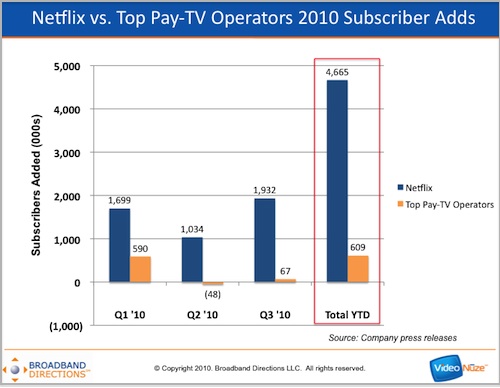
Categories: Aggregators, Cable TV Operators, Satellite, Telcos
Topics: AT&T, Cablevision, Charter, Comcast, Cox, DirecTV, DISH, Netflix, Time Warner Cable, Verizon
-
Top U.S. Pay-TV Operators Post Narrow Subscriber Gains in Q3, Rebounding From Q2 Loss
Eight out of the nine largest U.S. pay-TV operators have reported their Q3 '10 results, gaining a slim 66,700 video subscribers, a rebound from a loss of 47,600 subscribers in Q2 '10. The Q2 loss was the first on record for the industry and fueled speculation that "cord-cutting" due to adoption of Internet-delivered video alternatives was rising. With only mildly positive subscriber adds - and 5 of the top 8 operators actually losing subscribers in Q3 - fears that cord-cutting is rising will surely accelerate.
The 8 operators (privately-held Cox Cable, the 3rd-largest cable operator does not disclose its results) represent more than 85% of all U.S. pay-TV households. Though they collectively showed a quarterly gain, if Cox and other cable operators lost subscribers at a comparable rate as the 4 large cable operators in the top 8 (Comcast, Time Warner Cable, Charter and Cablevision), the industry as a whole would have actually lost about 97K subscribers in the 3rd quarter.
Categories: Cable TV Operators, Satellite, Telcos
Topics: AT&T, Cablevision, Charter, Comcast, Cox, DirecTV, DISH, Netflix, Time Warner Cable, Verizon
-
As DVD Sales Wane, Experiments With Movies' Digital Delivery Windows Rise
Yesterday brought more evidence of how digital distribution release windows and promotions are rising as DVD sales wane. First there was news that Disney had teamed up with Wal-mart to allow buyers of the Toy Story 3 DVD to get a bonus digital version of the film playable through the company's recently acquired Vudu digital outlet. That offer was quickly one-upped by Amazon which announced an increase from 300 to 10,000 movies in its "Disc+" program, which provides a digital copy to the user's Amazon VOD account when they purchase a qualifying DVD.
Meanwhile at the Blu-con conference in Beverly Hills, studio executives debated how to best calibrate digital, VOD and DVD distribution. Even emerging practices come with exceptions and debates about results. For example, while VOD has largely gained day-and-date release with DVD, exceptions are still made on a case-by-case basis, such as with Universal's "Despicable Me" which will have its DVD go on sale on Dec 14, but its VOD release not until after Christmas.
Topics: Amazon, Apple, Best Buy, Disney, EPIX, FOX, Netflix, Sony, Starz, Universal, VUDU, Wal-Mart, Warner Bros.
-
Netflix's Revenue Per Subscriber is Steadily Declining While Free Subscribers Are Soaring
It isn't news that Netflix has been on a huge growth spurt; over the last 5 quarters the company has added an astounding 6.3 million subscribers, increasing its total subscribers by 60% from 10.6 million at the end of Q2 '09 to over 16.9 million at the end of Q3 '10. What's less well understood though is that as the company has shifted its focus to streaming and to adding subscribers at its entry level $8.99/mo tier, several of the company's key metrics have changed substantially. I sensed this was happening with each passing quarter, but I finally got some time to crunch the numbers and see how things have actually been playing out.
No surprise, Netflix's emphasis on the $8.99/mo entry tier is resulting in a steady quarterly decrease in its average revenue per paying subscriber, which has declined 8.9% from $13.30 in Q3 '09 to $12.12 in Q3 '10 (Note I calculated this by excluding average quarterly free subscribers, and by assuming a straight average monthly revenue per quarter. Since Netflix doesn't release monthly information, this is as close an approximation as possible). Netflix management has been candid in explaining that as $8.99/mo subscribers dominate growth (and even lower priced streaming-only Canadian subs are now added), average revenue per subscriber will trend down. At $12.12 in Q3 '10 though, and millions of $8.99/mo subs being added, further decreases should be expected.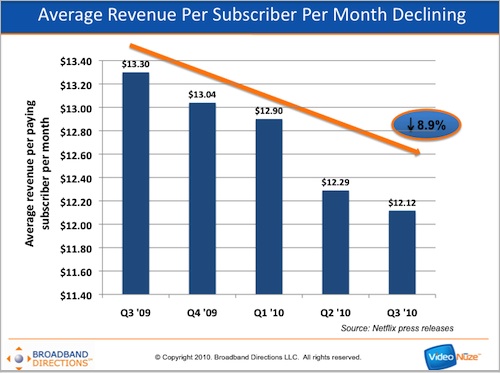
Categories: Aggregators
Topics: Netflix
-
Broadcast TV Networks Are Wrong to Block Google TV
Since word broke late last week that ABC, CBS and NBC are blocking access by Google TV to their full-length programs, I've been scouring the web and speaking to colleagues, attempting to get some insights about what's going on here. Though I've heard plenty of free-floating concerns raised, I've yet to really understand solid reasons for why broadcast networks are doing this that can't be addressed somehow. Therefore, as best I can tell, for now at least, I think the broadcast TV networks are wrong to block access.
The most obvious reason is that they're creating a false and meaningless distinction between screens. Whereas you can "go online" and freely access plenty of ABC, CBS and NBC shows at their own web sites, (and at Hulu for ABC and NBC), the networks have decided that if you're trying to "go online" via your Google TV, that's unacceptable. In an age where computer screens are getting bigger all the time - looking more like TVs - why exactly should this distinction matter?
Categories: Broadcasters, Devices
Topics: ABC, Boxee, CBS, Google TV, NBC, Netflix
-
VideoNuze Report Podcast #78 - Oct. 22, 2010
Daisy Whitney and I are pleased to present the 78th edition of the VideoNuze Report podcast, for October 22, 2010.
This week Daisy and I focus our attention on Netflix's Q3 results, which were announced on Wednesday. The company added nearly 2 million net new subscribers, a new record. It has added almost 4.7 million subscribers in the first 3 quarters this year. Daisy and I discuss the results and add more color to my original analysis.
Click here to listen to the podcast (11 minutes, 48 seconds)
Click here for previous podcasts
The VideoNuze Report is available in iTunes...subscribe today!Categories: Aggregators, Podcasts
Topics: Netflix
-
Netflix Racked Up Almost 2 Million Subscribers in Q3, A New Record
Netflix just reported Q3 '10 results and the eye-catching number is 1,932,000 net subscribers added in the quarter, a new record for the company, and almost 4x as many as the 510,000 it added a year ago in Q3 '09. Netflix ended Q3 '10 with 16,933,000 subscribers, almost double the 8,672,000 subscribers the company had 2 years ago, at the end of Q3 '08. Revenue was up 31% to $553.2 million.
Netflix ascribed the growth entirely to streaming, with CEO Reed Hastings saying in a statement, "By every measure, we are now primarily a streaming company that also offers DVD-by-mail." That's the first time I've heard this positioning, and it is only partly true, as only 66% of subscribers watched 15 minutes of streaming video in Q3 (though up from 61% in Q2 '10), whereas my guess is that 95%+ of the company's subscribers still take out at least 1 DVD each month and the volume of overall viewership must still tilt heavily toward DVDs. (see update below)
Categories: Aggregators
Topics: Netflix
-
Looking Ahead to Netflix's Q3 Results Today
Later today Netflix will report its Q3 results and if you're trying to get a sense of how over-the-top video is growing, there's no better company to look at. Netflix is the leader in paying subscribers viewing streaming Hollywood-quality video (at least 9 million/mo at the end of Q2), in availability on connected devices (200 and growing) and in offering the deepest catalog of movies/TV programs under subscription. As a result, its performance is as good a gauge as any for consumers' growing appetite for OTT video alternatives.
Q3 was a particularly productive quarter for Netflix in acquiring more content for streaming, arguably its most important priority as it transitions from its traditional DVD-by-mail business. The big content deal of Q3 was with premium cable network EPIX, but this quarter Netflix also inked new or expanded deals with Relativity Media, Warner Bros., NBCU and Nu Image/Milllenium Films. These deals have brought a combination of popular newer and classic movies along with recent-season TV episodes.
Categories: Aggregators
Topics: Netflix
-
Initial Pros and Cons of Logitech Revue, The First Google TV Product
Logitech debuted its Revue connected device, offering an up-close look at the first implementation of Google TV to hit the market. I attended the press briefing in NYC; here are some of the key highlights, followed by pros and cons as I initially see them:
HIGHLIGHTS:
- Logitech Revue will retail for $299.99, which includes the box itself and a "keyboard controller" which is a lightweight combination QWERTY keyboard with a touchpad and left/right/up/down arrow controller
- Revue is available for pre-order at Amazon, BestBuy.com and Logitech.com. Delivery is expected by end of October.
- Optional accessories include an additional keyboard controller ($99.99), a "mini controller" ($129.99) which offers all the same features in a smaller clamshell form factor and a Logitech TV cam, which is a 720p HD webcam that works with Revue ($149.99).
- Apps for iPhone and Android are available free and effectively turn these devices into a third controller for the Revue.
- A one-touch search bar allows discovery across broadcast TV and online sources, both free and paid (a Google spokesperson said a new optimized content "corpus" with just relevant video is searched, not the entire web; this means you don't have to wade through a lot of typical Google results for any term you enter into the search bar).
- Search will also tap into your DVR recordings for pay-TV operator optimized set-top boxes. The only operator on board so far is Dish Network, which has a short-term exclusive deal to only work with Logitech. Dish will also retail the Revue box and the accessories.
- In addition to search, you can also navigate via menus for websites, channels, apps, most visited, and "Spotlight" which allows surfing. A "queue" feature lets you explore podcasts.
- When using the apps, voice control navigation is also enabled. We saw a neat example of searching for "The Price is Right" simply by speaking the words. You can also share a video discovered on your phone to the Revue device with a couple of clicks. Both very Jetsons-like.
- "Dual view" is a picture in picture mode that allows you to watch video in one window while searching or doing other things in the larger background.
- Flash 10.1 video is supported.
- Netflix has created an app for Google TV that looks a lot like the first version of the Roku app I'm very familiar with. Note that browsing the Watch Instantly catalog isn't yet possible, and also that Revue's search doesn't crawl the Netflix catalog to expose results for searches conducted. This type of true universal search is already available in the TiVo Premiere for example and is really valuable.
- Other apps preloaded include CNBC, Chrome, Napster, NBA Game Time and Pandora, though none of these were demo's. No social media app was demo'd either, though Twitter was mentioned earlier.
- There's a Logitech media player that allows you to access and play media files from other devices on the network
- 720p HD-quality video calling is enabled with the new webcam using the Vid HD app. This can work Revue to Revue, or Revue to PC/Mac. Less than 1 megabit is needed upstream for video calling.
- Revue uses "Harmony Link" with RF connections so that all devices currently recognized by Harmony remotes will be recognized immediately
Categories: Devices
Topics: Google TV, Hulu, Logitech, Netflix, Revue
-
Netflix, HBO, Others Coming to Google TV
Google released further details on Google TV this morning, unveiling a slew of content services and apps that will be available at launch. Chief among them are Netflix and HBO Go (both for subscribers), Amazon VOD and Pandora, plus new apps from NBA ("NBA Game Time"), NBCU ("CNBC Real-Time"), and "optimized" content from Turner Broadcasting, NY Times, USA Today, VEVO, Napster, Twitter and blip.TV. Google didn't specify what optimized means, but I suspect it means appropriate metadata so that programs can be exposed in Google TV searches. Of course, "Leanback," YouTube's 10-foot interface, will also be featured.
Categories: Devices
Topics: Amazon, blip.TV, Google TV, HBO, Logitech, Napster, NBCU, Netflix, NY Times, Pandora, Turner, Twitter, USA Today, VEVO
-
Technology Innovation is the Key to Online Video's Rise
While in LA this week, I moderated a short panel at Always On's "OnHollywood" conference with Kaltura's Ron Yekutiel, Akamai's Kevin Freund, Microsoft's David Sayed and Fox Digital Media's Gregg Colvin. The conversation focused on the key technology building blocks for online video.
Clearly there has been a ton of innovation in online video technology, and the panel concluded that online distribution has now come into its own, with key strides in publishing/delivery, devices, user experience and monetization. In particular, panelists pointed to adaptive bit rate streaming, live streaming, HD and video opening up to new applications as important steps forward. On the flip side, the challenges identified as remaining included better measurement, improved capacity in broadband ISPs' "last mile" and reduction in work flow complexity to distribute to multiple devices.
Categories: Technology
Topics: Netflix
Posts for 'Netflix'

Connect with VideoNuze
Exclusive News Roundup
- Jimmy Kimmel is moving a Senate candidate interview to YouTube to sidestep FCC pressure Quartz
- Universal Music is launching an AI music platform with ElevenLabs The Verge
- Katzenberg and Ex-Sora Head Bill Peebles Launch AI Video Startup for Filmmakers AI Weekly
- Suno Launches New AI Model Trained on Licensed WMG, BMG Tracks The Hollywood Reporter
- Justice Department to take a closer look at Fox’s $22 billion Roku deal Semafor
- Congress Begins Drafting 20% Federal Film Incentive With Trump’s Blessing Variety