-
Adap.tv Releases OneSource 2.0
Adap.tv is announcing its upgraded OneSource 2.0 ad management platform this morning. The Adap team explained to me on Friday what's new in this release.
OneSource 2.0 builds on the product's initial vision of improving ad optimization while reducing complexity. Adap noted that the main pain point that its customers are expressing especially given the weak economy, is
 the need to spend more time focused on selling ads and less time on operationalizing the ad relationships. The need to improve their ROIs through both higher ad rates and higher fill rates is driving them to source ads from multiple sources and to want to refine those sources to find the optimal mix. All of this increases implementation and reporting complexity.
OneSource 2.0's new features are meant to address these issues. The video provider can now accept ad tags from virtually any source, and do so more efficiently. In addition, through a management dashboard, the provider's ad ops manager can specify and adjust the fill order for the ad sources on a per ad basis. That means that for a specific piece of content there can be one queue for pre-rolls and another for overlays or for two pieces of content there can be two different pre-roll queues, and so on.
By sequencing multiple sources, OneSource creates a failover system so that an ad is likely always served, thereby increasing fill rates. Adap pointed to one provider who has been able to increase their fill rate from 20% to 70%.
In addition, OneSource 2.0 allows reporting by revenue source, video positions and geographic regions, which, at least in the demo screens that I saw, looked quite powerful. The ad ops manager can track performance on a daily basis and re-order sources accordingly. Lastly, there are enhanced tools for managing ads when content is syndicated, along with performance reporting.
I continue to see OneSource in a competitive set with Tremor Media's Acudeo ad management system, and also to some extent with Panache and FreeWheel. All of these systems are, in one way or another trying to improve video content providers' monetization and/or syndication efforts. Adap notes that by not also operating an ad network, it can be more agnostic about ad sources and solely focused on its technology. It now has 300+ publishers on board, helping monetize "high 100s of millions" of impressions per month, which it said is a 10x increase from OneSource's launch in May '08.
What do you think? Post a comment now.
Categories: Advertising, Technology
Topics: Adap.TV, FreeWheel, Panache, Tremor Media
-
Local Video Ad Space is Bustling with Innovation
The ad business in general may be in the doldrums due to the economic downturn, but one space that's bustling with innovation is online video ads for local, small-to-medium (SMB) sized businesses.
Local advertising has of course been around since the beginning of time. And even the idea of allowing local SMBs to create video ads is not a new concept; cable operators' local ad divisions have been doing this for years. What's relatively new in the local ad space are companies that allow a far higher degree of self-service video ad creation and campaign management by the client, online placements of their ads, and much improved analytics and ROI measurement capabilities vs. traditional cable TV.
For some local merchants, engaging in this process will be overwhelming and they'll stick with the tried and true local options like newspaper, radio and yellow page listings. But I believe that for many others, who recognize that their customers are increasingly going online to find local merchants and understand that a video packs far higher emotional punch than a text ad, this new alternative will be highly compelling.
There are multiple fairly well-funded players covering the local SMB video ad space, each with their own particular points of differentiation. They include Spot Runner, Spot Mixer, Jivox, Mixpo, PixelFish and others. Some like Spot Runner don't limit themselves to online distribution only, they're targeting TV as well. But the basics are relatively similar: a low-cost, often self-service ad creation process, a pretty well-defined way of targeting the intended audience through locally-oriented sites, and fairly flexible campaign/spending options. A persistent goal is to make it incredibly easy and cost-effective for local SMBs, who have most likely never done anything like this, to get up and running quickly.
To get a better feel for this all works and how SMBs are benefitting, I recently spoke with both Jim Gustke, VP of Worldwide Marketing at Jivox and Stephen Condon, VP of Marketing at PixelFish. Jivox, which raised
 $10.5 million last summer, reported that it doubled its customer base in Q4 '08. Jim said a real differentiator for the company is its publishing network of 800 premium sites and 65 million monthly unique visitors. This allows it to offer advertisers improved targeting and analytics vs. competitors who can only promise placements on affiliated sites. Jivox video ads auto-play in a 300x250 window on the publisher's site with audio off until initiated by the user. Better still for the advertiser, Jivox only charges for ads when 100% of the video has been viewed, thereby providing a pay-for-performance value proposition as well.
Jim said the most popular local categories include cosmetic surgeons, dentists, contractors, hospitality and legal. Demonstrating how active the category is, most of Jivox's new business has come through search. New advertisers pay as little as $250 to get started.
Meanwhile, Stephen explained that PixelFish employs a more customized and channel-centric approach, getting 80% of its business through partners like YellowBook, Google TV and others who are interfacing
 directly with the SMBs. That means PixelFish overlaps a bit with TurnHere and other video production networks. When one of its partners generates an order, PixelFish taps into its network of videographers to shoot specific footage which is then centrally edited and produced for the client. Through online editing tools recently acquired from EyeSpot, the advertiser can make changes to the ad himself and continue to make updates to it as offers change.
"Democratization" is a much-overused word, but here I think it really does apply. Even with local cable advertising, the cost of producing and running a TV ad has been prohibitive for many local merchants. These new companies are changing that, making video advertising accessible and affordable for the first time for broad swaths of local SMBs. Incumbents like local cable, newspapers and radio need to prepare themselves as the power of broadband and search-based marketing disrupt their status quo. I'm expecting this new crop of companies is going to drive a lot of change in this space.
What do you think? Post a comment now.
Categories: Advertising
Topics: Jivox, Mixpo, PixelFish, Spot Mixer, Spot Runner
-
Tremor Media Raises $18 Million Further Validating Broadband Video's Impact
Tremor Media announced this morning that it has raised a Series C round of $18 million, led by Meritech Capital Partners, with participation from existing investors Canaan Partners, Masthead Venture Partners and European Founders Fund. Tremor has now raised nearly $40 million to date. Tremor's CEO Jason Glickman gave me a short update on the company yesterday and a little more background on the financing.
Tremor believes it is now the largest video ad network, with 1,400 publishing partners aggregating 137 million unique visitors per month. Tremor focuses exclusively on premium video (i.e. non user-generated)
 and Jason said the company has access to 1 billion "advertisable impressions" per month. According to Jason, this critical mass has been a big source of the company's recent success as it has been able to appeal to advertisers by segmenting its network to target certain types of users.
 Jason explained that as Tremor has grown and usage of broadband video has surged, the company has increased its efforts to shift traditional TV ad dollars over. Though it's hard to know exactly what budgets ad dollars were originally earmarked for, based on the size of the RFPs Tremor's responding to, Jason thinks this shift is indeed underway. And as he correctly points out, you don't need a lot of the $70 billion that's spent on TV annually to move over to make a big impact in broadband advertising. To help compete more effectively with TV, Tremor also recently announced that it would use comScore's Post Buy and Ad Effectiveness reports to offer GRP (gross ratings points) campaign metrics.
To give some sense of Tremor's relative size, comScore reported 14.3 billion total U.S. video views in Dec. '08. Of that YouTube accounted for approximately 5.9 billion views. If you assume that somewhere between half and two-thirds of YouTube's views are UGC (and don't even consider UGC views at all other sites), then premium U.S. video views might be somewhere around 11.3-12.3 billion per month. According to these calculations, that would mean Tremor has access to around 8-9% of premium U.S. video views per month.
While acknowledging the economic downturn has created new challenges, Jason said the company has met or beat all of its metrics, is still on track for profitability in '09 and had multiple financing offers. Meritech's media and advertising experience in other portfolio companies (e.g. Facebook, Quigo, Revenue Science, etc.) was a real draw. The funding will be used to build its network, enhance its Acudeo monetization platform and continue international expansion.
There's no denying the economic pain being felt these days, but Tremor's ability to raise, coupled with other market leaders' ability to do so, is solid evidence that the broadband video market is a rare bright spot in the media landscape today. I constantly remind people that the underlying fundamentals of broadband video consumption are only increasing each month. The companies that figure out how to capitalize on these trends will still be able to raise money.
What do you think? Post a comment now.
(Note: Tremor Media is a VideoNuze sponsor)
Categories: Advertising, Deals & Financings
Topics: comScore, Meritech, Tremor Media
-
Betawave TV: Video Syndication Aimed at Kids and Moms
The "syndicated video economy" continues to mature with today's announcement of Betawave TV, a video distribution network offering video content and ads to kids age 6-17 and moms. Betawave TV is being launched by Betawave Corp., which was until recently called GoFish (and which also recently raised $22.5M). The company has amassed a U.S. publisher network totaling 25 million monthly unique visitors. I recently spoke to Betawave's executive chairman Jim Moloshok to learn more.
Betawave TV illustrates how broadband is helping merge the traditional concept of an ad network with the
 potential for widespread distribution of video to contextually targeted publisher sites. The bet here is that Betawave TV's content and ads can generate more value on its publishers' pages than just pure advertising could. Since Betawave TV's network has a heavy emphasis on gaming sites (e.g. GamesGecko, Hallpass, etc.) that don't have really have video strategies themselves, Betawave TV's offering seems like a good augment. Betawave TV will be released on sites totalling 6 million monthly uniques by the end of Q1.
 Of course, these sites are by nature very immersive, so drawing users' attention away from their primary purpose requires compelling content. Betawave TV has a broad content strategy, including licensing from producers like Cookie Jar Entertainment, MGM and Young Hollywood to creating its own series. First up is the fashion-oriented and brand-sponsored "Raven Symone Presents." My guess is that much of Betawave TV's programming is relatively inexpensive to acquire or to produce, all the more so if Betawave TV can do more brand-sponsored deals.
Ultimately, Betawave TV is competing for audience attention and ad dollars that have traditionally flowed to major kids' TV programmers like Disney, Nickelodeon and Cartoon Network. As a piece in Mediaweek just yesterday suggested, 50-75% of ad dollars spent on kids' sites are no longer a part of integrated TV packages. The massive fragmentation of kids' attention away from just watching TV is certainly the underlying cause for this and what Betawave is banking on for success. I can attest to this trend myself: when my 8 1/2 year-old daughter gets together with friends they are far more likely to play games at AmericanGirl.com than watch Disney Channel.
No doubt Betawave TV won't be alone in pursuing kids online with syndicated video and ads. While Jim says they own 100% of the target inventory on their publishers' sites, there's no question these publishers will be evaluating plenty of competing offers in the future. Betawave TV's results will be an interesting test of how mature the video syndication opportunity actually is.
What do you think? Post a comment now.
Categories: Advertising, Syndicated Video Economy
Topics: Betawave
-
Media Buyer Interview Series Part 1: Ed Montes, EVP/Managing Director, Havas Digital US
Not a day goes by where there isn't an article about the health of the broadband video industry - how viewer consumption is growing, how much ad revenue it's slated to generate (or not), and what content and infrastructure partnerships have been inked. With the lion's share of the industry ad supported, it's time to hear from the people who are in position to make or break projected revenue budgets: the media buyers.
This interview is with Ed Montes, EVP/Managing Director of Havas Digital US; it is the first of a series of interviews that The Diffusion Group's senior analyst, Mugs Buckley, is conducting with advertising's key media buyers.
WHAT TYPE OF ONLINE ADS DO YOU BUY?
We buy pre-rolls, mid-rolls, in-line video ads. The only thing we have not bought much of are ads around user-generated content.
WHO ARE SOME OF YOUR CLIENTS?
Sears, K-Mart, Fidelity Investments, Amtrak, Tyson, Choice Hotels, Volvo, Air France, and Reckitt Benckiser, to name a few.
ARE ALL OF YOUR CLIENTS BUYING VIDEO ADS?
Many of our clients are placing ads in online video.
IS IT A "MUST HAVE" ON THE MEDIA PLAN?
We're definitely see it grow in importance and yes, it is a "must have" on some media plans. What I can say with more certainty is that online video advertising is becoming, and for some clients is, as important as display advertising. What remains a more consistent "must have" are search buys.
WHAT ARE THE SIZES OF SOME OF YOUR BUYS? WHAT ARE THE CPM TRENDS?
A buyer considers two things: scale (will it reach enough people) and the size/cost of a buy. It depends on the overall size of the campaign. For instance, in a large campaign a buy is south of $50K, may not make the plan, unless we're going to do it for the intelligence of the buy or because the CPM is very discounted. On a smaller campaign $50K might be the entire campaign so you will see much smaller video purchases. There is a huge swing for CPM range depending on the content. Everything hinges on the content. We see CPMs ranging from $15-$40 for non-UGV content in-stream units. UGV, the lower-end quality content CPMs tend to be in the single digits. In-banner video is generally on the lower end of the single digit range.
HOW LABOR INTENSIVE IS AN ONLINE VIDEO AD BUY?
Relatively speaking, it is a lot more labor intensive than a broadcast buy. In the online world, there are a lot of steps in the process to create, buy, optimize, build and analyze a video ad campaign.
WHAT DO YOU WANT YOUR SELLERS TO KNOW BEFORE THEY COME AND PITCH YOU?
I'd like sellers to be informed about our clients, their campaigns, and goals so we can build the best possible idea. I want someone to bring me a solution, not just sell me their unsold inventory.
IS THE "BUY" ALL ABOUT SCALE?
I think it's about audience fragmentation, the inverse of scale. People buy TV because they can aggregate a large audience; it is the best mass media vehicle. As TV ratings decline, a buyer has to buy an increased mix of television to achieve the same scale they did previously. Now the consideration shouldn't just be TV, it should be all video.
WHO DOES THE BUYING? BROADCAST BUYER? ONLINE BUYER?
Both online buyers and broadcast buyers do the buying but like anything, it depends on the buy. Pure online purchases (like Hulu, Veoh, YouTube), the online buyers are in the lead. On the network side (such as buying from ABC), it's a little bit different because there are instances where media is bought by network buyers with the assistance of online buyers.
WOULD YOU BUY FROM AN INDEPENDENT WEB STUDIO OR THEIR CONTENT?
I would consider such a buy but it goes back to the issue of scale. Would we buy directly from the programmer or buy from a network? In a world where I'm trying to aggregate reach, they may fall out of the category due to their limited audience size.
QUOTE
"We're bullish on online video, the performance we've seen from it is highly encouraging."
Categories: Advertising, People
Topics: Havas, The Diffusion Group
-
4 More Thoughts on the Super Bowl Ads
The Super Bowl ads are continuing to generate all kinds of buzz and continued chatter. In the spirit of "everything's been said, but not by everyone," here are a few additional broadband-related thoughts.
Doritos user-generated contest is a big winner - Doritos snagged 2 of the top 5 placements in the USA Today Ad Meter popularity rankings, displacing Anheuser-Busch for the first time. The fact that the Herbert brothers of Indiana could have created an ad more popular than all of those by the pros is impressive enough. More interesting though to me is Doritos is steadily morphing its brand into one which its customers control. This was the 3rd time Doritos handed over its Super Bowl advertising to fans to both submit ads and also vote on them. I've written about other brands' UGV contests, but Doritos is clearly the furthest along in embracing this concept. It's a great differentiator for the brand and will only build further momentum in the future.
Hulu's ad: funny but confusing - did you catch Hulu's first-ever Super Bowl ad starring Alec Baldwin as a creepy alien? The tag line was "Hulu: An evil plot to destroy the world. Enjoy." I thought the ad was hilarious and Baldwin's a classic, but I have to say I found myself wondering if this is really the best positioning for Hulu, the premium online video aggregator?
The ad development process usually starts with identifying key brand attributes (e.g. "convenient," "affordable," "wide variety," "hip," etc.). Did the Hulu marketing team start with attributes like "deceitful" or "creepy" or "offbeat?" Seemingly so. Although the spot was fun, it didn't do anything to articulate Hulu's great value proposition. Further, is Hulu now going to pursue this creepy positioning further? If they do, does that make sense for the brand? But if they don't, wasn't the ad a waste of effort, with little continued momentum? I'm not an ad expert, but I'm not clear on what Hulu was trying to do here, other than get some great yucks.
How about some more "behind-the-scenes" and "making-of" video - Ad executives don't seem to understand what filmmakers discovered with DVDs years ago - that the backstory around the final cut is often even more interesting to fans. Since DVDs offer the capacity to provide director's notes, explanations of special effects, outtakes, actor interviews, etc they often do. This stuff is fascinating. Same with broadband; it offers brands the ability to provide a lot more video than just the ads themselves on their web sites, which some did indeed do.
But many others who could have done so, did not. Two that come right to mind: Coke, whose fascinating ad with insects stealing a sleeping man's bottle had some of the best special effects ever. How about some interviews with the computer animation team that did them? That would be fascinating. The other: E-Trade's talking babies. How'd they do that? Would love to know.
Should ads be rated or filtered? Ok, here's something controversial to think about - should Super Bowl ads be rated or filtered somehow? This is supposed to be family entertainment after all, isn't it? Does the woman getting stripped in the Doritos "Bus" ad or the suggestive GoDaddy girls belong in prime-time? I wonder. Or maybe the online galleries should rate the ads somehow? Maybe the racier ones deserve a parental warning? Just a thought.
Ok, that's it for the '09 Super Bowl, on to other topics...
What do you think? Post a comment now.
Categories: Advertising, Sports
Topics: Super Bowl
-
January '09 VideoNuze Recap - 3 Key Themes
Following are 3 key themes from VideoNuze in January:
Broadband video marches to the TV - At CES in early January there were major announcements around connecting broadband to TVs, either directly or through intermediary devices (a recap of all the news is here). All of the major TV manufacturers have put stakes in the ground in this market and we'll be seeing their products released during the year. Technology players like Intel, Broadcom, Adobe, Macrovision, Move Networks, Yahoo and others are also now active in this space. And content aggregators like Netflix and Amazon are also scaling up their efforts.
Some of you have heard me say that as amazing as the growth in broadband video consumption has been over the last 5 years, what's even more amazing is that virtually all of it has happened outside of the traditional TV viewing environment. Consider if someone had forecasted 5 years ago that there would be this huge surge of video consumption, but by the way, practically none of it will happen on TVs. People would have said the forecaster was crazy. Now think about what will happen once widespread TV-based consumption is realized. The entire video landscape will be affected. Broadband-to-the-TV is a game-changer.
Broadband video advertising continues to evolve - The single biggest determinant of broadband video's financial success is solidifying the ad-supported model. For all the moves that Netflix, Amazon, iTunes and others have made recently in the paid space, the disproportionate amount of viewership will continue to be free and ad-supported.
This month brought encouraging research from ABC and Nielsen that online viewers are willing to accept more ads and that recall rates are high. We also saw the kickoff of "the Pool" a new ad consortium spearheaded by VivaKi and including major brands and publishers, which will conduct research around formats and standards. Three more signs of advertising's evolution this month were Panache's deal with MTV (signaling a big video provider's continued maturation of its monetization efforts), a partnership between Adap.tv and EyeWonder (further demonstrating how ecosystem partners are joining up to improve efficiencies for clients and publishers) and Cisco's investment in Digitalsmiths (a long term initiative to deliver context-based advanced advertising across multiple viewing platforms). Lastly, Canoe, the cable industry's recently formed ad consortium continued its progress toward launch.
(Note all of this and more will be grist for VideoNuze's March 17th all-star panel, "Broadband Video '09: Building the Road to Profitability" Learn more and register here)
Broadband Inauguration - Lastly, January witnessed the momentous inauguration of President Barack Obama, causing millions of broadband users to (try to) watch online, often at work. What could have been a shining moment for broadband delivery instead turned into a highly inconsistent and often frustrating experience for many.
In perspective this was not all that surprising. The Internet's capacity has not been built to handle extraordinary peak load. However on normal days, it still does a pretty good job of delivering video smoothly and consistently. As I wrote in my post mortem, hopefully the result of the inauguration snafus will be continued investment in the infrastructure and technologies needed to satisfy growing demand. That's been the hallmark of the Internet, underscored by the fact that 70 million U.S. homes now connect to the 'net via broadband vs. single digit millions just 10 years ago. I remain confident that over time supply will meet demand.
What do you think? Post a comment now.
Categories: Advertising, Aggregators, Devices, Politics, Technology
Topics: ABC, Adap.TV, Adobe, Amazon, Broadcom, EyeWon, Intel, Macrovision, Move Networks, MTV, Netflix, Nielsen, Panache, VivaKi, Yahoo
-
Super Bowl Ads are a Broadband Fumble, Again
Once again it was an incredibly exciting Super Bowl. And once again, the ads were a broadband fumble. I've been saying for three years now that broadband has introduced a whole new opportunity for Super Bowl advertisers to derive more value and drive engagement, making the ridiculous $3 million per ad that they pay far more worthwhile. Regrettably, the brains behind most of the Super Bowl's ads seem hopelessly oblivious to this notion.
I've watched all 56 ads this morning to see which ones had a broadband or online component. Here's what I found:
- 37 of the ads (66%) were tagged with the advertiser's URL (though some of them went by so fast it would have been nearly impossible to remember or write them down). Akamai has reported traffic spikes for many of these sites. For the online sites like Priceline, Overstock, Monster and CareerBuilders, tagging works very well to reinforce the brand.
- 19 of the ads (34%) were not tagged with the advertiser's URL. Oddly, this includes all of the Budweiser ads. From the people that brought us Bud.tv one would think they'd have a little more appreciation for the role of the web.
- Of the 37 ads with a URL shown, only 6 contained an explicit call to action to visit the web site (GoDaddy "Continues at GoDaddy.com," Disney-Pixar "Up" movie, "To see a special first look go to Disney.com," Universal Heroes, "Visit site for a free 7 day ticket," Monster.com, "Never been a better time to go to Monster.com,", Frosted Flakes, "Help decide where at FrostedFlakes.com," and Vizio, "Visit us at Vizio.com to check out 55 inch million dollar event."). These show solid attempts at engaging the audience beyond the on-air ad itself.
- Upon visiting the web sites of the 37 advertisers who tagged their ads with their URLs, 29 of them contained some video. But of these only 13 offered some video beyond just a replay of the ad. That means that of the total 56 ads, just 23% leveraged broadband video in some meaningful way.
What are a few examples? GoDaddy was surely a hands-down video winner again, by urging viewers to visit their web site, presumably for even more titillating video of the GoDaddy girls and Danica Patrick. Bridgestone Tires offered behind the scenes of how their Potato Head ad was created. Three films, "Year One, " "Up" and "Monsters vs. Aliens" all provided some first look or behind the scenes video. Gatorade introduced the "MissionG" reality series that the brand is sponsoring. NFL.com which showed the winner of its "Super Ad Contest" (Usama Young) also has the full gallery of all the players' ads. In addition, Discovery told me that Toyota has a very cool "Making of" video for its Killer Heat ad for its Tundra playing on HowStuffWorks.com. Unfortunately, there was no promotion of it during the ad itself, or even on Toyota.com.
Special mention of course to Doritos and its $1 million user-generated ad challenge. Amazingly, it looks like the ad did indeed top the USA Today AdMeter, and the creators are getting the $1 million prize.
For all the other advertisers, this year's Super Bowl was much like all of the prior ones. Come up with your most creative idea, work your tail off to execute it, and get your 30 seconds of fame. Sure, with all of the online viewership, the total number of impressions will be far higher than past years. But still, I'm just amazed that more advertisers don't seize on broadband's benefits to build their audience and engagement.
Three years ago I thought for sure this would happen, and as a result I was speculating that Super Bowl ads could eventually fetch $10 million. But with each passing year I'm getting a little more skeptical that big brand advertisers and their agencies actually understand what's happening with broadband video and how it opens up new horizons for them. Maybe 2010 will be different...
What do you think? Post a comment now.
Categories: Advertising, Sports
Topics: Super Bowl
-
Pixsy Premium Feed is Latest Entrant in the Syndicated Video Economy
Pixsy, a white label video search provider made an interesting announcement yesterday about the launch of its new "Premium Feed" service, which I think is another example of the Syndicated Video Economy that I've been talking about for a while now. I talked to Pixsy CEO Chase Norlin about Premium Feed to learn more.
For those of you not familiar with Pixsy, it has been quietly building one of the largest video indexes since its founding in 2005. To date it has mainly focused on licensing the index to partner sites which wanted to offer easy video discovery to their users. As more content providers have offered embedding, Pixsy also enabled found videos to be played right on its partners' sites. Even though activity has grown well, Chase is pretty candid about monetization to date being difficult.
Premium Feed takes embedding to the next level by creating a subset of Pixsy's video index that is both higher-than-average quality and has accompanying pre-roll and overlay ads. Then Pixsy is developing an economic relationship between the content provider and its publisher network by signing redistribution and revenue-sharing deals with both. Chase says that to date the publisher network has 45 million unique visitors/mo and that 1-2 million videos are in the Premium Feed.
One of those publishers is EgoTV, and I chatted with founder/president Jimmy Hutcheson to find out how they're implementing Premium Feed. If you look in the lower right corner of their home page you'll see 3 new "channels," Ego Cars, Ego Comedy and Ego Travel. Each of these are constructed solely of Pixsy Premium Feed videos that are curated by an EgoTV editor. In another example at Ego People, the 300x250 ad in the right column is now populated with the Premium Feed. This is a simple "highest-and-best-use" real estate decision: Jimmy explained that Premium Feed is yielding 2-4x as much net revenue for EgoTV as it would receive if it sold rich media ads in this position.
The concept of bundling content with ads (or vice versa?) and distributing them to sites seeking video and extra monetization is of course at the heart of the syndicated video economy. Much of what Pixsy is doing with Premium Feed is conceptually familiar to Google Content Network, Adconion TV, Voxant (now Grab Networks), Syndicaster, Jambo, Magnify.net, 1Cast and others.
Yet each of these initiatives has its own somewhat differentiated value proposition and underlying technology approach. As syndication grows in importance, sites with strong traffic and an interest in incorporating video will have many choices. As to how they'll decide, Chase makes a good point: simplicity and one-stop shopping are always valued by resource-constrained sites. Providers that can address as many of these sites' potential needs will be in a strong position.
What do you think? Post a comment now.
Categories: Advertising, Syndicated Video Economy, Video Search
Topics: 1Cast, Adconion, EgoTV, Google Content Network, Grab Networks, Jambo, Magnify.net, Pixsy, Syndicaster, Voxant
-
Hey Politico.com: Improve Your Overlay Ad Targeting!
This is quite funny, but also very embarrassing. Yesterday I was watching coverage of President Obama's first day on the job at Politico.com, one of my favorite political sites. Politico eschews pre-rolls in favor of overlays which is great because most of their videos are short clips.
But look at the graphic below and note the overlay running while President Obama is discussing the serious matters of governmental transparency and senior staff pay freezes. It is promoting a diet technique, and includes the obligatory "before" (flabby) and "after" (flat) tummy pictures. Clicking through brings you to a faux-blog page which is in turn a promotion for Nature's Best Acai Berry weight loss pills.
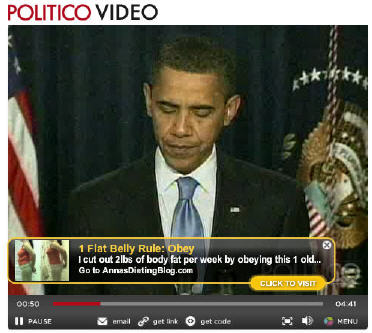
Hey Politico: what in heaven's name is this ad doing running during President Obama's somber remarks? Did Obama get tagged with "fit" or "great abs" based on his recent Hawaii vacation, thereby mapping any ad with "belly" or "diet" to him? If so, someone needs to tweak the system. And by the way - this is the kind of stuff that really undermines your brand. If you're going to expand into video, make sure someone is tasked with knowing what ads you're running so they don't end up embarrassing you!
What do you think? Post a comment now.
Categories: Advertising, Politics
Topics: Politico
-
Adap.tv and EyeWonder Partner
Adap.tv and EyeWonder, two key players in the broadband video and rich media ad space are announcing a partnership today, meant to further streamline ad sales and monetization for video content providers. The partnership follows on the deal I wrote about last week between Panache and MTV also highlighting these points.
Particularly given the tough economy, video content providers are focused more than ever on maximizing the value of their inventory with the least possible amount of effort and cost. On the flip side, ad technology companies are trying to figure out how to cover more customer ground more cost-effectively. Inevitably these forces will lead to more partnerships, and likely some industry consolidation. Panache, Adap.tv, Tremor Media and others are among the companies driving the broadband ad market forward. I'll have more news on this front in the coming days.
What do you think? Post a comment now.
Categories: Advertising, Partnerships
Topics: Adap.TV, EyeWonder, MTV, Panache
-
Canoe and the Broadband Video Challenge
In 2008, Canoe Ventures, the JV of six large U.S. cable operators, became one of the hottest topics of conversation in the cable, programming and advertising industries. Last week, I was fortunate to get time with Vicki Lins, Canoe's Chief Marketing Officer, to learn more about the company's plans. Though Vicki has been pulling double duty between her role at Comcast Spotlight and Canoe in recent months, she had only just started full time with Canoe, so she readily admitted that she's still getting up-to-speed.
Ordinarily Canoe's advanced TV advertising mission would be off-center for VideoNuze's strictly broadband video-centric focus. But the reason it's relevant to understand is because I think long-term, the world that Canoe is trying to create on top of cable's digital set-top boxes is on a collision course with the world that broadband video is trying to create. I see both eventually competing for the same viewers, ad dollars and mind-share.
Canoe is critical to the cable industry because it recognizes that ever-better targeting, interactivity and ROIs are driving ad spending decisions. For 10+ years now, the Internet (and Google in particular) has been resetting marketers' expectations, thereby placing ever-greater pressure on TV ad executives to improve their game.
Vicki explained that first and foremost, Canoe is a service bureau, helping advertisers, programmers and
 cable operators wring more value out of their ad inventory. It does not intend to sell any ads itself. Canoe's key is leveraging its access to its cable partners' digital set-top boxes. First up is what's called "Creative Versioning" or zone-based addressability - the ability to break down users into logical segments that get specific ads. Another focus is productizing the viewership data being captured by those set-tops to out-Nielsen Nielsen (while of course respecting users' privacy). A third is trying to enable user interactivity - the ability to get deeper information, zero in on a product feature in an ad, order an item, etc.
 All of this would benefit cable and broadcast networks seeking to more effectively monetize their ad inventory, as well as cable operators which sell a portion of cable networks' ad inventory locally. Clearly these are key constituencies, but as Vicki points out, Canoe must also address ad agencies, brands, cable technologists, local operations teams where Canoe's technology is actually deployed, cable marketers and others who have a stake in this process. It's a pretty long list, and one wonders whether a start-up is able to handle all of this at once.
But there are two even bigger issues that I see. First, I find myself wondering whether Canoe is even aiming at the right target with these initial plans. Instead, why doesn't Canoe just focus 100% of its energies on monetizing these cable operators' billions of current VOD streams? It's amazing to me that years after VOD's launch, I don't see any ads on Comcast (my cable company) VOD. My kids watch lots of Ben 10, Hannah Montana, Wizards of Waverly Place, etc on VOD yet never see a single ad for a sugared cereal or wizzy new toy. As a parent this isn't something I'm complaining about, but if I were a Comcast shareholder it would sure have me scratching my head. It seems like such a big missed opportunity...is there something I don't understand here?
As Denise Denson, MTV's EVP of Content Distribution and Marketing recently told Multichannel News, "We have over a billion VOD orders this year on Comcast alone, but we've made virtually no money in advertising in that space....With the convergence of TV and the Internet, there is a danger that the Internet's interactive content could usurp it. It's unfortunate, but programmers will have to put their content where they can actually monetize it."
And that brings us back to broadband video's challenge to Canoe. The fact is that broadband is a parallel and fast-growing VOD platform that is generating significant content provider interest because of it offers substantial control of the user experience and relatively robust monetization. As I wrote yesterday, broadband advertising innovation is being adopted by major media companies like MTV. And because broadband ad innovation is diffused over many companies (as is all innovation in the hyper-competitive Internet realm), there are rapid and continuous improvements. Conversely, by concentrating its set-top box ad efforts through just Canoe I think the cable industry is limiting the platform's vast potential.
Denise Denson hit the nail on the head: resources are finite and programming networks will focus their attention on platforms that offer the best scale and monetization opportunities. With broadband coming to TVs very soon, it will soon be a de facto competitor to cable's digital set-top box delivery. To preserve the value of its video platform, cable needs to shore up its VOD advertising and user experience and not let broadband surpass it. For my money, that seems like the most productive place for Canoe to first focus its attention.
What do you think? Post a comment now.
Categories: Advertising, Cable TV Operators
-
Panache Lands MTV Networks; Ad Insertion Space Evolves
The video ad insertion and management landscape continues to evolve as Panache is announcing this morning that its platform will be deployed across MTV Networks' sites. I caught up with Steve Robinson, Panache's president yesterday to learn more.
As Steve explains it, as major media companies have grown their broadband video usage, operationalizing the business has become increasingly complex. This is no surprise and I've heard it from others as well: multiple organizations including technology development, ad operations, ad sales and programming have had to learn to work together to deploy and monetize broadband video offerings.
This is important stuff, not just because of the potential for missed revenue, but because users can quickly notice when the organization's gears are grinding. How often have you seen the same untargeted ad play repeatedly? Or not seen any ads at all? Or have had a 30 second pre-roll ad in front of short 45 second news clips you're sequentially watching? As the broadband stakes have gotten higher, large media companies have increasingly focused on how to streamline their processes in order to scale and monetize more effectively.
That's where Panache comes in. In the MTV example, Panache first integrates with MTV's standardized
 video player. Once integrated, ad operations is able to use the Panache tools to create ad programs and logic, including campaigns, flights, formats, etc. This becomes the playbook for ad sales as it interfaces with customers, and can be readily modified to suit custom requests. A key benefit is that MTV's development organization doesn't need to get involved each time some part of the ad offering is changed. Improving the back-end processes helps ramp up sales, which for major media companies like MTV Networks is handled mostly by internal teams.
But the need for streamlining broadband video ad operations goes beyond the major media companies though, and there are other offerings with similar capabilities on the market too. For example in the past year Tremor Media has launched Acudeo, and Adap.tv has launched OneSource. Both are technology platforms for video providers that can pull ads from multiple sources (direct sales, ad networks, etc.) with an eye to maximizing fill rates and CPMs.
One key difference is business model: Panache and Adap.tv don't have ad sales organizations, whereas Tremor, as an ad network, does. For Panache or Adap.tv that means relying on some mix of licensing/platform usage fees and/or receiving a revenue share from customers, whereas for Tremor it means obtaining a chunk of the inventory to sell itself. There are no doubt feature-for-feature differences as well, but not having worked in ad ops myself, some of this is beyond my scope and would require specific due diligence.
For sure as the broadband video ad business becomes more integral to large and mid-sized content providers we'll continue to see more innovation and business process improvements in this area. Just as TV ad insertion has been refined to a science over the years, so too will broadband video.
What do you think? Post a comment now.
Categories: Advertising, Cable Networks, Technology
Topics: Adap.TV, MTV, Panache, Tremor Media
-
Where Does Advertising Fit In with Broadband-Enabled TVs?
If you haven't noticed, the theme at VideoNuze this week has been broadband-enabled TVs, since this has been one of the main themes of this week's CES. On Monday, when the dust has settled, I'll recap some of the key deals. For today though, I want to inject a small dose of reality into the hype that's starting to build up around broadband-enabled TVs.
First off, I'm thrilled to see an ecosystem of technology leaders, TV set manufacturers, content providers and aggregators taking shape around broadband-enabled TVs. It's looking increasingly inevitable that broadband access is going to be a staple feature of HDTVs in the years to come. Just as you wouldn't consider buying an HDTV without multiple HDMI ports today, at some point in the future you'll be unlikely to buy one without broadband capability. That's pretty cool.
Still, what's missing from the flurry of this week's announcements is how the exciting new broadband path to the TV will actually be monetized by video content providers. I know that mundane questions like this aren't what people tend to focus on at glitzy CES, but they are critical nonetheless. With services like Netflix or Amazon VOD - which have been in the middle of several announcements - it's obvious enough how they'll benefit. The more pertinent question is how video that is ad-supported is going to work, especially since ad-supported video will always represent the lion's share of the average consumer's viewership time.
The broadband video ad model itself is still nascent, and this week's J.P. Morgan report shows that there's no shortage of lingering skepticism still overhanging it. Nonetheless, I'd argue we're at least at a point now where most market participants have a pretty good handle on broadband video advertising's basics - serving technologies/vendors, formats, expected delivery quality, CPMs, user preferences, click-throughs, etc. In short, I believe the foundation is pretty well in place for a strong ramp up of spending (notwithstanding the larger economic issues) as the broadband video world exists today.
But how much of that foundation will still be valid for broadband-enabled TVs vs. how much will need to be re-built (as is the case with mobile video)? Many of the answers are driven by the chips from Intel, Broadcom and others that are going into these TVs. Understanding their respective capabilities and how they'll support broadband video advertising's existing ecosystem is key.
Here's why: in the broadband world to date, the computer's vast processing capabilities (along with the supporting cast of browser, media players, plug-ins, cookies and of course robust broadband access) has played an incredibly important, yet largely unsung role in raising the user experience bar to a point where broadband video has been massively adopted. Of course, this massive adoption has been THE key ingredient for the broadband video ad model to take off. And client-side capabilities only become more important in the highly syndicated broadband video world that I envision in the future. Ad servers need to know which site is playing the video so the right ad is dynamically served and everyone gets compensated properly. The new broadband TV chips need to support all of this and more.
One needs look no further than cable's VOD experience to date to recognize how important the building blocks for an effective advertising model are. While billions of VOD streams are now consumed, very little of it is monetized due to still-inadequate ad capabilities. Years after VOD's launch, these monetization constraints are curtail content providers' interest in participating in VOD. In fact, I'd argue that broadband has actually been a beneficiary of VOD's deficiencies: faced with a choice of where to allocate resources, many content providers have shifted attention to broadband because its monetization mechanisms are so robust.
Anyway, you get the point. Broadband-enabled TVs are very exciting. But to reach their potential, they must deliver a robust user experience and allow advertising to work effectively. In these penny-pinching, resource-constrained times, something that's cool is no longer enough to gain interest. People need to understand how they'll make money from it.
What do you think? Post a comment now.
Categories: Advertising, Devices
Topics: Amazon, Broadcom, Intel, J.P. Morgan, Netflix
-
J.P. Morgan is Too Bearish on Online Video
There's been a lot of buzz over the last couple of days about J.P. Morgan's just-released "Nothing But Net - 2009 Internet Investment Guide," including many references to Morgan's distinctly bearish commentary on online video. I'm always interested in what other analysts are saying about video, so I downloaded the document yesterday. Though it's 340 pages, only 2 pages (81-82) are devoted to online video specifically. (And incidentally, as best I can tell, that's 2 pages more than the "Nothing But Net - 2008" devoted to the video industry.)
I have to say I found Morgan's write-up to be quite superficial, with a generally dismissive tone regarding
 online video's opportunity. Like many Wall Street analyst reports I've previously read, it seems more focused on near-term financial prospects than longer-term strategic opportunities. An investment professional without in-depth knowledge of online video trends who read the report would likely conclude that it's not worth spending much time on online video, at least in the near term. That would be a critical mistake, because, as I've said many times, online delivery is the single most disruptive influence on the video industry today.
 Morgan's analysis is strictly focused on the ad-supported model. No attention is paid to broadband's impact on the multi-billion dollar multichannel subscription TV or home video markets which companies like Netflix, Amazon, Apple and others are pursuing with disruptive fervor. As for advertising, while Morgan acknowledges that online video usage has taken off, it believes that "performance-based marketers and brand advertisers are looking at three variables in determining their investment: reach, content quality and performance measurability." In Morgan's view, today's "advertising formats do not appropriately address these three variables."
It's important to note that a key Morgan theme is that performance-based advertising models like search are more desirable than CPM-based models like display, and most video ads today. Morgan believes (and I do agree) that performance and ROI-tracking will become even more important in the down economy where ad dollars are scarce and must deliver real sales results.
Still, the reality is that over time, online video ad dollars are most likely to be shifted from TV, which is a CPM-based medium. And online video ad units offer far greater interactivity than TV ever has. But this still misses a larger point - video is a CPM-based medium because video is the pre-eminent media format to make an impression on a consumer. Nothing packs the same emotional impact as video, and that's why brands have always been drawn to TV advertising. In short, while the overall online ad market is shifting to performance, brands will always need a visual medium. With all the challenges traditional TV has (e.g. DVR-based ad skipping, audience fragmentation, etc.), online video formats that are engaging, non-skippable and interactive will gain in appeal.
Yet Morgan suggests that brand interest will remain quite muted. Paraphrasing the report, it suggests: content providers can't guarantee viewership as they can in TV (though in reality many can and have been doing so for a while now), content providers have a hard time determining pricing (though the CPM ranges for many sites has already solidified), "many video sites are plagued with videos of varying quality and copyright violations" (though outside of YouTube and MySpace, all of comScore's top 10 video sites are premium video-only) and no "ad format seems to be widely accepted by users, publishers or advertisers" (though the IAB published its digital video ad format guidelines back in May '08, and users are now well-accustomed to the kinds of ads to expect in their online video experience).
If brands' interest in online video advertising is so challenged, you wouldn't know it from actual experience. In 10 minutes of random sampling this morning here are ads I saw: Oreos (MTV.com), HP (ComedyCentral.com), Blackberry, Target (Hulu), Gillette, IBM (ESPN.com), Ritz, Sears (ABC.com) and Dunkin' Donuts, Robitussin (Yahoo). I'm not suggesting that the online video medium doesn't have its challenges in attracting brands, but based on everything I continue to hear, the premium video sites in particular - like those cited above - are holding up pretty well even in this environment. Even much-maligned user-generated video may have some unexpected silver linings; just yesterday it was reported that Japanese anime producer Kadokwa Group Holdings is pulling in $110,000/mo from its YouTube channel stocked with user-created material.
Far from being the uninteresting medium that the Morgan report depicts, online video has already become a bright spot for many established content providers whose traditional models are under pressure. It is also opening up new opportunities for new ad-supported entrants. And it is threatening to completely upend the paid part of market through improvements in "over-the-top" technologies and consumer services.
To be sure, the medium is still in its adolescence. But that's all the more reason why savvy investors, entrepreneurs and other market participants who look past cursory industry reports, and instead choose to dig in and understand the massive disruption online video is causing will do quite well in the long term.
What do you think? Post a comment now.
Categories: Advertising
Topics: J.P. Morgan
-
Reviewing My 6 Predictions for 2008
Back on December 16, 2007, I offered up 6 predictions for 2008. As the year winds down, it's fair to review them and see how my crystal ball performed. But before I do, a quick editorial note: each day next week I'm going to offer one of five predictions for the broadband video market in 2009. (You may detect the predictions getting increasingly bolder...that's by design to keep you coming back!)
Now a review of my '08 predictions:
1. Advertising business model gains further momentum
I saw '08 as a year in which the broadband ad model continued growing in importance as the paid model remained in the back seat, at least for now. I think that's pretty much been borne out. We've seen countless new video-oriented sites launch in '08. To be sure many of them are now scrambling to stay afloat in the current ad-crunched environment, and there will no doubt be a shakeout among these sites in '09. However, the basic premise, that users mainly expect free video, and that this is the way to grow adoption, is mostly conventional wisdom now.
The exception on the paid front continues to be iTunes, which announced in October that it has sold 200 million TV episode downloads to date. At $1.99 apiece, that would imply iTunes TV program downloads exceed all ad-supported video sites to date. The problem of course is once you get past iTunes things fall off quickly. Other entrants like Xbox Live, Amazon and Netflix are all making progress with paid approaches, but still the market is held back by at least 3 challenges: lack of mass broadband-to-the-TV connectivity, a robust incumbent DVD model, and limited online delivery rights. That means advertising is likely to dominate again in '09.
2. Brand marketers jump on broadband bandwagon
I expected that '08 would see more brands pursue direct-to-consumer broadband-centric campaigns. Sure enough, the year brought a variety of initiatives from a diverse range of companies like Shell, Nike, Ritz-Carlton, Lifestyles Condoms, Hellman's and many others.
What I didn't foresee was the more important emphasis that many brands would place on user-generated video contests. In '08 there were such contests from Baby Ruth, Dove, McDonald's, Klondike and many others. Coming up in early '09 is Doritos' splashy $1 million UGV Super Bowl contest, certain to put even more emphasis on these contests. I see no letup in '09.
3. Beijing Summer Olympics are a broadband blowout
I was very bullish on the opportunity for the '08 Summer Games to redefine how broadband coverage can add value to live sporting events. Anyone who experienced any of the Olympics online can certainly attest to the convenience broadband enabled (especially given the huge time zone difference to the U.S.), but without sacrificing any video quality. The staggering numbers certainly attested to their popularity.
Still, some analysts were chagrined by how little revenue the Olympics likely brought in for NBC. While I'm always in favor of optimizing revenues, I tried to take the longer view as I wrote here and here. The Olympics were a breakthrough technical and operational accomplishment which exposed millions of users to broadband's benefits. For now, that's sufficient reward.
4. 2008 is the "Year of the broadband presidential election"
With the '08 election already in full swing last December (remember the heated primaries?), broadband was already making its presence known. It only continued as the year and the election drama wore on. As I recently summarized, broadband was felt in many ways in this election cycle. President-elect Obama seems committed to continuing broadband's role with his weekly YouTube updates and behind-the-scenes clips. Still, as important as video was in the election, more important was the Internet's social media capabilities being harnessed for organizing and fundraising. Obama has set a high bar for future candidates to meet.
5. WGA Strike fuels broadband video proliferation
Here's one I overstated. Last December, I thought the WGA strike would accelerate interest in broadband as an alternative to traditional outlets. While it's fair to include initiatives like Joss Wheedon's Dr. Horrible and Strike.TV as directly resulting from the strike, the reality is that I believe there was very little embrace of broadband that can be traced directly to the strike (if I'm missing something here, please correct me). To be sure, lots of talent is dipping its toes into the broadband waters, but I think that's more attributable to the larger climate of interest, not the WGA strike specifically.
6. Broadband consumption remains on computers, but HD delivery proliferates
I suggested that "99.9% of users who start the year watching broadband video on their computers will end the year no closer to watching broadband video on their TVs." My guess is that's turned out to be right. If you totaled up all the Rokus, AppleTVs, Vudus, Xbox's accessing video and other broadband-to-the-TV devices, that would equal less than .1% of the 147 million U.S. Internet users who comScore says watched video online in October.
However, there are some positive signs of progress for '09. I've been particularly bullish on Netflix's recent moves (particularly with Xbox) and expect some other good efforts coming as well. It's unlikely that '09 will end with even 5% of the addressable broadband universe watching on their TVs, but even that would be a good start.
Meanwhile, HD had a banner year. Everyone from iTunes to Hulu to Xbox to many others embraced online HD delivery. As I mentioned here, there are times when I really do catch myself saying, "it's hard to believe this level of video quality is now available online." For sure HD will be more widely embraced in '09 and quality will get even better.
OK, that's it for '08. On Monday the focus turns to what to expect in '09.
What do you think? Post a comment now.
Categories: Advertising, Aggregators, Brand Marketing, Devices, HD, Indie Video, Politics, Predictions, Sports, Technology, UGC
Topics: Amazon, Apple, AppleTV, Barack Obama, Hulu, iTunes, NBC, Netflix, Olympics, Roku, VUDU, XBox
-
Adconion.TV: Trying to Do Google Content Network One Better
I've been very intrigued by two recent announcements from Adconion, which bills itself as the largest independent online advertising network.
First, in early October, it announced "AMG-TV," a video content syndication network now called "Adconion.TV" as well as its first deal, to distribute Vuguru's "Back on Topps." Then last week it acquired KTV Digital Media, a production studio and syndicator, to become a wholly-owned subsidiary called RedLever. Late last week I got a briefing from Adconion CEO/founder Tyler Moebius and Reeve Collins, CEO RedLever to learn more.
My take is that Adconion.TV/RedLever is emulating the same model as Google Content Network, except with a couple of interesting twists (for more on GCN, see "Google Content Network Has Lots of Potential, Implications"). Nevertheless, both are classic Syndicated Video Economy plays, which could have a huge impact on the fundamentals of broadband video's future business model.
For those not familiar with Adconion, it says it reaches 260M unique visitors/month, second only to Google.
 Traffic is about evenly split between the U.S. and the rest of the world. It has 800+ publishers in its network, including 60-70 that it represents exclusively, primarily for international sales. The company made a big splash earlier this year when it raised a monster $80M round led by Index Ventures (the lead investor in Skype among others). It has grown from 30 employees in '06 to 285 in '08.
 The similarities between Adconion.TV and GCN are as follows: both believe their vast network of publisher web sites - which were initially built to serve ads - can now be modified to also accept high-quality syndicated video content. Each leverages the same algorithms it used to optimize which ads to insert, so that video too will only be served to the most appropriate sites. One might think of both these companies as being in the real estate business. Each has colonized vast tracts of web property and is now trying to identify, as real estate pros would say, the "highest and best use" of its inventory: ads, video or some combination of the two.
At the core of both Adconion.TV and GCN is the conviction that content should be brought to users wherever they may live, as opposed to attempting to drive them to a destination site, a la the "must-see TV" model of old. This has been a key tenet of the Syndicated Video Economy concept I've been fleshing out in '08. With the fragmentation of users over the web, social networks, mobile devices, gaming consoles, etc. the way to build a franchise is to propagate video into all of the web's nooks and crannies. Note others like Grab Networks, Syndicaster, 1Cast, Jambo and others are also heavily pursuing the syndication opportunity, each with their own competitive angle.
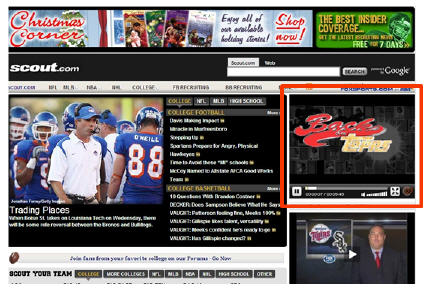
In both initiatives content-distribution-brand advertising are the three legs of the business model stool. Consider: in Adconion.TV's launch deal it was a package of Vuguru/Back On Topps (content) - Adconion.TV (distribution) and Skype (brand), while GCN's was Seth MacFarlane/Cavalcade of Comedy (content) - GCN (distribution) - Burger King (brand). I asked Tyler whether this three-legged stool is the model for independent broadband content (whose nascent studios have been slammed by the down economy) to be funded in the future, he emphatically replied "yes."
This highlights one key difference between GCN and Adconion.TV. Google of course has been very clear in steering away from content creation, consistently declaring it's "not a content company." Adconion, on the other hand, specifically intends to custom produce brand-infused broadband video programming. That's where the KTV acquisition comes in. Tyler explained that it is deep into talks with numerous agencies and brands about creating programs that showcase the brand sponsors. Two deals are expected to be announced soon.
Another difference is that GCN tried to drive traffic back to YouTube to incent users to subscribe to ongoing program updates and get exposed to other related programs. In my GCN post, I wrote enthusiastically that the marriage of AdSense-powered video distribution as the "spokes" with YouTube as the "hub" was formidable because it gives GCN a mechanism to build ongoing viewership beyond the first exposure at the publisher site.
Today Adconion lacks a comparable destination site. Tyler doesn't think that's important since it offers ways to subscribe, get email alerts and share within the player itself. Plus he's not hearing demand for it from brands. Still I think as this story unfolds and Adconion.TV finds itself competing with GCN for the highest-potential content, a destination site compliment will become essential. Should it agree, an acquisition would make sense to fill this hole (Metacafe? DailyMotion?).
For now though, Adconion has an aggressive plan to build Adconion.TV as an exciting new entry on the Syndicated Video Economy landscape. With its resources, reach and new production capabilities, this is clearly one to keep an eye on.
What do you think? Post a comment now.
Categories: Advertising, Aggregators, Syndicated Video Economy
Topics: 1Cast, Adconion, Google, Google Content Network, Grab Networks, KTV Digital Media, Syndicaster, YouTube
-
eStara Video Connect Enables Higher Value and ROI in Video
Sometimes high-potential products can initially look pretty modest, especially when compared to higher-profile alternatives. Such is the case with a clever new product from ecommerce provider ATG called "eStara Video Connect" that could easily be overlooked in the sea of snazzy new video ad formats constantly being rolled out.
Two weeks ago when I first glanced at the pitch email I received from ATG's PR rep it looked like a ho-hummer. However, I gave it a slightly closer read and was intrigued enough to set up a call and demo. I'm glad I did. After talking to Shari Solis, VP of ATG's Media Business and giving Video Connect a spin, I think the product could add real value to broadband video advertising. Importantly, it could really improve the business cases being presented by broadband content providers to agencies and advertisers each day.
Here's how it works: the Video Connect player presents an icon or other message inviting the viewer take action. These actions can include clicking to call, IM, email, go to web site, etc. When the user clicks, the underlying video minimizes to a corner of the player and a simple pop-up appears. If you select "call us now", you then enter your phone #. Within seconds your phone rings, and within seconds after that another voice patches in from the advertiser.
In the demo a search was done in SuperPages.com for restaurants in Washington, DC which yielded a list of options. Many displayed a video camera, denoting video information was available. I selected the video for Ruths Chris Steak House and clicked to call. In a few moments I was on the line with the restaurant, asking for my reservation. The loop from search to more information to making a reservation was completed in minutes.

The applicability of Video Connect in the local ad space is obvious. Indeed, ATG is targeting local directories and online yellow pages as its initial market. These companies are in perpetual search of ways to add more value to their local clients. And of course, in this economy, local businesses gravitate to solutions that provide an improved ROI and clearly distinguish them from their competitors (more on this in my recent post "Citysearch Offering Local Merchants Video Enhancement").
Meanwhile, I'm also intrigued by the national opportunities. For example, one of the knocks on pre-roll ads is that they're just a branding opportunity, doing little more to directly drive actual sales than traditional TV ads. I can see how integrating Video Connect (which also has a full set of APIs, so that creative teams can incorporate it seamlessly) would allow pre-roll advertisers to derive a more measurable and higher ROI than they do currently, even when these ads also include a companion banner.
A great example would be creating a distinct offer in the pre-roll to "be one of the first 1,000 callers and receive...." that mimics traditional direct-response advertising. Wouldn't an auto company be interested in handing out a $500 coupon to the first 1,000 callers since they've self-identified themselves as higher-probability buyers? Or how about a consumer packaged goods company rolling out a "new and improved" version of a product. Wouldn't it be interested in having the first 5,000 loyal customers who called receive a complimentary box of the product, and then have them share the word with their friends? Given how inexpensive it is to outsource simple call center functions, the business case should be quite attractive.
I'm not suggesting that Video Connect is going to revolutionize video advertising, but it is a solid incremental feature that creates more value and will generate a higher ROI on advertisers' spending. These aren't trivial benefits, especially in a down economy where all ad spending is under close scrutiny.
What do you think? Post a comment now.
Categories: Advertising, Technology
Topics: ATG, eStara Video Connect
-
Reflections from Digital Hollywood
On Monday I wrote that a key mission of mine while attending the Digital Hollywood Fall conference in LA this week was to dig into what impact the economic crises is having on the broadband video industry. Specifically I was focused on three things: financing, staffing and customer spending effects.
I wasn't terribly surprised by what I heard; people are quite nervous. Most significantly they're nervous about financing. Many I spoke to cited the recent Sequoia Ventures presentation which offers a very harsh assessment of the landscape for financings and startups. I heard a lot of lukewarm responses like "we'll have to see what happens" from folks when asked about their ability to pursue future financings.
That said, some deals are still being done. One in particular is a new venture debt deal announced this morning by Clearleap. I caught up with their CEO Braxton Jarratt at DH, and one of my takeaways from that meeting was that venture investing may well be returning to its roots favoring technology-oriented companies that address well-understood industry pain points.
This shift would not bode well for content-oriented startups where investors are bet more on the startup's ability to create enterprise value from audience generation and ad revenue. Evidence of belt-tightening in the content world abounds, with the latest news of layoffs coming from 60Frames. All signs from DH suggest this is going to be one of the hardest hit sectors, as business models remain nascent and ROIs uncertain (one executive told me that every content startup has already eliminated at least 10-20% of their headcount, even if you haven't read about it publicly). While there's no shortage of interest in broadband content creation, the question is whether the dollars will be there to fund these ventures.
Closely tied to content's success is the video management/publishing platform space. I had a numerous conversations with folks about the large number of competitors and concern that both customer spending slowdowns and limited financing are going to force a shakeout. These companies are being advised to watch their cash carefully.
Lastly, there was lots of discussion, especially on panels, around ad spending in this climate. Optimists felt that the fundamentals of consumer behavior embracing broadband consumption would force advertisers to continue their spending in broadband. Conversely many pessimists said that friction, lack of clear ROIs, a flight to safety (i.e. a bias toward TV advertising) and the general slowdown would all conspire against broadband ad spending. It's hard to ignore the pessimists' arguments here; my hope is that any pullback is relatively shallow.
One thing that's certain: broadband is not exempt from the consequences of the financial meltdown. All businesses are assessing what they need to do to survive and succeed. Another major wrinkle has been introduced in the broadband video industry's evolution.
What do you think? Post a comment now.
(A postscript: thanks to the many of you who volunteered feedback on VideoNuze at the show. I really appreciate your comments and encourage all readers to let me know their thoughts. What can VideoNuze do differently or better to provide you more value?)
Categories: Advertising, Deals & Financings, Indie Video, Technology
Topics: 60Frames, Clearleap, Silicon Valley Bank
-
EveryZing's New MetaPlayer Aims to Shake Up Market
EveryZing, a company I wrote about last February, is announcing the launch of its MetaPlayer today and that DallasCowboys.com is the first customer to implement it. My initial take is that MetaPlayer should have strong appeal in the market, and could well shake things up for other broadband technology companies and for content providers. Last week I spoke to EveryZing's CEO Tom Wilde to learn more about the product.
MetaPlayer is interesting for at least three reasons: (1) it drives EveryZing's video search and SEO capabilities inside the videos themselves, (2) it provides deeper engagement opportunities than typically found in other video player environments and (3) it enables content providers to dramatically expand their video catalogs, while maintaining branding and editorial integrity.
To date EveryZing's customers have used its speech-to-text engine to create metadata for their sites' videos, which are then grouped into SEO-friendly "topical pages" that users are directed to when entering terms into the sites' search box. Speech-to-text and other automated metadata generating techniques from companies like Digitalsmiths are becoming increasingly popular as content providers continue to recognize the value of robust metadata.
MetaPlayer takes metadata usage a step further by creating virtual clips based on specified terms, which are exposed to the user. A user's search produces an index of these virtual clips, which can be navigated through time-stamped cue points, transcript review, and thumbnail scenes (see below for example). The virtual clip approach is comparable in some ways to what Gotuit has been doing and is pretty powerful stuff, as it lets the user jump to desired points, thus avoiding wasted viewing time (e.g. just showing the moments when "Tony Romo" is spoken)
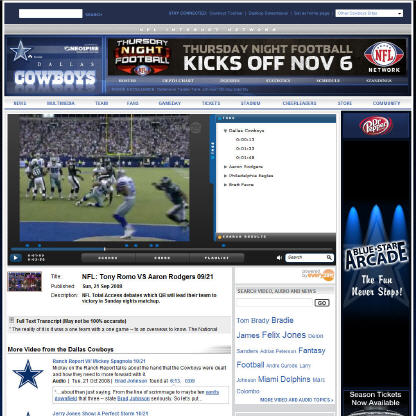
Next, MetaPlayer enables deeper engagement with available video. Yesterday, in "Broadband Video Needs to Become More Engaging," I talked about how the importance of engagement to both consumers and content providers. MetaPlayer is a move in this direction as it allows intuitive clipping, sharing and commenting of a specific video clip within MetaPlayer. Example: you can easily send friends just the clips of Romo's touchdown passes along with your comments on each.
Last, and possibly most interesting from a syndication perspective, MetaPlayer allows content providers to dramatically expand their video offerings through the use of what's known as "chromeless" video players. I was first introduced to the chromeless approach by Metacafe's Eyal Hertzog last summer. It basically allows the content provider to maintain elements of the underlying video player, such as its ability to enforce a video's business policies (ad tags, syndication rules, etc.), while allowing new features to be overlayed (customized look-and-feel, consistent player controls, etc.).
MetaPlayer takes advantage of chromeless APIs available now from companies like Brightcove, and also importantly YouTube. For example, the Cowboys could harvest select Cowboys-related YouTube videos and incorporate them into their site (this is similar to what Magnify.net also enables). With the chromeless approach, the Cowboys's user experience and their video player's branding is maintained while YouTube's rules, such as no pre-roll ads are also enforced.
To the extent that chromeless APIs become more widely available, it means that syndication can really flourish. The underlying content provider's model is protected while simultaneously enabling widespread distribution. All of this obviously leads to more monetization opportunities through highly targeted ads.
Bottom line: EveryZing's new MetaPlayer addresses at least three real hot buttons of the broadband video landscape: improved navigation, enhanced engagement and expanding content selection/monetization. All of this should give MetaPlayer strong appeal in the market.
What do you think? Post a comment now!
Categories: Advertising, Sports, Syndicated Video Economy, Technology, Video Search, Video Sharing
Topics: Brightcove, Dallas Cowboys, Digitalsmiths, EveryZing, Gotuit, Magnify.net, MetaCafe, YouTube
Posts for 'Advertising'

Connect with VideoNuze
Exclusive News Roundup
- Jimmy Kimmel is moving a Senate candidate interview to YouTube to sidestep FCC pressure Quartz
- Universal Music is launching an AI music platform with ElevenLabs The Verge
- Katzenberg and Ex-Sora Head Bill Peebles Launch AI Video Startup for Filmmakers AI Weekly
- Suno Launches New AI Model Trained on Licensed WMG, BMG Tracks The Hollywood Reporter
- Justice Department to take a closer look at Fox’s $22 billion Roku deal Semafor
- Congress Begins Drafting 20% Federal Film Incentive With Trump’s Blessing Variety