-
Netflix Watch Instantly Now Connected to 1 million Xboxes
Netflix has pulled back the curtain a little on its progress connecting its Watch Instantly streaming feature to TVs through its device partners. It and Microsoft have announced that since November '08,1 million Xbox LIVE Gold members have enabled the WI feature, consuming 1.5 billion minutes of movies and TV episodes.
By any measure this is an impressive start. For perspective, this may well be the largest number of people
 who have connected broadband to their TVs using an external device. More have probably connected their computers directly to their TVs, but as for devices I can't imagine any other having close to a million (Apple TV? Vudu? Roku?). In addition, simple math suggests that these users would already be watching the equivalent of around 1 movie or so per week (1.5 billion minutes divided by 1 million Xbox users divided by 12 weeks = 125 minutes viewed per user per week). Obviously this is just an average and also doesn't account for the ramp up in users over the 3 months. I think consumption will steadily increase especially if Netflix can expand WI's library of 12K titles.
Xbox must represent the largest footprint of Netflix-connected devices, simply because the number of Xbox LIVE Gold members is far larger than the number of owners of TiVo or the Blu-ray players that connect to Netflix. The Xbox adoption rate underscores the validity of Netflix's approach to make WI a value add for its subscribers and to integrate with third-party devices.
VideoNuze readers know I've become extremely enthusiastic about Netflix's broadband activities. The Xbox numbers are a positive early indicator of success. I only see more good news coming down the road.
What do you think? Post a comment now.
Categories: Aggregators, Devices
Topics: Microsoft, Netflix, XBox
-
January '09 VideoNuze Recap - 3 Key Themes
Following are 3 key themes from VideoNuze in January:
Broadband video marches to the TV - At CES in early January there were major announcements around connecting broadband to TVs, either directly or through intermediary devices (a recap of all the news is here). All of the major TV manufacturers have put stakes in the ground in this market and we'll be seeing their products released during the year. Technology players like Intel, Broadcom, Adobe, Macrovision, Move Networks, Yahoo and others are also now active in this space. And content aggregators like Netflix and Amazon are also scaling up their efforts.
Some of you have heard me say that as amazing as the growth in broadband video consumption has been over the last 5 years, what's even more amazing is that virtually all of it has happened outside of the traditional TV viewing environment. Consider if someone had forecasted 5 years ago that there would be this huge surge of video consumption, but by the way, practically none of it will happen on TVs. People would have said the forecaster was crazy. Now think about what will happen once widespread TV-based consumption is realized. The entire video landscape will be affected. Broadband-to-the-TV is a game-changer.
Broadband video advertising continues to evolve - The single biggest determinant of broadband video's financial success is solidifying the ad-supported model. For all the moves that Netflix, Amazon, iTunes and others have made recently in the paid space, the disproportionate amount of viewership will continue to be free and ad-supported.
This month brought encouraging research from ABC and Nielsen that online viewers are willing to accept more ads and that recall rates are high. We also saw the kickoff of "the Pool" a new ad consortium spearheaded by VivaKi and including major brands and publishers, which will conduct research around formats and standards. Three more signs of advertising's evolution this month were Panache's deal with MTV (signaling a big video provider's continued maturation of its monetization efforts), a partnership between Adap.tv and EyeWonder (further demonstrating how ecosystem partners are joining up to improve efficiencies for clients and publishers) and Cisco's investment in Digitalsmiths (a long term initiative to deliver context-based advanced advertising across multiple viewing platforms). Lastly, Canoe, the cable industry's recently formed ad consortium continued its progress toward launch.
(Note all of this and more will be grist for VideoNuze's March 17th all-star panel, "Broadband Video '09: Building the Road to Profitability" Learn more and register here)
Broadband Inauguration - Lastly, January witnessed the momentous inauguration of President Barack Obama, causing millions of broadband users to (try to) watch online, often at work. What could have been a shining moment for broadband delivery instead turned into a highly inconsistent and often frustrating experience for many.
In perspective this was not all that surprising. The Internet's capacity has not been built to handle extraordinary peak load. However on normal days, it still does a pretty good job of delivering video smoothly and consistently. As I wrote in my post mortem, hopefully the result of the inauguration snafus will be continued investment in the infrastructure and technologies needed to satisfy growing demand. That's been the hallmark of the Internet, underscored by the fact that 70 million U.S. homes now connect to the 'net via broadband vs. single digit millions just 10 years ago. I remain confident that over time supply will meet demand.
What do you think? Post a comment now.
Categories: Advertising, Aggregators, Devices, Politics, Technology
Topics: ABC, Adap.TV, Adobe, Amazon, Broadcom, EyeWon, Intel, Macrovision, Move Networks, MTV, Netflix, Nielsen, Panache, VivaKi, Yahoo
-
Netflix's Q4 Results Powered by Streaming; Further Growth Ahead
Netflix's Q4 earnings and business metrics released late Monday are resounding evidence of how important the company's Watch Instantly streaming feature is becoming to its future. Netflix ended '08 with just under 9.4 million subscribers, up 26% for the year. In Q4 '08 it added almost 2.1M gross subs (39% better than in Q4 '07) and 718K net subs (59% better than in Q4 '07). The company generated $51M in free cash flow in Q4 alone, more than in all of 2007. Did someone say there's a recession going? Not for Netflix it seems.
But here's the really interesting news: on the earnings call CEO Reed Hastings pinned the company's ability to beat its Q4 subscriber growth guidance on underestimating "the positive impact of the introduction of the multi-function CE devices from LG Electronics, Samsung, Microsoft and TiVo that promote Netflix streaming." He further added that "streaming is energizing our growth." Those are pretty strong validations of the company's broadband and CE strategy. (Btw, SeekingAlpha has the full transcript here. If you're a Netflix follower like me, it's a must-read.)
Hastings highlighted the LG and Samsung Blu-ray players as having a high connect rate in the 4th quarter,
though noting that in terms of gross numbers Xbox and TiVo were more significant simply because their installed bases are so much larger. It's also important to know that Netflix is paying spiffs to CE partners to generate new Netflix subscribers. That further enhances the relationship between Netflix and its CE-partners. On the one hand Netflix content is both a competitive differentiator for these brands' and a generator of cash while on the other CE partners are a driver of both new subs and streaming adoption for Netflix. Hastings noted that Netflix is in discussions with all major CE companies to "broadly cover the Blu-ray category and Internet TV category over the next few years." In the coming years, expect Netflix to be the content locomotive for marketing broadband-enabled devices the same way that "Intel Inside" was once the technology locomotive for marketing PCs. What other content provider is going to come close to such ubiquity? Possibly Amazon, whose pay-per-download model could actually be complimentary to Netflix in driving more device adoption. But certainly not Apple, which seems intent to yoke its massive iTunes video library to the proprietary Apple TV box in a fruitless (my opinion) attempt to recreate its iPod success.
Netflix's eventual device ubiquity is going to open up vast opportunities for the company. As I've said in prior posts, in combination with its affordable subscription model and well-respected brand name, Netflix could well become the prime potential "over-the-top" competitor to incumbent video service providers (cable/satellite/telco).
The fly in the ointment remains Watch Instantly's content selection, which is still a shadow of the DVD-by-mail catalog. VideoNuze readers know that I've been a forceful proponent of Netflix bolstering the number of broadcast network programs in its streaming catalog. Yet I think it's clear from Netflix CFO Barry McCarthy's comments on the call that Netflix isn't planning any home run initiatives when it comes to building the streaming catalog. He notes that the level of online content spending "will be paced by our success with streaming and our determination to continue to deliver strong earnings growth."
I generally favor that kind of steady-Eddie approach. But in this case I'd hate to see Netflix give too much weight to smoothly-growing earnings (which of course act to defend its stock price) at the expense of missing out on the big first-mover advantages it is sitting on. In fact, a key part of my prediction that Netflix could well be acquired this year (in my opinion by Microsoft, but who knows...) is that a deep-pocketed acquirer who can insulate Netflix from Wall Street's earnings expectations would be able to build Watch Instantly's library with far more vigor and hence make Netflix an even more formidable competitor.
Only time will tell on that front. Meanwhile Netflix's outstanding Q4 - in the face of a titanic economic slowdown - is tangible evidence that the company is on a path to play a far larger role in entertainment distribution in the broadband era.
What do you think? Post a comment now.
Categories: Aggregators, Devices
Topics: Amazon, Apple, Netflix
-
Recapping CES '09 Broadband Video-Related Announcements
CES '09 is now behind us. As has become typical, this year's show saw numerous broadband video product and technology announcements. As I wrote often last week, the key theme was broadband-enabled TVs. Assuming TV manufacturers deliver on their promises, Christmas '09 should mark the start of real growth in the installed base of connected TVs.
Here are the noteworthy announcements that I caught, in no particular order (I'm sure I've missed some; if so please add a comment and include the appropriate link):
Intel and Adobe to Extend Flash Platform to TVs
Adobe and Broadcom Bring the Adobe Flash Platform to TVs
Samsung and Yahoo Bring the Best of the Web to Television
Yahoo Brings the Cinematic Internet to Life and Revolutionizes Internet-Connected Television
LG Electronics First to Unveil "Broadband HDTVs" That Instantly Stream Movies From Netflix
LG Electronics Launches Broadband HDTVs with "Netcast Entertainment Access"
Sony Debuts Integrated Networked Televisions
Vizio Announces New and Exciting "Connected HDTV" Platform with Wireless Connectivity
Netflix Announces Partnership with Vizio to Instantly Stream Movies to New High Definition TVs
MySpace Partnerships Bring Web Site to TV Set
Macrovision to Bring Instant Access to Digital Content Directly to Internet-Connected Televisions
Cisco Brings Manufacturers Together to Make Connected Home Products Simple to Set-up and Easy to Use
blip.tv and ActiveVideo Networks Sign Deal to Bring Original Online Shows Directly to Television
Hillcrest Labs and Texas Instruments Showcase RF4CE Remote Controls with Freespace Technology
Categories: Aggregators, Devices
Topics: Ac, Adobe, Amazon, Broadcom, Intel, LG, Macrovision, Move Networks, MySpace, Netflix, Netgear, Roku, Samsung, Sony, Vizio, Yahoo
-
Where Does Advertising Fit In with Broadband-Enabled TVs?
If you haven't noticed, the theme at VideoNuze this week has been broadband-enabled TVs, since this has been one of the main themes of this week's CES. On Monday, when the dust has settled, I'll recap some of the key deals. For today though, I want to inject a small dose of reality into the hype that's starting to build up around broadband-enabled TVs.
First off, I'm thrilled to see an ecosystem of technology leaders, TV set manufacturers, content providers and aggregators taking shape around broadband-enabled TVs. It's looking increasingly inevitable that broadband access is going to be a staple feature of HDTVs in the years to come. Just as you wouldn't consider buying an HDTV without multiple HDMI ports today, at some point in the future you'll be unlikely to buy one without broadband capability. That's pretty cool.
Still, what's missing from the flurry of this week's announcements is how the exciting new broadband path to the TV will actually be monetized by video content providers. I know that mundane questions like this aren't what people tend to focus on at glitzy CES, but they are critical nonetheless. With services like Netflix or Amazon VOD - which have been in the middle of several announcements - it's obvious enough how they'll benefit. The more pertinent question is how video that is ad-supported is going to work, especially since ad-supported video will always represent the lion's share of the average consumer's viewership time.
The broadband video ad model itself is still nascent, and this week's J.P. Morgan report shows that there's no shortage of lingering skepticism still overhanging it. Nonetheless, I'd argue we're at least at a point now where most market participants have a pretty good handle on broadband video advertising's basics - serving technologies/vendors, formats, expected delivery quality, CPMs, user preferences, click-throughs, etc. In short, I believe the foundation is pretty well in place for a strong ramp up of spending (notwithstanding the larger economic issues) as the broadband video world exists today.
But how much of that foundation will still be valid for broadband-enabled TVs vs. how much will need to be re-built (as is the case with mobile video)? Many of the answers are driven by the chips from Intel, Broadcom and others that are going into these TVs. Understanding their respective capabilities and how they'll support broadband video advertising's existing ecosystem is key.
Here's why: in the broadband world to date, the computer's vast processing capabilities (along with the supporting cast of browser, media players, plug-ins, cookies and of course robust broadband access) has played an incredibly important, yet largely unsung role in raising the user experience bar to a point where broadband video has been massively adopted. Of course, this massive adoption has been THE key ingredient for the broadband video ad model to take off. And client-side capabilities only become more important in the highly syndicated broadband video world that I envision in the future. Ad servers need to know which site is playing the video so the right ad is dynamically served and everyone gets compensated properly. The new broadband TV chips need to support all of this and more.
One needs look no further than cable's VOD experience to date to recognize how important the building blocks for an effective advertising model are. While billions of VOD streams are now consumed, very little of it is monetized due to still-inadequate ad capabilities. Years after VOD's launch, these monetization constraints are curtail content providers' interest in participating in VOD. In fact, I'd argue that broadband has actually been a beneficiary of VOD's deficiencies: faced with a choice of where to allocate resources, many content providers have shifted attention to broadband because its monetization mechanisms are so robust.
Anyway, you get the point. Broadband-enabled TVs are very exciting. But to reach their potential, they must deliver a robust user experience and allow advertising to work effectively. In these penny-pinching, resource-constrained times, something that's cool is no longer enough to gain interest. People need to understand how they'll make money from it.
What do you think? Post a comment now.
Categories: Advertising, Devices
Topics: Amazon, Broadcom, Intel, J.P. Morgan, Netflix
-
Vizio is Latest to Announce Broadband/TV Integration
Broadband video integrated TVs got another big boost as Vizio, one of the top 3 flat panel brands in the U.S. announced its new "Connected HDTV" platform at CES this afternoon. The move comes on top of Netflix's LG announcement, and other chip-based announcements from Adobe with Intel and Broadcom. More
 broadband TV announcements are sure to follow.
The new Vizio TVs will incorporate the Yahoo Widget Engine and support for Adobe Flash Lite. Importantly, the TVs will allow access to a very broad range of content including Netflix Watch Instantly, Amazon VOD, Blockbuster OnDemand, Accedo, Flickr, Pandora, Rhapsody and Yahoo. For Netflix and Amazon specifically, the Vizio deal continues building out the portfolio of 3rd party devices that play their video libraries.
From a consumer standpoint, I think it's becoming increasingly clear that by late '09 into '10, buying an HDTV will almost always include the experience of bringing the set home, connecting it to your home wireless network and browsing a growing collection of paid and free broadband video choices. I envisioned for a while that 3 devices - game consoles, Blu-ray players and IP-enabled TVs - would be leading the charge into the "over-the-top" market. With these CES announcements and more to come, TVs could well become the most prolific of the three in the long run.
What do you think? Post a comment now.
Categories: Devices
Topics: Adobe, Broadcom, Intel, Netflix, Vizio
-
Netflix and LG Go Over-the-Top with New "Broadband HDTVs"
Happy New Year and welcome to 2009.
The new year is picking up right where the old year left off - with Netflix adding yet another way for its subscribers to use its Watch Instantly streaming service on their TVs. Today's announcement that its WI software will be embedded in a select number of new LG "Broadband HDTVs" is more evidence of how content providers and consumer electronics companies are aiming to go "over the top" of cable/satellite/telco, driving high quality broadband video all the way to the TV.
The new LG Broadband HDTVs joins XBox 360, TiVo, Samsung and LG Blu-ray players and Roku as options
 for Netflix subscribers looking to watch WI on their TVs. The differentiator here is that this is the first "boxless" approach, so it offers a potentially simpler (though not less expensive) solution for consumers. No doubt it is the first of many deals Netflix will announce with TV manufacturers in '09.
Still, my bet is that the group of box-based solutions will matter more to WI usage for a long time to come. That's because, even though LG is the #3 HDTV manufacturer, TV set replacement cycles are getting longer with the down economy, the new Broadband HDTVs will likely have a several hundred dollar price premium, and importantly, a solid portion of the existing Netflix subscriber target audience for these broadband sets may have long since been using one of the box-based alternatives and not see a lot of incremental benefit in buying one of the LG Broadband HDTVs.
Nevertheless, I think an interesting target market for these sets are non-Netflix subscribers, who are open to a "cord-cutting" proposition. Netflix is laying the groundwork for becoming a genuine alternative to today's multichannel subscription video services. As I've said before, to make itself more viable as an alternative, the most important thing Netflix can do is beef-up WI's broadcast network programming library.
When top-tier broadcast network programming is combined with its movie catalog, Netflix could become very appealing for consumers who don't care much about cable network programs or sports. For $17/month for Netflix vs. $60/month or more for a typical digital TV package from cable/satellite/telco, the math on paying the premium for the Netflix-enabled LG TV becomes much more interesting. Importantly, the retailer has a much stronger hook to sell the LG Broadband HDTVs, especially if, as an added incentive, Netflix perhaps threw in a 3-4 month trial subscription.The bottom line here is that Netflix continues to do the right thing by building out the portfolio of devices that play its WI streaming programming. The bigger the addressable audience is, the more that content providers of all stripes will take notice and want to do deals (Netflix's expansion of its promotional deal with Showtime is a useful data point on this subject). No other non-cable/satellite/telco subscription video service is close to Netflix in terms of number of subscribers, compatible streaming devices, library or brand name. In '09, Netflix is poised to build on these advantages as it morphs itself into an over-the-top broadband powerhouse.
What do you think? Post a comment now.
Categories: Aggregators, Devices
-
Recapping 5 Broadband Video Predictions for 2009
For those who weren't up for reading 700-1,000 words each day last week, today I offer a quick recap my 5 broadband video projections for 2009.
1. The Syndicated Video Economy Accelerates
This one is easily my least controversial prediction, since I've been writing about this trend for most of 2008. The "SVE" as I call it, is an ecosystem of video content providers, distributors and the technology companies who facilitate their relationships. In '08 video content providers increasingly realized that widespread distribution to the sites that users already frequent would improve on the "one central destination site" approach. That's a big change in the traditional media mentality. In '09 the SVE will only accelerate, as the technology building blocks for distributing, monetizing and measuring syndicated video continues to improve. To be sure, the SVE is still nascent, but many companies across the broadband landscape have begun embracing it in earnest.
2. Mobile Video Takes Off, Finally
In '08 VideoNuze has been mainly focused on wired broadband delivery of video to homes and businesses. But as the year has progressed, powerful new mobile devices have mutated the definition of broadband to also include wireless delivery. The huge success of the iPhone and other newer video-capable devices, coupled with 3G, and soon 4G networks, have contributed to mobile delivery finally realizing some of its long-held promise. Still, as some of you commented, obstacles remain. iPhones don't support Flash, the most popular video format. Wireless carriers are careful with doling out too much bandwidth for video apps. And so on. Still, '08 was a big year for video delivery to mobile devices, and I think '09 will be even bigger.
3. Net Neutrality Remains Dormant
Proponents of "net neutrality" legislation, which would codify the Internet's level playing field, expected that under an Obama administration they would finally be granted their wish, particularly since he supported the concept on the campaign trail. But I'm predicting that net neutrality will be dormant for yet another year. Mr. Obama has been emphatic about basing policy decisions on facts and data, and this is an area where net neutrality advocates continue to come up short as there's yet to be any sustained and proven ISP misbehavior. With Mr. Obama and his team having urgent fires to address all around them, there are only two scenarios I can see that move net neutrality up the prioritization list: a startling new pattern of ISP misbehavior or some kind of deal ISPs agree to in exchange for infrastructure buildout subsidies from the stimulus package.
4. Ad-Supported Premium Video Aggregators Shakeout
One of the best-funded categories of the broadband landscape has been aggregators of premium-quality video - TV programs, movies and other well-produced video. These companies have been thought of as potential long-term online competitors to today's video distributors (cable/satellite/telco). However, it's proving very difficult for these sites to differentiate themselves. Content is commonly available, user experience advantages are hard to maintain, user acquisition is not straightforward, audiences are fragmented and ad dollars are under pressure. All of this means that '09 will see a shakeout among the many players in this category, though it's hard to predict at this point who will be left standing (though at a minimum I expect Hulu and Fancast to be in this group).
5. Microsoft Will Acquire Netflix
My long-ball prediction was that at some point in '09 Microsoft will acquire Netflix. Though many of you emailed me offering kudos for boldness, not many are buying into my prediction. Fair enough, I'll either be flat-out wrong on this one or I'll get a gold star for prescience. I provided my rationale, which starts with the assumption that Apple and Google (Microsoft's two fiercest rivals in the consumer space) are best-positioned for success in the battle for the biggest consumer prize of the next 10 years: delivering broadband video services directly to the TV.
I think Microsoft needs to directly play in this space, and Netflix is a perfect vehicle. It has a great brand, a large and loyal subscriber base and excellent back-end fulfillment systems. In 2008 Netflix great strides in broadband, building out its "Watch Instantly" feature. Yet to grow WI's catalog from its current 12K titles to anything approaching the 100K+ available by DVD will require deep financial resources to deal with a recalcitrant Hollywood, and also shelter from quarter-to-quarter earnings pressures. Netflix's measured approach to broadband is consistent with its historical overall operating style. While that style has worked exceedingly well in the past, the broadband-to-the-TV service landscape is wide open right now, and Netflix should be pursuing in a thoughtful, yet ultra-aggressive way. Combined with Microsoft it would be poised to become the broadband video category leader over the next 10 years.
OK, there's the summary. I'll be checking back in on these as the year progresses.
What do you think? Post a comment now.
Categories: Aggregators, Broadband ISPs, Deals & Financings, Mobile Video, Predictions, Syndicated Video Economy
Topics: Apple, Fancast, Google, Hulu, Microsoft, Net Neutrality, Netflix
-
2009 Prediction #5: Microsoft Will Acquire Netflix
As I promised, I've tried to make my 2009 broadband predictions bolder as the week has progressed. So to cap off the week, I'm offering up a doozy: my 2009 prediction #5 is that Microsoft will acquire Netflix sometime next year.
Before I get into my rationale, I want to be perfectly clear that I have absolutely no insider information, nor have I talked to anyone at either company about this prediction, which is solely my own personal opinion. I don't directly own stock in either company, though I may have some in various mutual funds I own. This prediction doesn't constitute advice to purchase stock in either company. I'm an industry analyst who happens to believe that this deal would make a lot of strategic sense for both companies based on my assumptions about broadband video's future.
First, it's important to understand that the single biggest consumer market opportunity in the next 10 years will be delivering premium-quality video (mainly hit TV programs and movies) over broadband Internet connections to TVs. Broadband is poised to disrupt the current providers of multichannel video (cable/satellite/telco) which generate about $80-100 billion of annual revenue in the U.S. alone. Rich potential rewards await successful new broadband-only or "over the top" entrants.
While Microsoft has an impressive portfolio of consumer-facing products (e.g. Xbox, Silverlight, WMP, IE,
 MSN, etc.), the reality is that today it lacks a well-branded service offering with sufficient consumer traction to credibly vie for a piece of the multichannel video market that will be up for grabs. It is unimaginable to me that Microsoft will continue to content itself with focusing only on the enablers like those listed above, along with its Mediaroom IPTV software platform, while others launch new broadband video services to consumers. Further, since the race is actually already well underway, the classic "build vs. buy" analysis tilts heavily toward "buy," especially if a jewel like Netflix is possibly available.
 Another Microsoft motivator is that its two keenest competitors in the consumer space, Apple and Google, also happen to be the two best-positioned companies to deliver premium video to the TV using broadband. In iTunes, Apple has by far the most successful consumer-paid download store which is already highly relevant to studios and networks (witness NBC's decision to return to iTunes earlier this fall), not to mention the most successful devices (iPod and iPhone). iTunes is Apple's springboard into disrupting the traditional multichannel video model, though exactly how the company will do so is yet to be determined. Its initial foray with Apple TV is hardly the company's final word. And with Steve Jobs' personal stake in Disney, Apple has a lot of insight and leverage to get things done in Hollywood.
Meanwhile Google, when combined with YouTube, has the highest potential for delivering an ad-supported premium broadband video service. I recognize that the operative word in that sentence is "potential." YouTube still has lots of monetization challenges. And though it has made great strides adding premium video to its site in '08, I doubt many users yet associate YouTube with premium video the way they do with Hulu for example, or any of the network sites for that matter. Further, YouTube has made little progress in articulating a strategy for getting to the TV. In a post I did earlier this year, "YouTube: Over-the-Top's Best Friend" I suggested that it would be an appealing partner for all of the over-the-top device makers, who desperately need content and a brand to penetrate the market.
Despite these shortcomings, when you consider the upside of Google Content Network and the reality that YouTube dominates video usage with 40% share of all monthly streams, its potential from an ad-supported standpoint is impressive.
Meanwhile Netflix, with over 8 million subscribers, is the most successful video subscription service outside
of the cable/satellite/telco industry. Nobody else is even close. Netflix's big opportunity is to morph its DVD-by-mail business into an online delivery model. If it succeeds it could pose significant new on-demand competition to today's multichannel providers (something that cable operators now well appreciate according to several people I've spoken to).2008 has been a very good year for Netflix in broadband. It has beefed up its WI catalog to 12,000 titles by doing deals with Starz, CBS and Disney. It has gained a toehold in the home with its Roku box, and by integrating with Xbox 360 and LG and Samsung Blu-ray players. By offering WI as a value add instead of an extra charge, it has further strengthened its customer relationships and begun collecting valuable data about what impact WI can have on future subscriber acquisition costs and retention tactics.
As I've pointed out previously, Netflix's problem is that growing its WI catalog, so that it can be perceived as a bona fide replacement for DVDs-by-mail, is a tough challenge. In most of its content deals, Netflix has DVD-based subscription rights, but not electronic or online subscription rights. That's why it only offers 12,000 titles on WI out of its total catalog of 100,000+ titles on DVD.
The major pay TV channels (HBO, Showtime and Starz) have paid billions of dollars for these exclusive electronic rights. Though Netflix was able to do a content deal with Starz, I think similar deals with HBO or Showtime are highly unlikely. Neither network is nearly as committed to online, and both no doubt view Netflix as an eventual competitor.
Reviewing Netflix's recent "Investor Day" presentation, it is clear that the company is taking a concerted, yet gradual approach to online distribution, at one point stating that the evolution to full streaming will happen over 20 years. Since Netflix is a public company and has to manage Wall Street's expectations and its quarter-to-quarter earnings, it must emphasize gradual, not disruptive, change. One look at the gorgeous hockey stick graphs of Netflix's historical revenue and earnings growth over the years attests to its "steady-Eddie" approach.
Indeed, while that approach is admirable, I think broadband represents a game-changing opportunity for Netflix. As such, rather than easing into it as the company appears to be doing, it should instead be pursuing it full bore, capitalizing on the opening competitors like Apple and Google have currently created. However, doing so will require vastly more resources, as well as insulation from public market pressures. So here are some of the appealing points of a Microsoft acquisition:
- Microsoft would instantly give Netflix new economic clout in Hollywood to compete with the pay TV networks' studio deals as they come up for renewal, scrambling the traditional "windowing" paradigm and clearing a path to a far stronger future WI catalog.
- Microsoft would also allow Netflix to build a business model where it pays broadcast networks a fee for their programs. Over time these payments could become an important adjunct to broadcasters' traditional advertising model (much like cable networks' rely on both affiliate fees and advertising). If successful, Netflix could possibly even gain preferred terms relative to broadcasters' distribution to ad-supported online aggregators.
- As the WI model takes shape, Netflix would also be in a totally new position to approach certain cable networks - who are among the most reluctant to embrace broadband delivery for their full episodes - with financial incentives that could rival what they currently collect from their cable/satellite/telco affiliates. Deals with cable networks would give potential "cord cutters" more comfort in doing so, while also pressuring the close ties between cable networks and operators.
- Just as Google has given YouTube financial cover for its spiraling bandwidth/delivery costs, Microsoft could do the same for Netflix, as it encourages its subscribers to use WI more heavily.
- Last but not least, there's Microsoft's MSN, which not only represents a solid intra-company promotional platform for Netflix's subscriber acquisition, but also the possibility of a new Netflix ad-supported service. This isn't something the company has ever pursued, but is an intriguing as a possible competitor to the likes of Hulu and others. It would give Netflix a unique hybrid paid/free model.
So that's the strategic rationale. Then there's a lot of other existing inter-company stuff that lays nice groundwork for a deal: Netflix CEO Reed Hastings is on Microsoft's board, Netflix is now using Silverlight for WI, XBox has recently integrated WI in it NXE release, etc. In short, these are two companies that already know each other well. And on the financial front, with a current market cap of $1.6B, even with an acquisition premium, Netflix would be a relatively small bite for Microsoft (particularly compared with $45B, which Microsoft was prepared to shell out for Yahoo!).
Successful as Netflix is, it is still a relative minnow swimming in a sea of whales that will be competing for the biggest consumer prize of the next 10 years. Netflix has an impressive track record and it could very well succeed by remaining independent. But it (and its stock price) will be under continuous scrutiny as everyone from Apple to Google to Comcast to Amazon to Hulu to countless others launch broadband initiatives that pressure Netflix's model.
Meanwhile, Microsoft has significant financial resources, but it lacks the ability to be a credible competitor in the broadband-to-the-TV race. Together, I believe they could turn Netflix into the single-most potent broadband competitor to today's multichannel video providers. My bet is that in '09 the two companies will come to the same conclusion.
What do you think? Post a comment now.
2009 Prediction #1: The Syndicated Video Economy Accelerates
2009 Prediction #2: Mobile Video Takes Off, Finally
2009 Prediction #3: Net Neutrality Remains Dormant
2009 Prediction #4: Ad-Supported Premium Video Aggregators Shakeout
Categories: Aggregators, Deals & Financings
-
Reviewing My 6 Predictions for 2008
Back on December 16, 2007, I offered up 6 predictions for 2008. As the year winds down, it's fair to review them and see how my crystal ball performed. But before I do, a quick editorial note: each day next week I'm going to offer one of five predictions for the broadband video market in 2009. (You may detect the predictions getting increasingly bolder...that's by design to keep you coming back!)
Now a review of my '08 predictions:
1. Advertising business model gains further momentum
I saw '08 as a year in which the broadband ad model continued growing in importance as the paid model remained in the back seat, at least for now. I think that's pretty much been borne out. We've seen countless new video-oriented sites launch in '08. To be sure many of them are now scrambling to stay afloat in the current ad-crunched environment, and there will no doubt be a shakeout among these sites in '09. However, the basic premise, that users mainly expect free video, and that this is the way to grow adoption, is mostly conventional wisdom now.
The exception on the paid front continues to be iTunes, which announced in October that it has sold 200 million TV episode downloads to date. At $1.99 apiece, that would imply iTunes TV program downloads exceed all ad-supported video sites to date. The problem of course is once you get past iTunes things fall off quickly. Other entrants like Xbox Live, Amazon and Netflix are all making progress with paid approaches, but still the market is held back by at least 3 challenges: lack of mass broadband-to-the-TV connectivity, a robust incumbent DVD model, and limited online delivery rights. That means advertising is likely to dominate again in '09.
2. Brand marketers jump on broadband bandwagon
I expected that '08 would see more brands pursue direct-to-consumer broadband-centric campaigns. Sure enough, the year brought a variety of initiatives from a diverse range of companies like Shell, Nike, Ritz-Carlton, Lifestyles Condoms, Hellman's and many others.
What I didn't foresee was the more important emphasis that many brands would place on user-generated video contests. In '08 there were such contests from Baby Ruth, Dove, McDonald's, Klondike and many others. Coming up in early '09 is Doritos' splashy $1 million UGV Super Bowl contest, certain to put even more emphasis on these contests. I see no letup in '09.
3. Beijing Summer Olympics are a broadband blowout
I was very bullish on the opportunity for the '08 Summer Games to redefine how broadband coverage can add value to live sporting events. Anyone who experienced any of the Olympics online can certainly attest to the convenience broadband enabled (especially given the huge time zone difference to the U.S.), but without sacrificing any video quality. The staggering numbers certainly attested to their popularity.
Still, some analysts were chagrined by how little revenue the Olympics likely brought in for NBC. While I'm always in favor of optimizing revenues, I tried to take the longer view as I wrote here and here. The Olympics were a breakthrough technical and operational accomplishment which exposed millions of users to broadband's benefits. For now, that's sufficient reward.
4. 2008 is the "Year of the broadband presidential election"
With the '08 election already in full swing last December (remember the heated primaries?), broadband was already making its presence known. It only continued as the year and the election drama wore on. As I recently summarized, broadband was felt in many ways in this election cycle. President-elect Obama seems committed to continuing broadband's role with his weekly YouTube updates and behind-the-scenes clips. Still, as important as video was in the election, more important was the Internet's social media capabilities being harnessed for organizing and fundraising. Obama has set a high bar for future candidates to meet.
5. WGA Strike fuels broadband video proliferation
Here's one I overstated. Last December, I thought the WGA strike would accelerate interest in broadband as an alternative to traditional outlets. While it's fair to include initiatives like Joss Wheedon's Dr. Horrible and Strike.TV as directly resulting from the strike, the reality is that I believe there was very little embrace of broadband that can be traced directly to the strike (if I'm missing something here, please correct me). To be sure, lots of talent is dipping its toes into the broadband waters, but I think that's more attributable to the larger climate of interest, not the WGA strike specifically.
6. Broadband consumption remains on computers, but HD delivery proliferates
I suggested that "99.9% of users who start the year watching broadband video on their computers will end the year no closer to watching broadband video on their TVs." My guess is that's turned out to be right. If you totaled up all the Rokus, AppleTVs, Vudus, Xbox's accessing video and other broadband-to-the-TV devices, that would equal less than .1% of the 147 million U.S. Internet users who comScore says watched video online in October.
However, there are some positive signs of progress for '09. I've been particularly bullish on Netflix's recent moves (particularly with Xbox) and expect some other good efforts coming as well. It's unlikely that '09 will end with even 5% of the addressable broadband universe watching on their TVs, but even that would be a good start.
Meanwhile, HD had a banner year. Everyone from iTunes to Hulu to Xbox to many others embraced online HD delivery. As I mentioned here, there are times when I really do catch myself saying, "it's hard to believe this level of video quality is now available online." For sure HD will be more widely embraced in '09 and quality will get even better.
OK, that's it for '08. On Monday the focus turns to what to expect in '09.
What do you think? Post a comment now.
Categories: Advertising, Aggregators, Brand Marketing, Devices, HD, Indie Video, Politics, Predictions, Sports, Technology, UGC
Topics: Amazon, Apple, AppleTV, Barack Obama, Hulu, iTunes, NBC, Netflix, Olympics, Roku, VUDU, XBox
-
Blockbuster Online with New 2Wire MediaPoint Player Has a Tough Climb Ahead
Have you received the email pitch from Blockbuster Online yet, to rent 25 movies and get the new 2Wire MediaPoint Digital Media Player "free?" I've received a couple already this week (see below), and after reviewing the offer and its details, and comparing it to other alternatives, my conclusion is that the new service has a tough climb ahead.
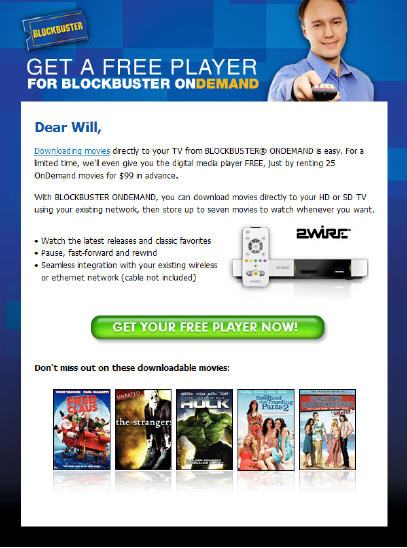
The new 2Wire box itself is in the same general family as other single-purpose boxes such as AppleTV, Vudu and Netflix's Roku. There are some differences among them in hard drive size, pricing, outputs and streaming vs. downloading orientation. But they all serve the same basic purpose: connecting you via your home broadband connection to one source of "walled garden" premium-quality video content.
VideoNuze readers know I've been quite skeptical of the standalone box model, especially when box prices start in the $200-300 range. There's no question there's an upscale, early adopter audience that will buy in, but mainstream consumers will be uninterested for all kinds of reasons including: financial considerations (especially in this economy), resistance to connecting another box in already crowded consoles, perceived technical complexity, strong existing substitutes (e.g. cheap ubiquitous DVD players) and indistinct value propositions.
My judgment is based on a pretty simple set of criteria I rely on to gauge a new product or service's likelihood of success: Does it offer meaningful new value (some combination of better price, quality or speed) with minimal adoption effort required? Can a large target audience for this new value be clearly defined, served and acquired in an economically-reasonable manner? Is this new value attainable without sacrificing meaningful benefits of existing alternatives?
Miss on any one of these and the odds of success lengthen. Miss on any two and you're in long-shot territory. Miss on all three and you're dead on arrival. After evaluating the Blockbuster Online/MediaPoint current offer, my sense is that it misses on at least two and possibly all three.
Value: As explained below, for certain movies renters, the offer is valuable. It provides convenience at a relatively low financial commitment for the new device. But explaining these benefits just to the relevant target audience at an economic cost per acquisition is going to be nearly impossible. I'm dubious that even in-store promotions - which on the surface seem Blockbuster's strength - will work. First, there may be franchisee issues, as there were with previous "Total Access" promotions. And second, Blockbuster has closed so many stores in prime target neighborhoods - due to the rise of Netflix and other options eroding their business - that they'll be missing many prospects (example: in my upscale home town of Newton, MA there is not a single Blockbuster store left).
Audience: There's only one real target audience I can see for this offer, and it seems very narrow to me: low-volume renters of movies only, who are not iTunes users. Think about it - if you rent a lot of movies, you've likely been subscribing to Netflix for years (more so if you also rent TV shows). If you want to own your content instead of rent it, then you buy DVDs or maybe more recently have been buying digital version, most likely with iTunes primarily. If that's the case, then when it comes to watching on TV, you're going to buy an Apple TV (even then, few have done so to date), not a 2Wire MediaPoint. The eligible target audience left for Blockbuster/MediaPoint seems pretty slim.
Sacrificing existing benefits: Inevitably all digital distribution options need to be compared to the incumbent DVD format, which is remarkably strong (no wonder a billion units have been shipped to date). Against the DVD standard, Blockbuster/MediaPoint is inferior in a number of ways: limited viewing windows (the usual online limitations of 24 hour expiration after starting, and 30 day automatic file deletion), no portability to view rented movies on other TVs not connected to a MediaPoint, no TV shows available for rent, and at this point, smallish storage that only keeps up to 5 movies at a time.
Add it all up, and it's a pretty daunting set of issues. To be sure, much of this isn't specific to Blockbuster. To succeed, all new digital delivery options must be mindful of the above criteria as well.
What do you think? Post a comment now.
Categories: Aggregators, Devices
Topics: 2Wire, AppleTV, Blockbuster, Netflix, VUDU
-
Video is the Killer App Driving Coming Bandwidth Explosion
A short interview in Multichannel News with Rouzbeh Yassini before the Thanksgiving break last week caught my eye.
Rouzbeh's name is likely unfamiliar to many of you. But for others who have been in and around the cable and broadband industries since the '90s, he is semi-famous. In those days Rouzbeh ran a company called LANCity, which was a pioneer in designing and manufacturing cable modems. These of course are the devices that now reside in tens of millions of homes around the world, enabling broadband Internet access and the high-quality video services like YouTube, Hulu, iTunes and others that run through them.
Though it's only been about 15 years, the early-to-mid '90s seem like another age entirely. Can you remember dial-up Internet access? Busying up your phone line if you wanted to be online? Listening to all those weird tones as your creaky 56K modem connected you to Prodigy, CompuServe, AOL, or eventually this thing everyone seemed to be talking about called the "World Wide Web?"
In my opinion, Rouzbeh deserves as much credit as anyone for the transformation of the dial-up Internet era
 to the broadband world we now enjoy. He played a crucial role in articulating broadband's business potential to scores of senior cable executives who barely knew what a computer was, much less this new-fangled thing called the Internet. Importantly, he was a key technical architect of modern cable networks, which today barely resemble the passive, one-way networks of old.
 In short, I've learned to take notice of Rouzbeh's prognostications. Though he can be irrepressibly optimistic, he's directionally right more often than not.
All of that brings me to his Multichannel interview. Rouzbeh now envisions the era of gigabit or 1,000 megabit Internet access within a decade. To put this in perspective, today's cable modems typically deliver around 10 megabit service or 1% of a gigabit. Spurred by competitive pressures, Comcast has recently announced the rollout of 50 megabit service to certain regions, with expansion to its entire footprint by 2010. These new rollouts are part of the cable industry's "DOCSIS 3.0" standards, covering a new generation of modems and channel management techniques.
There's an axiom in the broadband industry that usage always rises to the level of bandwidth provided. Yet when we're talking 1 gigabit service, one has to rightly ask, "what in the world are people going to do with all that bandwidth?" Rouzbeh posits things like corporate networking, remote offices, medical services and the like, but only touches briefly on video delivery.
From my perspective, video is the killer application that will drive this bandwidth explosion. As I wrote recently in "Video Quality Keeps Improving - What's it All Mean?" we are on the front end of a shift toward dramatically higher video quality, with near HD delivery already becoming common (Hulu, Netflix and Vudu are among the most recent to announce HD initiatives). This shift will only accelerate going forward. And to accommodate it will require lots more bandwidth from network providers.
In reality, the trickiest part of bandwidth expansion is less the technology development and deployment and more the business models that support the investments and make the most strategic sense. Questions abound: Is the right model to charge $150/mo for 50 megabit access as Comcast plans? Or to build a content service available only to those high-powered users? Or act like a CDN and provide services so as to charge content providers themselves to deliver higher-quality video? Maybe some hybrid of these, or some other model? And of course, what impact do these models have on the incumbent multichannel subscription video offering?
While there's murkiness now, like Rouzbeh, I'm a big believer that these things will ultimately be worked out and that bandwidth expansion is inevitable. Just as we now look back on the dial-up era and wonder how we got by, eventually we'll look at the mid-to-late 2000s and wonder how we survived on so little bandwidth.
What do you think? Post a comment now.
Categories: Aggregators, Broadband ISPs, Cable TV Operators, People
Topics: Comcast, DOCSIS, Hulu, Netflix, VUDU
-
November '08 VideoNuze Recap - 3 Key Themes
Welcome to December and to the home stretch of 2008. Following are 3 key themes from VideoNuze in November:
Cable programming's online distribution narrows - Last month I concluded that cable programmers (e.g. Discovery, MTV, Lifetime) are going to become much more sparing when it comes to distributing their full programs online. As noted in "The Cable Industry Closes Ranks," after hearing from industry executives at the CTAM Summit and on the Broadband Video Leadership Breakfast, it has become apparent that the industry is going to defend its traditional multichannel video subscription model from broadband and new "over-the-top" incursions.
Both programmers and operators have a lot vested in this successful model, and are surely wise to see it last as long as possible. Subscription and affiliate fees are particularly precious in this economy, as the WSJ wrote on Saturday. Still, many VideoNuze readers pointed out the music industry's folly in trying to maintain its business model, only to see it turned upside down. Many predicted the cable industry is doomed to follow suit. Truth-be-told though, as I wrote in "Comcast: A Company Transformed," major cable operators are already far more diversified than they used to be. Broadband, phone and digital TV (+ add-ons like DVR, HD and VOD) have created huge new revenue streams. Surging broadband video consumption only helps them, even as "cord-cutting" looms down the road.
Netflix moves to first ranks of cord-cutting catalysts - Three posts in November highlighted the significant role that Netflix is poised to play in moving premium programming to broadband distribution. Most recently, in "New Xbox Experience with Netflix Watch Instantly: A 'Wow' Moment," I shared early reactions from a VideoNuze reader (echoed by many others) to receiving a subset of Netflix's catalog through Xbox's recently upgraded interface. Netflix CEO Reed Hastings highlighted the increasing importance of game devices in bridging broadband to the TV in his keynote at NewTeeVee Live this month (recapped here).
Still, Netflix lacks the rights to deliver many movies online, a problem unlikely to be rectified any time soon given Hollywood's stringent windowing approach. As such, in "Netflix Should be Aggressively Pursuing Broadcast Networks for Watch Instantly Service," I offered my $.02 of advice to the company that it should build on its recent deal with CBS to blow out its online library of network programs. In this ad-challenged environment, I believe networks would welcome the opportunity. Hit TV programs would help drive device sales, which is crucial for building WI's adoption. While the Roku box is a modest $99, other alternatives are still pricey, though becoming cheaper (the Samsung BD-P2500 Blu-ray player is down $100, now available at $300, I spotted the LG BD300 over the weekend for $245). A robust Netflix online package would be poised to draw subscribers away from today's cable model.
Lousy economy still looms large - Wherever you go, there it is: the lousy economy. Though the market staged a nice little rebound over the last 5 days, things are still fragile. Across the industry broadband companies are doing layoffs. This is only the most obvious of the side effects of the economic downturn. Another, more subtle one could be downward price pressure. As I wrote in "Deflation's Risks to the Broadband Video Ecosystem," economists are now growing concerned that the credit crunch could lead to collapsing prices and profits across the economy. I noted that such an occurrence would be particularly damaging for the broadband industry, where business models are still nascent, so ROIs and spending are softer.
Here's to hoping for some good economic news in December...
What do you think? Post a comment now.
Categories: Aggregators, Broadcasters, Cable Networks, Cable TV Operators, Devices, Games
Topics: CBS, Comcast, LG, Microsoft, Netflix, Roku, Samsung, XBox
-
New Xbox Experience with Netflix Watch Instantly: A "Wow" Moment
Wow.
That was the reaction that VideoNuze reader and digital media public relations executive Jeff Rutherford had after downloading the "New Xbox Experience" (or NXE) to his Xbox 360 and activating Netflix Watch Instantly. Jeff relayed the details to me in an email and phone call yesterday, adding that it felt comparable to his (and many others') first experience with TiVo.
Hyperbole? Maybe. I'm always mindful about how gadgeteers' early wows seem to melt away when new technology products reach the broader mass market. Still, the Xbox 360/Netflix Watch Instantly integration seems promising on at least three fronts.
First, Xbox 360 is a relatively mainstream device that has its own clear value propositions, thereby driving a sizable footprint that is only going to grow. Second, Netflix's Watch Instantly is a value-add to its subscription service, requiring no incremental fees, or special new add-on hardware to Xbox 360. And third, as Jeff reported, it was very easy to get going: he was given a code to input online and when he returned to his Xbox, his Watch Instantly queue was displayed there, awaiting his on-demand selections.
These benefits - large distribution, no extra fees, no new hardware and easy install/strong user experience - are all key to a successful broadband-to-the-TV service. But equally, if not more important is content selection and value. This is where the Xbox 360/Netflix implementation hits a speed bump, at least for now.
As I explained recently in "Netflix Should be Aggressively Pursuing Broadcast Networks for Watch Instantly Service," today's windowing model puts the company is in a serious bind with respect to getting top-flight Hollywood films. While Jeff reported seeing some strong titles like Disney's Ratatouille (and other films he noticed carrying the Starz watermark), the reality is that Watch Instantly's catalog is still a small sliver of Netflix's DVD-by-mail catalog and will remain so for some time to come.
Further portending the difficulties of what's ahead for Netflix as it navigates Hollywood's minefields is early word, courtesy of Joystiq and other blogs, that all of Sony's Columbia Pictures movies have been disabled for XBox 360 Netflix users, due to licensing issues. While we may all be rooting for Netflix to find deal terms with Sony and the others, the realist side of me says that Hollywood's overseers understand that the Xbox 360 integration (and others TBD) have real significance in the relentless push to digital delivery. So before the proverbial horse gets out of the barn, they want to ensure the right deals are in place for them to capture appropriate value.
While that drama plays itself out, Netflix would be wise to do everything else it can to bolster Watch Instantly content value and selection. As I wrote in the prior post, incorporating broadcast programs should be a top priority. Also high on the list should be well-branded, high-quality broadband-only content.
Netflix has a very interesting opportunity to accelerate the Watch Instantly adoption curve, leveraging the huge installed base of Xbox 360 users and Microsoft's UI improvements (more on NXE's new look at Engadget if you're interested). With proof of its success in hand, Netflix's negotiations with recalcitrant studios can only be helped along. Meantime, Xbox 360 is getting another strong (albeit likely temporary) value proposition to compete in the game console space. And consumers win - as Jeff pointed out - by gaining ever-better access to the content they want.
What do you think? Post a comment now.
Categories: Aggregators, Devices, Games
Topics: Microsoft, Netflix, Xbox 360
-
Watching Reed Hastings at NewTeeVee Live
Yesterday I had my own positive broadband video experience, remotely watching portions of the
 NewTeeVee Live conference held in SF from the comfort of my office. Om Malik and crew put together a packed agenda and I had wanted to go, but a personal conflict kept me in Boston.
 I caught most of Netflix CEO Reed Hastings' keynote (until the UStream feed froze up, arghh...) and thought he offered some interesting tidbits about how he sees the broadband video market unfolding. VideoNuze readers know I've been avidly following Netflix's recent moves with Watch Instantly and I've come to think of the company as one of three key aggregators best-positioned to disrupt the cable model (the other two being YouTube and Apple).
Three noteworthy points that Hastings made:
Standards needed to interface broadband to the TV - Hastings catalogued the efforts Netflix is making to integrate with various devices like Roku, LG, TiVo, Xbox, etc, but concluded by saying that these one-off, ad hoc integrations are not scalable and are really slowing the market's evolution. Most of us would agree with this assessment. Still, he was quite pessimistic about a standards setting process's ability to move quickly enough - saying this could be a 10-30 year endeavor. Instead, if I understood him correctly, he thinks the TV approach should just be browser- based, and also that today's remotes should be scrapped in favor of pointer-driven (i.e. mouse-like) navigation.
Cable should evolve to focus on broadband delivery and de-emphasize multichannel packaging - Of course this is incredibly self-serving from Netflix's standpoint, but Hastings made the case that broadband margins for cable operators are nearly 100%, because they have no content costs, whereas on the cable side, they have high and ever-increasing programming costs. He cited Comcast's recent announcement of 50 Mbps service as evidence that cable operators should focus on winning the broadband war, and eventually letting go of the multichannel model. Nice try Reed, but I don't see that happening anytime soon. However, as I recently wrote in "Comcast: A Company Transformed," there's no question that broadband is becoming an ever greater part of its revenue and cash flow mix.(Reed emailed to clarify the above point. He didn't say cable should focus on broadband delivery over the current multichannel model; rather that cable - and satellite/telco - should focus more on web-like viewing experiences through improved navigation and VOD/DVR to be more on-demand, personalized and browser-friendly. And he added that with the shift to heavier broadband consumption, cable is a winner either way. Note - I thought I interpreted him correctly, but between UStream choking and my own scribble, it seems I was a bit off here. Thanks for correcting Reed.)Game consoles in leading position to bridge broadband to the TV - Hastings made a pretty strong case for the Wii - and to a lesser extent the PlayStation and Xbox - as the leading bridge devices. The Wii in particular could be a real broadband winner if it could support HD and Flash. As I've been thinking about broadband to the TV, I've concluded - barring anything from left field - that game devices, IP-enabled TVs and IP-enabled Blu-ray players are where the action will be concentrated for the next 3-4 years (this doesn't take account of forklift substitutes like a Sezmi or others sure to come).
NewTeeVee has a good wrap-up of Hastings' talk as well, here. The video replay isn't up yet, but when I see it, I'll post an update.
What do you think? Post a comment now!
Categories: Aggregators, Cable TV Operators, Devices
Topics: Apple, Comcast, LG, Netflix, PlayStation, Roku, TiVo, Wii, XBox, XBox, YouTube
-
Comcast: A Company Transformed
Three numbers in last week's third quarter Comcast earnings release underscored something I've believed for a while: Comcast is a company transformed, now reliant on business drivers that barely existed just ten short years ago. Comcast's transformation from a traditional, plain vanilla cable TV operator to a digital TV and broadband Internet access powerhouse is profound proof of how consumer behaviors' are changing and value is going to be created in the future.
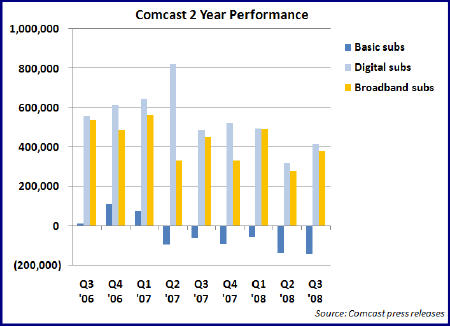
The three numbers that caught my attention were the net additions of 382,000 broadband Internet subscribers and 417,000 digital subscribers, with the simultaneous net loss of 147,000 basic subscribers. The latter number is the largest basic sub loss the company has sustained and, based on the company's own earnings releases, the sixth straight quarter of basic sub contraction. In the pre-digital, pre-broadband days, when a key measure of cable operators' health was ever-expanding basic subscribers, this trend would have caused a DEFCON 1 situation at the company. (see graph below for 2 year performance of these three services)
That it doesn't any longer owes to the company's ability to bolster video services revenue and cash flow through ever-higher penetration of digital services into its remaining sub base (at the end of Q3 it stood at 69% or 16.8 million subs). Years after Comcast and other cable operators introduced "digital tiers," stocked with ever-more specialized channels that consumers resisted adopting, the industry has hit upon a winning formula for driving digital boxes into Americans' homes: layering on advanced services like HD, VOD and DVR that are only accessible with digital set top boxes and then bundling them with voice and broadband Internet service into "triple play" packages. Comcast has in effect gone "up-market," targeting consumers willing and able to afford a $100-$200/month bundle in order to enjoy the modern digital lifestyle.
Still, in a sense the new advanced video services represent just the latest in a continuum of improved video services. Far more impressive to me is the broadband growth that both Comcast and other cable operators have experienced. Comcast's approximately 15 million YE '08 broadband subscribers will generate almost $8 billion in annual revenue for Comcast, up dramatically from its modest days as part of @Home 10 years ago. (It's also worth noting the company now also provides phone service to over 6 million homes today vs. zero 10 years ago)
The cable industry as a whole will end 2008 with approximately 37 million broadband subs, again up from single digit millions 10 years ago. And note that the 387,000 net new broadband subs Comcast added in Q3 '08 compares with just 277,000 net broadband subs that the two largest telcos, AT&T and Verizon added in quarter, combined. As someone who was involved in the initial trials of broadband service at Continental Cablevision less than 15 years ago, observing this growth is nothing short of astounding.
While broadband's financial contribution to Comcast is unmistakable, its real impact on the company is more
 keenly felt in its newfound importance in its customers' lives. Broadband Internet access has become a true utility for many, as essential in many homes as heat, water and electricity. A senior cable equipment executive told me recently that research done by cable companies themselves has shown that in broadband households, broadband service would be considered the last service to get cut back in these tough economic times. In these homes cable TV itself - long thought to be recession-resistant - would get cut ahead of broadband.
But Comcast and other cable operators must not rest on their laurels. Their next big challenge is to figure out how to take this massive base of broadband subs and start delivering profitable video services to it. If Comcast allows its broadband service to be turned into a dumb pipe, with "over the top," on demand video offerings from the likes of Hulu, YouTube, Neflix, Apple and others to ascend to dominance, that would be criminal. Not only would it devalue the broadband business, it would dampen interest in the company's advanced video services (VOD in particular) while making the company as a whole vulnerable in the coming era of alternative, high-quality wireless delivery.
Comcast is indeed a company transformed from what it was just 10 years ago. Technology, changing consumer behaviors and a little bit of "being in the right place at the right time" dumb luck have combined to allow Comcast to remake itself. Comcast itself must fully recognize these changes and aggressively build out Fancast and other initiatives to fully capitalize on its newfound opportunities.
What do you think? Post a comment now.
Categories: Aggregators, Broadband ISPs, Cable TV Operators, Telcos
Topics: Apple, AT&T, Comcast, Netflix, Verizon, Verizon, YouTube
-
Netflix Should be Aggressively Pursuing Broadcast Networks for Watch Instantly Service
Over the past several months Netflix has made a series of announcements related to its "Watch Instantly" feature. On the device side, there are new partnerships with TiVo (for Series 3, HD and HD XL models), Microsoft Silverlight (for Mac viewing), Samsung (for Blu-ray players), LG (for Blu-ray players), Xbox 360 and of course Roku. All allow Netflix Watch Instantly content to be delivered directly to users' TVs. Meanwhile on the content side, there have been deals with Starz, CBS and Disney Channel, with more no doubt yet to come.
Our household has been an enthusiastic subscriber to Netflix for years and I welcome the commitment that
Netflix appears to be making to Watch Instantly. However, as I pointed out in May, in "Online Movie Delivery Advances, Big Hurdles Still Loom," Watch Instantly is hobbled by its limited catalog, now totaling around 12,000 titles, just 10% of Netflix's total catalog, even after including the recently added Starz titles. The fundamental problem Netflix is bumping up against in building out Watch Instantly's film catalog is Hollywood's well-established windowing process. Studios have wisely and methodically maximized their films' lifetime financial value by doling out the rights to air them to a series of distribution outlets. These rights unfold in a carefully calibrated timeline and have become wrapped up in a thick layer of contractual agreements extending to all parties in the value chain. It is a system that has served all constituencies well, generating billions of dollars of value. It is also unlikely to change in any material way any time soon.
As such, Netflix, the "world's largest online movie rental service," as it calls itself, is increasingly discordant. On the one hand, growing the Watch Instantly service is crucial to Netflix's long term success in the digital/broadband era but on the other, it doesn't have the ability to offer a competitive catalog that meets consumers' online delivery expectations. So what to do?
My recommendation is for Netflix to incorporate the delivery of TV programming, via Watch Instantly, into its core value proposition. Specifically, Netflix should be making an all-out effort (if it is not already doing so) to secure next-day rights to deliver all prime-time broadcast network programs to its subscribers.
This strategy provides Netflix with many clear benefits and positions it well for long-term success. First, in these tight economic times, it dramatically expands the value of the Watch Instantly feature, turning it into both a bona fide subscriber retention tool to battle churn as well as a high-profile subscriber acquisition lever (not to mention an exciting pull-through offer big box retailers could use in their Sunday circulars to generate traffic).
Second, it is a clever competitive strike against four primary alternative ways whereby consumers can watch network programs on demand: cable-based VOD, a la carte paid downloads at iTunes/Amazon/others, free online aggregators like Hulu/Fancast/others and DVRs (though note the TiVo deal addresses this last option).
A comprehensive Netflix prime-time catalog compares well with each alternative. Against cable VOD it offers familiar, superior navigation plus a viable revenue stream for broadcasters while cable tries to get Canoe ready; against paid downloads, the obvious advantage of being a value-add service; against online aggregators, commercial free delivery; and against DVRs, the lack of consumer hardware purchases and persistent recording space limitations.
All of this should make Netflix a very appealing partner for the broadcast networks. They are getting hammered by ad-skipping, audience fragmentation, quality programming migrating to cable and an inferior single revenue source business model. The prospect of Netflix offering payments for their programs should be well-received. There may be concerns about programs' long term syndication value and also the potential enablement of a new gatekeeper. In better times these might be deal-killers; in this climate they shouldn't be.
Finally, there's the big potential long-term Netflix prize: if it can stitch together a large-scale network of compatible devices for Watch Instantly distribution, it could create a viable "over-the-top" alternative to today's multichannel subscription services (cable/telco/satellite). As I described in my recent "Cord Cutters" post, to really succeed, Netflix would have to eventually incorporate cable network programming. But if its reach is wide and its economics sound, that's within the realm of possibility as well.
But those are long-term issues. For now, while the recent CBS deal is a great start, Netflix should be working double-time to build out a full library of broadcast programs. It would dramatically improve Watch Instantly's appeal and value, while positioning Netflix well for the broadband era.
What do you think? Post a comment now.
Categories: Aggregators, Broadcasters, Devices, Partnerships
Topics: CBS, Disney, LG, Microsoft, Netflix, Roku, Samsung, Silverlight, Starz, TiVo
-
Inside the Netflix-Starz Play Licensing Deal
This past Wednesday, Starz, the Liberty Media-owned premium cable network, licensed its "Starz Play" broadband service to Netflix. The three year deal makes all of Starz's 2,500 movies, TV shows and concerts available to Netflix subscribers using its Watch Instantly streaming video feature. Very coincidentally I happened to be at Starz yesterday for an unrelated Liberty meeting, and had a chance to speak to Starz CEO Bob Clasen, who I've known for a while, to learn more.
On the surface the deal is an eye-opener as it gives a non-cable/telco/satellite operator access to Starz's
 trove of prime content. As I've written in the past, cable channels, which rely on their traditional distributors for monthly service fees, have been super-sensitive to not antagonizing their best customers when trying to take advantage of new distribution platforms. This deal, which uses broadband-only distribution to reach into the home, no doubt triggers "over-the-top" or "cable bypass" alarm bells with incumbent distributors.
 Then there is the value-add/no extra cost nature of Netflix's Watch Instantly feature. That there is no extra charge to subscribers for Starz's premium content (as there typically is when subscribing to Starz through cable for example) raises the question of whether Starz might have given better pricing to Netflix to get this deal done than it has to its other distributors.
But Bob is quick to point out that in reality, the Netflix deal is a continuation of Starz's ongoing push into broadband delivery begun several years ago with its original RealNetworks deal and continued recently with Vongo. To Starz, Netflix is another "affiliate" or distributor, which, given its tiny current online footprint does not pose meaningful competition to incumbent distributors. With only about 17 million out of a total 100 million+ U.S. homes subscribing to Starz, broadband partnerships are seen as a sizable growth opportunity by the company.
Further, Starz has been aggressively pitching online deals to cable operators and telcos for a while now, though only the latter has bit so far (Verizon's FiOS is an announced customer). Cable operators seem interested in the online rights, but have been reluctant to pay extra for them as Starz requires.
Bob also noted that Starz's wholesale pricing was protected in its Netflix deal, and that for obvious reasons of not hurting its own profitability, Starz has strong incentives to preserve incumbent deal terms in all of its new platform deals.
To me, all of this adds up to at least a few things. First is that Netflix must be paying up in a big way to
license Starz Play. I assume this is an obvious recognition by Netflix that it needed more content to make Watch Instantly more compelling (see also Netflix's recent Disney Channel and CBS deals). Since it's not charging subscribers extra, Netflix is making a bet that over time - and aided by its Roku and other broadband-to-the-TV devices - Watch Instantly will succeed and as a result, will drive down its costs by reducing the number of DVDs the company needs to buy and ship. That seems like a smart long-term bet as the broadband era unfolds.And while I agree that Starz Play on Netflix doesn't represent real competition to cable, telco and satellite outlets today, it's hard not to see it as a signal that traditional distributors are losing their hegemony in premium video distribution. (for another example of this, see Comedy Central's licensing of Daily Show and Colbert to Hulu). As I've said for a while, over the long term, the inevitability of broadband all the way to the TV portends significant disruption to current distribution models. I see Netflix at the forefront of this disruptive process.
What do you think? Post a comment now.
Categories: Aggregators, Cable Networks, Cable TV Operators, Devices, Telcos
Topics: CBS, Comedy Central, Disney, Liberty Media, Netflix, Starz, Verizon
-
Comcast's Fancast Becomes Hub for Premieres; But Where's Project Infinity?
Here's a clever move from Comcast's Fancast broadband portal to create new value for users and generate excitement in the broadband market: this week it is running "Premiere Week," an aggregation of 168 premiere TV episodes. The episodes span series premieres ("Desperate Housewives," "Dexter," "The Office"), season premieres ("Fringe," "Sons of Anarchy," "Crash") and classic pilots ("Dynasty," "The A-Team," "Miami Vice"). It's great fun and a visitor could get lost on the site for hours, as I nearly did.
These are the kinds of promotions that Comcast should be all over. Given its extensive reach and programming muscle, the company has definite - though not insurmountable - advantages over other aggregators to pull this kind of promotion together.
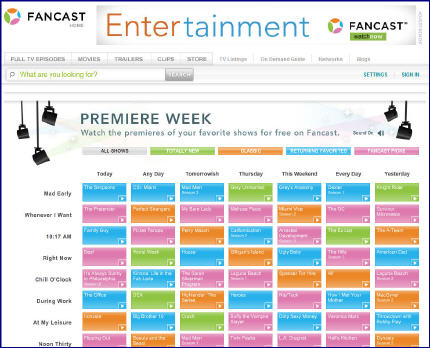
The competition for aggregating premium programming continues to intensify. Business models are all over the board as are approaches for getting video all the way to the TV. For example, last week Amazon launched its pay-per-use VOD initiative which includes a page of info for how to watch using TiVo, Sony Bravia Internet Video Link, Xbox 360, etc. Then yesterday, Netflix announced that it will incorporate about 2,500 of Starz's movies, TV shows and concerts in its Watch Instantly feature, along with a feed of its linear channel. Still other moves are forthcoming.
Comcast's real lever though is unifying its currently siloed worlds of digital TV, broadband Internet access and Fancast. When converged they're a blockbuster; companies like Netflix, Amazon and others cannot replicate this combination. In particular, Comcast, and other cable operators are ideally positioned to bridge broadband all the way to the TV. That's the last big hurdle to unlock broadband's ultimate value. Whether they'll do so is an open question.
Earlier this year Comcast CEO Brian Roberts unveiled the company's "Project Infinity" which suggested Comcast was looking to unify its various video offerings and bring broadband to its subscribers' TV. It seemed like a promising move, though there was no timeline disclosed. Now, nearly 9 months later I can't find any updates on the status of Project Infinity. It would be great for the company to publicly release a progress report or sense of upcoming milestones.
Promotions like "Premiere Week" are a positive step from Comcast, but real competitive advantage for the company lies in launching services which are truly impossible for others to match.
What do you think? Post a comment.
Categories: Aggregators, Cable TV Operators, Portals
Topics: Amazon, Comcast, Fancast, Netflix, Starz, TiVo
-
May '08 VideoNuze Recap - 3 Key Topics
Looking back over two dozen posts in May and countless industry news items, I have synthesized 3 key topics below. I'll have more on all of these in the coming months.
1. Broadband-delivered movies inch forward - breakthroughs still far out
In May there was incremental progress in the holy grail-like pursuit of broadband-delivered movies. Apple established day-and-date deals with the major studios for iTunes. Netlix and Roku announced a new lightweight box for delivering Netlix's "Watch Now" catalog of 10,000 titles to TVs. Bell Canada launched its Bell Video Store, complete with day-and-date Paramount releases, with others to come soon. And Starz announced a deal with Verizon to market "Starz Play" a newly branded version of its Vongo broadband subscription and video-on-demand service.
Taken together, these deals suggest that studios are warming to the broadband opportunity. This is certainly influenced by slowing DVD sales. Yet as I explained in "iTunes Film Deals Not a Game Changer" and "Online Move Delivery Advances, Big Hurdles Still Loom" broadband movies are still bedeviled by a lack of mass PC-TV connectivity, no real portability, well-defined consumer behavior around DVDs and the studios' well-entrenched, window-driven business model. Despite May's progress, major breakthroughs in the broadband movie business are still way out on the horizon.
2. Broadcast TV networks are embracing broadband delivery - but leading to what?
Unlike the film studios, the broadcast TV networks are plowing headlong into broadband delivery, yet it's not at all clear where this leads. In "Does Broadband Video Help or Hurt Broadcast TV Networks" and "Fox's 'Remote-Free TV': Broadband's First Adverse Impact on Networks?" I laid out an initial analysis about broadband's pluses and minuses for networks. I'll have more on this in the coming weeks, including more in-depth financial analysis.
On the plus side, in "2009 Super Bowl Ads to Hit $3 Million, Broadband's Role Must Grow," "Sunday Morning Talk Shows Need Broadband Refresh" and "Today Show Interview with McClellan Showcases Broadband's Power," I illustrated some opportunities broadband is creating. On the other hand, "Bebo Pursues Distinctive Original Programming Model" and "More Questions than Answers at Digital Hollywood" explained how exciting new programming approaches are taking hold, challenging traditional TV production models. Broadcasters are in the eye of the broadband storm.
3. Advertising's evolution fueled by innovation and resources
Last, but hardly least, I continued on one of my favorite topics: the impact broadband video is having on the advertising industry. Over the last 10 years the Internet, with its targetability, interactivity and measurability has caused major shifts in marketers' thinking. With broadband further extending these capabilities to video, the traditional TV ad business is now ripe for budget-shifting. We'll be exploring a lot of this at a panel I'm moderating at Advertising 2.0 this Thursday.
In "Tremor, Adap.tv Introduce New Ad Platforms" and "All Eyes on Cable Industry's 'Project Canoe'" (from Mugs Buckley), key players' innovations were described along with how the cable industry plans to compete. Content providers are being presented with more and more options for monetizing their video, a trend which will only accelerate. Yet as I wrote in "Key Themes from My 2 Panel Discussions Last Week," many issues remain, and with so many content start-ups reliant on ads, there may be some disappointment looming when people realize the ad market is not as mature as they had hoped.
That's it for May. Lots more coming in June. Please stay tuned.
Categories: Advertising, Aggregators, Broadcasters, Cable TV Operators, Devices, Downloads, FIlms, Studios, Video Sharing
Topics: Adap.TV, Apple, Bell Canada, Canoe, iTunes, Netflix, Paramount, Roku, Starz, Tremor, Verizon, Vongo
Posts for 'Netflix'

Connect with VideoNuze
Exclusive News Roundup
- Jimmy Kimmel is moving a Senate candidate interview to YouTube to sidestep FCC pressure Quartz
- Universal Music is launching an AI music platform with ElevenLabs The Verge
- Katzenberg and Ex-Sora Head Bill Peebles Launch AI Video Startup for Filmmakers AI Weekly
- Suno Launches New AI Model Trained on Licensed WMG, BMG Tracks The Hollywood Reporter
- Justice Department to take a closer look at Fox’s $22 billion Roku deal Semafor
- Congress Begins Drafting 20% Federal Film Incentive With Trump’s Blessing Variety