-
Disney/ABC's Stage 9 Launches, With YouTube
Disney/ABC Television Group's official announcement this morning of Stage 9 Digital Media, an experimental new media content studio, is another key milestone in the fast-moving broadband video industry.
I got a short briefing about Stage 9 late yesterday from Disney/ABC because it asked me to provide some analyst context to the LA Times' Dawn Chmielewski, who's done a great piece here. Stage 9 is Disney/ABC's key initiative to reach the coveted 18-34 audience in synch with this audience's unique media consumption patterns. Programming will be short, funny, well-produced, episodic, and widely distributed through popular broadband sites, social networks, mobile and download services.
I interpret Disney/ABC's move, when coupled with recent initiatives by other big media companies into original broadband video production, as further evidence of two key trends: that broadband video has come of age as a key priority for the largest media companies and that it is impossible to appeal to today's younger audiences simply by hewing to the traditional rules of the media game.
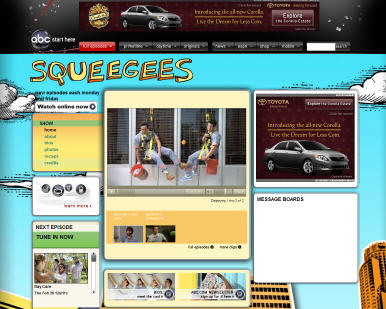
Also of significance is that Disney/ABC announced that "Squeegees," which is Stage 9's first release, will be co-exclusively premiered on ABC.com and YouTube starting today and sponsored by Toyota. Yes, you read that right. YouTube! The scruffy user-generated phenom that big media was threatening to sue out existence not so long ago, and which of course is now owned by Google, big media's most anxiety-inducing "frenemy," has been elevated to launch partner status for Stage 9's first program.
The "Squeegees" co-premiere is quite an accomplishment for YouTube. It shows that YouTube's methodical efforts to gain legitimacy (and a business model!) by establishing partner channels with media companies are beginning to pay off. David Eun, Google's VP of Content Partnerships has repeatedly explained this game plan to me, and others over the last year. The Stage 9 launch partnership should certainly be regarded as a major win for the young company. It is also another data point I'd use to support my contention that in the broadband age, traditional conceptions about copyright monetization need to be radically re-thought (Viacom, are you listening?).
I'm enthusiastic about the Stage 9 initiative, as I believe it holds lots of potential for Disney/ABC. It gives the company inroads to the elusive 18-34 set, offers the prospect of innumerable and invaluable insights about how to effectively program in the broadband age, provides a whole new internal breeding ground for developing new on-air programming (a possible double win, as this might help fix the broken and expensive traditional pilot process, though my enthusiasm on this point is tempered by news today of Quarterlife's NBC ratings fiasco) and creates new and exciting multi-platform sponsorship opportunities.
In short, the strategy is sound and the upside significant. Now for the hard part: Stage 9 needs to execute and actually deliver on all this potential.
What do you think? Post a comment now!
Categories: Broadcasters, Indie Video, UGC
Topics: ABC, Disney, Stage 9, Toyota, Viacom, YouTube
-
And the Oscar Goes To.....Dove
Obviously there is no Oscar category for "Most Effective Advertisement at Oscar.com," but if there were, the hands-down winner last night would have been Unilever's "Dove Supreme Cream Oil Body Wash Ad Contest" display ads.

As many of you know, I'm a big believer that brand advertisers need to evolve their mindsets, which have traditionally called for making the cutest or the funniest or the quirkiest ad and then spending big money on placing it on popular programs, in the hopes of driving audience awareness and recall.
Instead, advertisers need to be focusing on user engagement, reinforcing brand authenticity, leveraging multiple platforms and extending the campaign's life. Dove did all of these and more with its "Cream Oil" campaign, and the resulting lessons for other brand marketers and their agencies are abundant.
Dove kicked the "Cream Oil" campaign off late last year, with a user-generated video contest asking women "how does showering yourself in everyday luxury with Dove Supreme Cream Oil Body Wash make you feel?" There were 3,500 entries received for the 30 second spot between Dec. 5th and Jan. 9th, which were winnowed to 5 semi-finalists on Jan 30th who were invited to LA for a private Oscars party. The 2 finalists were presented for viewing on Oscar.com. Dove's display ads on the site prompted visitors to click and vote for the best spot, which would become Dove's new ad. This voting process created an even larger user engagement opportunity than the original UGC contest. Capping it all off was actress Amy Brenneman, announcing the winning ad during a spot Dove bought during the Oscar telecast.
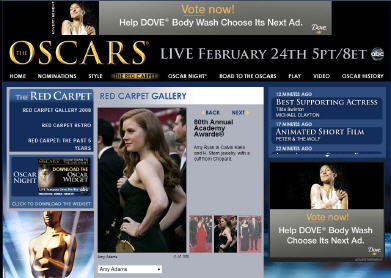
In my post last week, "An Intersection of UGC and Brand Marketing?" I proposed that brand marketers should create opportunities for passionate customers interested in expressing themselves to submit user-generated video supporting or explaining products. Dove's marketing people were clearly in synch with this thinking. The campaign shows their belief that the authenticity of the Cream Oil product could best be conveyed by real women using video to creatively express themselves. That sense of authenticity in turn resonates really well with other prospective customers. The YouTube age has conditioned many of us to appreciate each other's video more than the professionally produced, because its rough edges make it feel far more real.
Lastly, by having Ms. Brenneman announcing the winner in the on-air spot, Dove recognized that if it is going to spend $1.7 million + for a 30 second ad (last year's price), it better do more than just offer another cute, funny, or quirky spot. Instead it created anticipation, and capped off 3 months of contest excitement. I've argued in the past that these expensive on-air spots should reinforce or continue campaigns begun before and/or extended after in the broadband medium. Doing so increases their ROI, and will only raise the value of this on-air time in the future.
In the past I've been critical of brand marketers and their agencies for being abysmally slow in recognizing new opportunities broadband video presents. Yet there have been exceptions, and Dove's "Cream Oil" campaign is certainly one. Hopefully we'll see more like it in the future.
What do you think? Post a comment and let us all know!
Categories: Brand Marketing, UGC
-
How-to Category Gets Crowded
The Internet's low entry barriers are again at work, this time in the video-based "how-to" category, which has recently attracted a rush of well-funded new competitors. It's no surprise: how many of us would rather watch a video of someone explaining how to do something vs. reading a lengthy and often poorly-written guide?
Like many things in the broadband video world, the players' strategies, content approaches and business models are all over the board. In the ad-supported category, the earliest entrants (and their funding) are ExpertVillage (now owned by Demand Media) and VideoJug ($30M from last May), with HowCast ($8M from Tudor/others), 5Min.com ($5M from Spark Capital) and WonderHowTo.com (undisclosed amount from General Catalyst) launching more recently. Of course there's also YouTube and DIYNetwork from Scripps, with its sister cable channel, and scores of other sites that offer free instructional video. Then in the paid download category there is Zipidee (angel round), which recently acquired TotalVid and iAmplify ($6M from Kodiak). plus countless other video download sites.
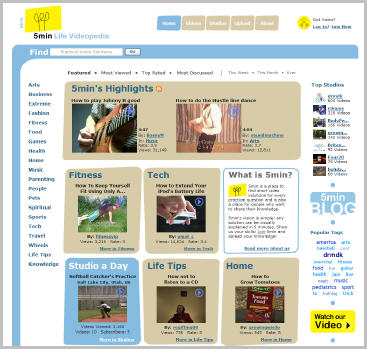
One of the lines of demarcation for the ad-supported sites is how they acquire content. Does the video come solely from "experts" or also from the community? For now, it appears that ExpertVillage and VideoJug rely on experts while the other ad-supported upstarts rely on the community as well. I spoke with Ran Harnevo, CEO of 5Min.com, who believes its highly community-oriented focus is a real differentiator. In fact, 5Min bills itself as a "Life Videopedia", a spin on the hugely popular Wikipedia, which demonstrates the power of user contributions.
The whole notion that a top-down editorially-driven approach will ever be sufficiently comprehensive seems unlikely, so my guess is that some UGC augment eventually will be required by all players. That means these sites will compete with each other for the best contributors, in the same way that video sharing sites like Metacafe, Veoh, Revver and others compete with each other in general video.
To succeed in this horse race, 5Min's focus is to offer the best overall platform, including a focus on technology. So 5Min provides strong branding opportunities, a revenue share, tools and features and of course, traffic. On the technology side, one differentiator is its "SmartPlayer", which allows zooming, super slow-motion, frame-by-frame and storyboard playback.
One of the main reasons there's so much activity on the ad-supported side is that how-to videos provide highly-targeted and engaged audiences that sponsors crave. At a minimum, marrying these how-to videos to Google AdSense provides a baseline revenue model. But the real opportunity is to aggregate enough traffic in a category to land sponsors who will be prominently featured. So for example, while 5Min already does an impressive 5M views/mo, it will likely need to be in that range per category to appeal to big-name sponsors. The company will begin running ads in Q2, and is focused on display ads and overlays, not pre-rolls, which Ran thinks are too disruptive. To build its traffic it will pursue widgetization, 3rd party distribution and SEO.
All of this how-to activity is clearly going to be a boon for users. Just as the Internet has provided an explosion of information, these video how-to sites will now make doing things a whole lot easier. How to break out of the growing pack will continue to be each how-to site's challenge for the foreseeable future.
Categories: Indie Video, Startups
Topics: 5Min.com, DIY, ExpertVillage, HowCast, Scripps, VideoJug, WonderHowTo.com, YouTube, Zipidee
-
Last Super Bowl Post - I Promise
I promise, this will be my last post on the Super Bowl ads. I suspect some of you are getting sick of hearing about them, but the reality is that there are some cool follow up tidbits emerging that I think many of you will be interested in.

First a clarification. I accidently omitted mentioning Audi as another Super Bowl advertiser that had a broadband component to their ad. Their mention of "TruthInEngineering" at the end of their spot was so quick that I didn't even notice it. That's a shame, because when you visit the mini-site there's a lot of great video, including one lasting 3 minutes all about the making of the ad.
Ken Liebeskind has a good interview with Paul Venables, who is the founder and co-creative director of the ad agency that created the spot and the videos at the mini-site. I really like how well developed the whole "Truth In" concept has been executed in the mini-site. My only gripe with the execution of the TV spot is that just flashing "Truthinengineering.com" at the end for a quick second is insufficient to really optimize traffic flow. Though Venables says traffic is way up since the game, I think it would be far higher had they focused on the URL longer.
Meanwhile, some interesting follow up stats that have bubbled up. comScore is reporting that 13% of Super Bowl viewers watched an ad online and that 13% visited an advertiser's web site. Of those who visited an advertiser's web site, 38% visited GoDaddy.com, 22% Coca-Cola and 21% Pepsi.
YouTube's AdBlitz Gallery provides the number of views for all the ads. The top 5 list is currently: SoBe LifeWater/Thrillicious (740,094),
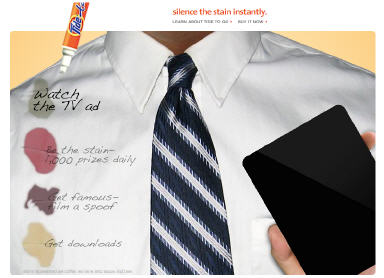
Derek Jeter/G2 (677,686), Bridgestone/Scream (564,986), ETrade/Talking Baby (530,397) and CareerBuilder/Queen of Hearts (442,273).Lastly, the Cincinnati Enquirer is reporting that MyTalkingStain.com, the mini-site TideToGo promoted, had received 30,000 visits by the end of Sun night and already had 5,500 customized ads created. The UGC contest at the site invites users to create their own spoof of the Super Bowl ad. In my opinion, Tide To Go gets top honors for making all the right moves: A clever game spot. Great promotion to the mini-site. Great engagement opportunities and payoffs for consumers. I think it's a model for future Super Bowl advertisers to follow.
Ok, that's it. Now I'll shut up about Super Bowl ads, until 2009.
Categories: Brand Marketing, Sports
Topics: Bridgestone, CareerBuilder, Coca-Cola, ETrade, G2, GoDaddy, Pepsi, SoBe LifeWater, YouTube
-
CES 2008 Broadband Video-Related News Wrap-up
CES 2008 broadband video-related news wrap-up:
Panasonic and Comcast Announce Products With tru2way™ Technology
Panasonic And Comcast Debut AnyPlay™ Portable DVR
NETGEAR® Joins BitTorrent™ Device PartnersD-Link Joins BitTorrent™ Device Partners
Vudu Expand High Definition Content Available Through On-Demand Service
Sling Media Unveils Top-of-Line Slingbox PRO-HD
Open Internet Television: A Letter to the Consumer Electronics Industry
Paid downloads a thing of the past
Samsung, Vongo Partner To Offer Movie Downloads For P2 Portable Player
Comcast Interactive Media Launches Fancast.com
New Year Brings Hot New Shows and Longtime Favorites to FLO TV
P2Ps and ISPs team to tame file-sharing traffic
ClipBlast Releases OpenSocial API
Categories: Advertising, Aggregators, Broadband ISPs, Broadcasters, Cable Networks, Cable TV Operators, Devices, Downloads, FIlms, Games, HD, Mobile Video, P2P, Partnerships, Sports, Technology, UGC, Video Search, Video Sharing
Topics: ABC, BitTorrent, BT, Comcast, D-Link, Disney, Google, HP, Microsoft, NBC, Netgear, Panasonic, Samsung, Sony, TiVo, XBox, YouTube
-
Highlighting 3 Partnerships Announced at CES
Among the many partnership announcements at CES this week, there are a number worth highlighting. Today I focus on the following three:
Viacom syndication - Viacom announced syndication deals for MTV Networks' stable of content with five leading broadband video sites: Dailymotion, GoFish, Imeem, MeeVee and Veoh. As those of you who have been following my previous posts know, I believe syndication is a critical engine in driving the advertising business model, which itself is the key to broadband video succeeding. As a result, I follow these syndication deals closely.

I've previously been critical of MTVN which appeared reluctant about syndicating its content when it launched its DailyShow.com destination site. However, with its recent deal with AOL, and now these five deals, it appears that MTVN does in fact believe syndication is the way to go. As one of the biggest cable network groups, MTVN is a key barometer for other networks' moves, so I view this as a real positive for the market.
Panasonic/Google - In this deal, Google and Matsushita announced that YouTube videos and Picasa photos would be directly accessible on new model Panasonic HDTVs launching in Q2 '08. Ordinarily I wouldn't be
 too excited about a deal like this, a permutation of which we've seen with other TV makers such as Sony.
 Yet this one rises in potential importance because YouTube is not just the most popular video site - with 40% of all video traffic - but because Google is determined to turn YouTube into a platform for legitimate content distribution. This was underscored by the Sony mini-sode deal also announced this week, and the
 many partnerships YouTube has already struck with premium content providers. If successful (and there are many if's to be sure), YouTube would be far more than a scraggly collection of UGC. So, marry a broad-based premium video aggregator to HDTVs and you could see a new device/content model emerge.
BitTorrent device deals Netgear and D-Link - In a less publicized move, BitTorrent announced expanded deals with Netgear and D-Link covering a range of home networking products, with an emphasis on HD distribution. BitTorrent, which has been steadily legitimizing itself from its P2P file-sharing roots, has launched an aggressive SDK program called BitTorrent Device Partners, intended to permeate the market with its client software. BitTorrent also integrates easy access to its digital download store with these partners as well.

While I'm not very bullish about the market potential of bridge devices from companies like Netgear and D-Link, I do believe that P2P distribution has a real role to play in content distribution, especially for heavy HD files. I continue to see P2P as more of a "peer assist" play. To the extent that BitTorrent can continue getting its software into multiple devices, it gains validation and strengthens its potential to be a meaningful partner in the larger content distribution ecosystem.
Share your thoughts on these deals, and suggest others you think are noteworthy from CES!
Categories: Cable Networks, Devices, HD, Indie Video, P2P, Partnerships, UGC
Topics: BitTorrent, D-Link, DailyMotion, GoFish, Google, Imeem, MeeVee, MTVN, Netgear, Panasonic, Veoh, YouTube
-
Holiday Week 2007 News Wrap-up
Happy New Year and welcome to 2008!
With many of you taking last week off, a quick review of what you might have missed is in order:
1. iTunes-Fox download-to-rent movie deal rumors
The FT (reg. required) reported that Apple and Fox are close to announcing a deal under which Fox movies would be available for download-to-rent on iTunes. This would be a deviation from Apple's policy of download-to-own only. Call me a skeptic, but while some analysts think this deal is a big breakthrough, for me it's more of a ho-hum, for at least the following reasons.
Download-to-rent offerings have been around for a while (e.g. Movielink, CinemaNow, Amazon Unbox, etc.) and none have been grand slams. Admittedly none have enabled playback on an iPod. Yet, while many think iPod ubiquity is a killer advantage for iTunes rentals I disagree. It's one thing to watch a 30 or maybe a 60 minute TV show, but watching a 2 hour movie on an iPod? That's only appealing for a tiny minority of iPod owners. Further, while the rumored $2.99 or so price point is attractive, download-to-rent movies will come with the same cumbersome business rules (e.g. 24 hour viewing, window limitations, finite device sharing, etc.) that cause significant customer inconvenience. And DVDs, available for rental or purchase still offer superior portability and flexibility to any download model. Movie downloads' time will come, just not yet.
2. Wal-Mart Folds its Video Download Store
And speaking of download challenges, Wal-Mart decided to unceremoniously close its video download store less than a year since its launch. While it pointed its finger at its vendor HP, which decided to discontinue support for the technology underlying the Wal-Mart store, there are certainly other white label platform alternatives available if Wal-Mart had conviction about the download store's potential. It clearly didn't and so it folded its tent. More evidence of the challenges facing paid downloads.
3. YouTube's Top 2007 Videos Announced
Meanwhile over in YouTube land, the hits keep coming. YouTube released its top 10 list and the year's most popular video, with almost 23 million views, was "Battle at Kruger", which shows the fight to save a baby water buffalo from a group of lions and a crocodile. It's fascinating if you haven't seen it. Other top videos on the list were "Chocolate Rain", "Obama Girl" and "Leave Britney Alone", among others. If nothing else, this diverse group of videos shows that UGC is alive and well.
4. Queen Elizabeth and Roger Clemens Seek Out YouTube
And UGC wasn't for pure amateurs either. YouTube's reach was once again recognized as 2 celebrities, Queen Elizabeth and Roger Clemens posted videos serving their individual purposes. In a first for the 81 year-old queen, she posted her popular Christmas message on YouTube, augmenting its traditional broadcast. The Royal Channel - "The Official Channel of the British Monarchy" - also launched on YouTube.
Clemens, who's been fingered in baseball's steroid controversy, saw fit to post his proclamation of innocence on YouTube. Clemens is adamant in his own defense, and clearly believes that reaching out to fans with video instead of the usual press release is more compelling.
Trivia question: whose video do you think drew more views?
Answer: It's not even close: 741,000 for the queen vs. 274,000 for Clemens.
5. MTV Delivers 1.2 Billion Streams in '07
MTV self-reported that MTV.com, VH1.com and CMT.com delivered more than 1.2 billion video streams in '07, an increase of 30% vs. '06. It also reported the top 30 music videos it streamed, and number 1 was Gimme More by Britney Spears. Broadband is offering MTV an opportunity to return to its brand roots as the go-to destination for music videos even as more and more of the on-air experience is dominated by non-music video fare. As I wrote a couple months ago, music videos are becoming a sought-after new revenue stream for labels and aggregators. We'll see more emphasis on music videos in '08.
Categories: Aggregators, Cable Networks, Downloads, FIlms, Music, UGC
Topics: Apple, FOX, HP, iTunes, MTV, Wal-Mart, YouTube
-
MTV Networks Dips Toe Into Syndication Waters
I was very happy to see news today of MTVN striking a big video syndication deal for its multiple networks' content with AOL Video.

Recently I praised Comedy Central's launch of TheDailyShow.com, but I took it to task for what appeared to be a destination-centric strategy, which was further supported by some executives' remarks. In this age of syndication, I thought that was a wrong-headed approach. Coupled with Viacom's misguided lawsuit against Google/YouTube, it felt like further evidence that MTVN was falling out of step with key broadband opportunities.
Today's news shows renewed hope that this may not be the case. I know these deals don't get done in a day, but I'd really like to see more syndication momentum from MTVN (and other content providers for that matter) to spread its content far and wide. Broadband Internet users don't expect to have to go to destination sites to get their favorite videos, they want them accessible where they already frequently visit. Hulu and CBS, to name two content providers that are solidly focused on syndication understand this, as do many others.
Categories: Cable Networks, Partnerships, Portals
Topics: AOL, CBS, Google, Hulu, MTVN, TheDailyShow.com, Viacom, YouTube
-
blinkx Focuses on Network and Ads
blinkx, which has been around as long as just about anyone in the video search space, is steadily building out its distribution network and advertising capabilities. I caught up with Suranga Chandratillake, CEO of blinkx, who's led the company since its spinoff from Autonomy, and successfully took the company public on London's AIM earlier this year.
Suranga said blinkx is now supporting 5 million searches/day and generating 50 million unique visitors/mo across its network. Network partners featuring a blinkx search box now include Ask.com, Real, Lycos, Infospace and scores of smaller sites that use blinkx's API. Suranga says blinkx can't distinguish between traffic coming from network partners vs. at blinkx.com itself. And the revenue splits in the business deals seem to vary widely, though typically they average out to 50-50. All deals are based on advertising, with the partner usually selling the inventory.
On the ad side, blinkx took a big step forward earlier this year, launching its "AdHoc" contextual ad program. Given the analysis blinkx is doing on video to drive search, it's a natural that the company now leverages this knowledge to improve targeting for ads. In fact, Suranga sees AdHoc as a sort of AdSense for video, dynamcially matching ads with relevant content.
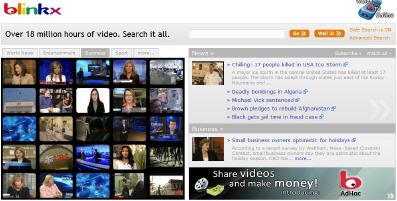
With improved targeting of course comes improved CPMs. Suranga says they've seen CPMs as high as $66 through AdHoc. blinkx is relying on the scale of its 220+ content relationships and millions of impressions to make AdHoc work. Formats can vary but the one that has been most successful so far in a mid-roll banner with an invitation for user to click and engage. As I've written before, AdHoc plays in the same space as other contextual video ad companies such as ScanScout, Adap.tv, DigitalSmiths, AdBrite, YuMe and of course YouTube, plus others.
Both the contextual ad and video search spaces are growing increasingly crowded. Players recognize these are 3 interrelated Achilles heels of the current broadband video model: users finding desired content, content providers getting paid for their work and advertisers getting sufficient and well-targeted industry. blinkx seems well-positioned to address all three.
Categories: Advertising, Video Search
Topics: Adap.TV, AdBrite, Blinkx, Digitalsmiths, ScanScout, YouTube, YuMe
-
Survey Says Broadband To Lag TV in 2012. Forget About It.
This piece in today's Hollywood Reporter about a newly-released survey ("Broadband Won't Overtake TV, Execs Say") caught my eye because it continues a highly speculative, and largely irrelevant debate pervasive throughout the industry about future video consumption patterns.
Why's the debate highly speculative? Because truly, none of us has any idea how people will consume video in 2012. There are just too many variables and too many unknowns to make an accurate prediction. Here's a point of comparison: let's say 5 years ago, in 2002, you were asked what percentage of Americans would consume broadband video in a given month? How many (or few!) of us would have predicted a whopping 75%? (the correct answer according to comScore in July '07). Better yet, how many of us would have guessed that over 25% of this consumption would be at just one site (YouTube) - a site that didn't even exist in 2002? Given these examples, who's to predict what 2012 will bring?
And why's the debate largely irrelevant?
Categories: Broadcasters
Topics: blip.TV, comScore, MetaCafe, MySpace, NBC, Veoh, YouTube
-
Survey: Broadband To Lag TV in 2012. Forget It.
This piece in today's Hollywood Reporter about a newly-released survey ("Broadband Won't Overtake TV, Execs Say") caught my eye because it continues a highly speculative, and largely irrelevant debate pervasive throughout the industry about future video consumption patterns.
Why's the debate highly speculative? Because truly, none of us has any idea how people will consume video in 2012. There are just too many variables and too many unknowns to make an accurate prediction. Here's a point of comparison: let's say 5 years ago, in 2002, you were asked what percentage of Americans would consume broadband video in a given month? How many (or few!) of us would have predicted a whopping 75%? (the correct answer according to comScore in July '07). Better yet, how many of us would have guessed that over 25% of this consumption would be at just one site (YouTube) - a site that didn't even exist in 2002? Given these examples, who's to predict what 2012 will bring?
And why's the debate largely irrelevant? Because, in my opinion, it presupposes a continuation of the existing paradigm: an either/or choice of TV consumption OR broadband consumption. Yet these traditional lines of demarcation are already fading. Broadband programming is starting to migrate to networks, as in the recent case of Quarterlife's move from MySpace to NBC, while at the same time network TV programming is increasingly being consumed online. Meanwhile shorter form programming, not bound by traditional advertising pods is on the rise, further confusing industry definitions. Sites like Metacafe, blip.tv, Veoh and others are driving a whole new category of video that could eventually be a more popular format than 30 or 60 minute programs.
These days consumers themselves are driving this "broadband or TV" debate into irrelevance. They're busy accessing programming on demand - whether "broadband" or "TV" - through a host of devices and services whose popularity is only going to skyrocket in the future. These include TiVo, Xbox, Netflix, Amazon Unbox and many others. Yet traditional thinking is still pervasive. For example, just this week, the chairman of the FCC has attempted to enact new regulations governing how cable programming might be unbundled. Fortunately this initiative collapsed, but take heed, market forces will eventually cause cable operators to offer programming as consumers want it, not how tradition dictates.
I think Jim Denney, a TiVo product management VP whom I spoke with yesterday hit the nail on the head. Jim said TiVo's philosophy is to have their users "not worry about where any particular video's coming from, but rather just have all choices easily available." That strikes me as a winning business approach for the turbulent and converging 5 years that lie ahead. In my view, those companies which think about how to deliver value to consumers on their terms, rather than being guided by increasingly artificial distinctions, will be the ones to emerge as the winners in 2012.
Categories: Broadcasters
Topics: blip.TV, comScore, MetaCafe, MySpace, NBC, Veoh, YouTube
-
YouTube Used for Toy Safety Advocacy
YouTube's role in our lives just keeps expanding.
A little blurb I read in the newspaper lead me to this humorous/serious video created by a liberal group named Campaign for America's Future now posted at YouTube.

The video spoof shows Ken and Barbie hooking up in a bar and then talking by phone a week later. In that conversation, Barbie tells Ken that she's having some "symptoms", but the twist is they are not what you're expecting. She says she is suffering from lead poisoning.
The video then cut to messages focused on the importation of 2 million toys from China with toxic levels of lead paint, why our inspection regulations aren't sufficient and that Nancy Nord, Acting Chairman of the Consumer Product Safety Commission should be dumped.
Regardless of where you are on these questions, this little video again demonstrates how ingrained YouTube has become in our lives. It also illustrates how video is the most persuasive method for advocacy. How long will it be before producing videos for YouTube distribution is a standard part of any PR/advocacy campaign? Not very.
Categories: Video Sharing
Topics: YouTube
-
Rigging Viral Video Success at YouTube
While most of the world was de-stuffing itself from Thanksgiving over the last few days, a firestorm was raging at TechCrunch, a popular blog, over a guest post that described how you can rig YouTube to drive viral video success. The post was written by Dan Ackerman Greenberg (don't know him) who is co-founder of The Commotion Group and a graduate student at Stanford. His original post is here and his follow-up post is here.
The original post in particular is well worth reading. While it's easy to focus on the author's integrity (and many of the comments following the post do so), the most interesting takeaway for me is how YouTube, and broadband in general, is still a "wild west" environment, where popularity isn't always what it seems and knowing how to play the game can be a key to success.
Greenberg runs through a litany of "strategies" which his firm has used (or not used depending on how you read his follow on post) successfully to drive his clients' videos to huge success. These include using catchy titles, manufacturing dialogue around the video using fake identities, embedding videos in others MySpace pages, optimizing thumbnail descriptions, emailing the clips to everyone possible, manipulating tags, etc.
Of course there are no laws against any of this stuff, in my view it's an extension of guerilla marketing techniques seen elsewhere. It's using the full range of tactics available to achieve a client's goals and a stark reminder that consumers must always have their BS antenna up.
But whether you think it's unseemly or just an extension of guerilla practices long established in the offline world is beside the point. It's easy to tisk-tisk others for their business practices. But the reality is that if viral video success is important to you then you'd better be well-versed in the rules of the game and be prepared to play it like the winners do.
Categories: Video Sharing
Topics: YouTube
-
Adap.tv Improves Broadband Video Ad Targeting with CPC Approach
As the broadband video world continues to coalesce around advertising as its primary business model, there is a flurry of companies seeking to improve the monetization process. As I've written before, this is critical work, because at some point the bloom will be off the broadband video rose if participants can't earn an attractive ROI.
Enter Adap.tv, which is addressing the ad monetization challenge. The company was founded last year and is based in San Mateo, CA. It is backed by Redpoint and Gemini and now has 20 employees.

CEO/co-founder Amir Ashkenazi recently gave me a run-down on Adap.tv's approach and progress. Amir was the founder of Shopping.com, which was acquired by eBay and he has brought together many former colleagues for his experienced management team.
Like its competitors, the heart of Adap.tv's model is its ad targeting and relevance engine. Adap.tv uses a "multi-disciplinary approach": analysis of the video/audio (context, metadata, etc.), analysis of the ad (keyword submission, etc.) and analysis of the user (demographics, location, etc.). This data is then fed to a matching engine to pair ads with the most relevant video. Over time the system optimizes based on actual click behavior.
Adap.tv is highly focused on overlays (Amir believes this will be the "de-facto standard" soon), and provides a series of customizable templates for advertisers (see below Kayak overlay). It is also positioning itself as a cost-per-click model, so there's no fixed cost to advertisers. In fact, advertisers can power Adap.tv ads using the same keyword feeds they use for their keyword campaigns.

So far publishers have been responsive to the CPC model because they see overlays as opening up a lot of untapped inventory. Obviously implementing overlays needs to be done judiciously or the viewer experience will become cluttered and broken. Amir believes the whole broadband video ad model will move to CPC over time as advertisers become more sophisticated and focused on performance. This Google-like model would be very good news for advertisers, but would be a brave new world for traditional broadcast and cable networks long accustomed to CPM approaches in their traditional businesses.
While I think a more performance-based broadband ad environment would be welcome, I continue to believe a CPC/overlay approaches will ultimately co-exist with CPM/pre-rolls. There's a lot of interest in overlays, yet there are too many great 15 and 30 second TV spots not be re-used online and the CPMs are way too rich for big branded content providers to walk away from.
Other companies that are in the contextual analysis and/or overlay space include: ScanScout, Digitalsmiths (note: a VideoNuze sponsor), YuMe, blinkx, VideoEgg, YouTube, Brightcove, AdBrite, Viddler (which TechCrunch just wrote about yesterday) and others I'm sure I'm missing or are yet to surface.
Categories: Advertising, Startups, Technology
Topics: Adap.TV, AdBrite, Blinkx, Brightcove, Digitalsmiths, ScanScout, Viddler, VideoEgg, YouTube, YuMe
-
Google's Android: Striving for Broadband's Openness
Google's announcement on Monday of its "Android" mobile operating platform is another example of open platforms' appeal and underscores why broadband video has grown so quickly and is so compelling.

For those who missed the news, on Monday Google announced its Android mobile platform and the Open Handset Alliance, with 33 other companies, aiming to accelerate innovation and application development for mobile devices. In essence the goal is to develop a widely-deployed open platform,
 comparable to the Internet itself. Mobile video would certainly be a key beneficiary if Android succeeds.
This push to openness in mobile can be seen as an attempt to emulate what's unfolded in the broadband video industry over the last 5 years. The result of broadband's openness has been nothing short of staggering, Whether it's video found at YouTube, iTunes, Hulu, NYTimes.com, MLB.com, Cosmopolitan.com or countless others, the torrent of video that's been unleashed, the shift in consumer behavior that's ensued and the capital that's been invested in this sector are all the direct result of broadband's open pipe.
In fact, as I have said innumerable times, the reason why broadband video delivery is the single most disruptive influence on the traditional video industry is precisely BECAUSE it offers an open platform for producers to send video directly to their target audiences. As such, it eliminates the requirement for video producers to land a deal with a traditional gatekeeper to the home such as a broadcast or cable TV network, or a cable TV, satellite or telco service provider.
In short, the ability for producers to connect directly with their audiences strikes at the heart of the traditional video distribution value chain, threatening a permanent re-ordering of the economics of the video business. It enables all kinds of players who have been shut out of the video game to now jump in.
And while broadband video is admittedly still in its embryonic stage from a revenue standpoint, its long-term appeal portends vulnerability for those who cling too long to the traditional closed, walled-garden model. The Internet has shown us all the power of open over closed models, of interoperability over proprietary approaches, and of often chaotic, but user-centric growth over top-down control.
Broadband's ecosystem is experiencing a rapid "layer-cake" effect where new technologies and applications are being built on top of preceding ones. The result is a vibrant, entrepreneurial culture in the broadband sector. If Android succeeds the same will be true in the mobile video sector as well.
Categories: Mobile Video, Partnerships
Topics: Android, Cosmopolitan, Google, Hulu, iTunes, MLB.com, NYTimes.com, Open Handset Alliance, YouTube
-
Showtime Finding Broadband Marketing Groove
The premium cable channel Showtime is coming up with some solid examples of how to creatively use broadband video to promote its programs.
To support Dexter's episode last night, Showtime is developing a parallel story line around the "Dark Defender" with a series of short animated webisodes. Episode 1 is now up at MySpace and Sho.com. Ken Tod, Showtime's VP of Content/Digital Media explained that creating this kind of ancillary content allows the company to target specific audiences more directly. So for example, Dexter has a following among comic/sci-fi fans and Dark Defender has specific appeal to them.
And for Brotherhood, a program set in Providence, Rhode Island, they landed a cardstacker to create the state's capitol building out of 22,000 cards. Posted on YouTube 3 weeks ago, it's generated 350,000+ views.
For Showtime, and for any other premium content providers, broadband's ability to expose potential viewers to their shows is huge. Doing so with novel approaches like the ones above continue to demonstrate how broadband opens up a whole new creative palette for marketing and programming teams. More evidence that traditional marketing equations are changing.
Categories: Brand Marketing, Cable Networks
Topics: MySpace, Showtime, YouTube
-
Dailyshow.com: Third-Party Distribution Isn't an Either/Or Decision
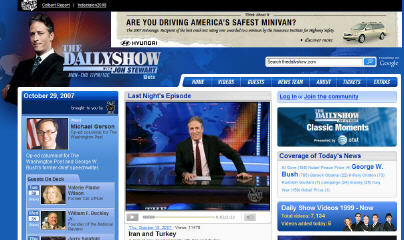 First things first, congrats to the folks at MTVN, Comedy Central and The Daily Show. The newly unveiled Dailyshow.com is fabulous. It is the best TV program-centric web site I have yet seen. As a long-time Jon Stewart fan, being able to see all the old clips is nirvana, and will no doubt send fans over the moon.
However, a bigger picture question that Dailyshow.com's launch raises is how these direct-to-consumer initiatives work vis-a-vis third-party distribution deals. With media companies newly empowered to engage directly with their audiences using the Internet and broadband, many analysts have predicted the result will be diminishing relevance of third-party aggregators, including everyone from Comcast to Yahoo to Joost to you name 'em.
It's pretty apparent that MTVN/Comedy Central is coming down on the side of heavily emphasizing direct-to-consumer as its broadband video strategy when you combine Viacom's ongoing lawsuit against Google/YouTube, MTVN EVP Erik Flannigan's comment ("People should be reacting to 'The Daily Show' on its own site...God bless them for doing it everywhere else, but this should be the epicenter of it") and a company spokesman's comment ("that a few selected clips could become available on sites through syndication deals").
Count me among those who think this is both the wrong approach and one that will ultimately under-optimize the value of the Daily Show and other franchises in the broadband era. Quite simply, building out a strong direct-to-consumer presence like Dailyshow.com is NOT an either/or decision relative to also developing strong third-party distribution relationships.
In fact, the reality is that strong third-party distribution is essential in the Internet era, because Internet usage is both highly distributed among millions of web sites and also concentrated at a few large portals. Media companies' goal should be to proliferate their content (under the right deals of course) into all the nooks and crannies of the Internet while also striking deals with big portals to maximize exposure, usage and ad revenue.
But don't think distributors get a free ride in the Internet era. They need to prove they can leverage their audience devotion and traffic to drive value for content providers. Those that do will succeed. Proof of this is already emerging. One senior broadband executive recently told me that over 80% of his traffic comes from YouTube and other distribution partners, with his own site's traffic in the minority.
Not aggressively pursuing third-party distribution, as it appears is MTVN's plan, in essence requires that users reorient their behavior to come solely to one uber destination site like Dailyshow.com. To me this smacks of classic traditional media thinking where consumer convenience or preference gets short shrift in the name of what's supposedly "best" for the brand. My guess is if you asked Jon Stewart off the record what his preference is, he'd likely say, "make my stuff available everywhere!"
So kudos to the folks behind Dailyshow.com. But don't let your good works end now. Go out and find the best third-party distributors you can and let them help you extend the Daily Show franchise even further.
Categories: Cable Networks, Portals
Topics: Comedy Central, Daily Show, Google, Jon Stewart, MTVN, Viacom, YouTube
-
YouTube Gets Serious About Copyright Protection with New Video ID Service
At long last YouTube has launched "Video Identification" in beta, its answer to copyright owners who feel
YouTube has built its business on the back of their copyrighted content. Having not seen the system in actual use, it's impossible for me to judge how well it works. But having read how YouTube describes its approach in developing the system, considering how it allocates responsibilities for copyright protection with the rights-holders themselves and thinking about the bigger picture challenges all media companies face in the broadband era, my initial reaction is that Video ID is a pretty good first step.
YouTube's approach - As the Video ID page says, YouTube was guided by 3 motivations in creating the system: accurate identification, choice for copyright holders and a great user experience. While there will be plenty of debate about how much emphasis each of these should have received relative to the others, my guess is that the DMCA's requirements and the health of YouTube's business drove the final balance. While YouTube has an image problem with major media which it would like to improve, nobody can expect that the company's SOLE motivation in developing a copyright protection scheme should be the concerns of copyright holders. Whenever I read a copyright holder complaining about YouTube or other piracy issues, I wonder, would these people only be happy if we returned to the pre-Internet age? Since that's not going to happen, less complaining and more adjusting is what's required of media companies now.
Allocating responsibilities - The most controversial part of Video ID will likely be the requirement that copyright holders provide their videos so YouTube can build its database against which to judge alleged pirated copies. The predictable reactions will be "it's too much work", "we don't trust that YouTube won't misuse it and "why should we?". There will be much second guessing whether other technical approaches not requiring submitting full video files would have been as effective. Of course nobody knows for certain, so at the end of the day either you trust that Google, with its pantheon of computer science experts, vetted the options well and selected the best choice, or you don't. It's ludicrous for lawyers and media executives who have never written a line of code in their life to suggest that Alternative A or Alternative B would have been better. I suggest that for now media companies give YouTube the benefit of the doubt. It is incumbent on YouTube to show it will be responsible with these video files and that having them really does make the Video ID system work well.
Bigger picture challenges - YouTube isn't going away, nor are the other video sharing sites. Broadband isn't going away either. And lastly, consumer behavior isn't going to change back what it was in the pre-Internet era. Media companies need to accept that the world is what it is, and learn to adapt themselves to it to succeed. My sense is that Video ID gives media companies all the options they should desire or expect: having the offending content removed, having it continue to run as promotional fodder, or making money off it through a revenue split (though these percentages are TBD). These tools, if they actually work, will give media companies lots of new flexibility to exploit their content with by far the largest audience of broadband video users. If media companies choose not to participate, shame on them for sticking their heads in the sand and wishing the world would return to a simpler time. YouTube has demonstrated for all of us what I believe and have said many times: that broadband is the single most disruptive influence on the traditional video industry. Companies that don't recognize this and don't work with the YouTubes of the world to adapt themselves will ultimately be rendered irrelevant or worse.
Categories: UGC, Video Search
-
Google's "Video Units": Turbocharging Video Syndication
 Google/YouTube's formal announcement of its "Video Units" content syndication this morning is a welcome development following previous moves in this direction that did not seem to materialize (there was a test with MTV and also comments about doing same with partners Sony BMG and Warner Music Group). What Google'sAdSense has already done in distributing ads to the "Long Tail" of publishers, Google is now going to try replicating with video. It's a very smart move.
As I have written repeatedly, robust syndication is a crucial piece of the broadband video economy. That's because advertising is going to be the main business model for a long time to come. And the only way to make the ad business work is through massive traffic increases, and of course improved ad monetization methods.
There's no better way to scale up traffic than through turnkey syndication. Google's ability to harness AdSense as a combination video syndication engine and monetization platform for content providers (by eventually marrying video units to AdWords) is unmatchable by anyone else.
As Google expands this initiative, it will be simultaneously alluring and threatening to others. Trying to capture the same benefits without the same underlying technology infrastructure and far-reaching distribution network is going to be very challenging to replicate.
Take for example, Hulu, the News Corp/NBCU JV, meant to regain control over their broadcast TV programs. Hulu has been striking its own distribution deals and will no doubt monetize its traffic with a "feet-on-the-street" ad sales approach. While there are benefits to this approach to aggregate the biggest sites as partners, Google's one-stop syndication/monetization capability provides the turnkey, hands-off approach needed to gather up the all the rest of the market (i.e. the Long Tail).
Depending how Google chooses to split the revenues between AdSense partners and content providers, Google/YouTube could well become a dominant part of the broadband-centric video value chain that is now taking shape.
Categories: Advertising, Broadcasters, Video Sharing
-
Music Videos are Another Example of Broadband's Ability to Create Unforeseen Revenues
 On my flight home last night I was thumbing through my hotel-provided USA Today and happened on this interesting piece about how record labels are transforming their music videos from promotional tool to a bona fide new revenue source. Chalk up another unforeseen win for broadband's ability to enable new business models.
Rio Caraeff, EVP of eLabs, Universal Music Group's digital division says that licensing its music videos to the likes of Yahoo, AOL, YouTube and others now generates over $20M/year and is growing briskly. Supporting a forecast of solid growth ahead, Ian Rogers, Yahoo Music's GM believes that viewership of music videos will expand by "10 to 100 times over the next one to two years."
According to comScore, Yahoo is the web's #1 music destination, pulling in 23.4M uniques in August. Caraeff also noted that streaming accounts for the lion's share of the revenue, with paid downloads of music videos still miniscule. He cites the best-selling download of all-time, a Justin Timberlake single as generating only 58K buys, which, at $1.99 apiece, adds up to less than $120K.
None of this is to say that music videos won't continue to be used as promotional fodder. But these nascent, growing licensing and ad-sharing revenues show broadband's power to mine content value that was previously inaccessible. Sports leagues, particularly MLB.com, have been masterful at this as well, driving successful broadband-only subscription businesses. I expect others to sprout up as well.
Categories: Music
Topics: AOL, eLabs, MySpace, Sony BMG, Universal Music Group, Yahoo, YouTube
Posts for 'YouTube'

Connect with VideoNuze
Exclusive News Roundup
- BBC News launches live stream on YouTube in U.S., U.K. The Desk
- Netflix Shocker: Bela Bajaria Leaving After 10 Years Amid Layoffs, Peter Rice to Replace as Chief Content Officer Variety
- YouTube Is Looking to Expand Into Audiobooks WSJ
- YouTube Music launches new labels as AI-generated music floods streaming platforms
- Netflix Eliminates About 6% of Staff in Biggest Cuts Since 2022 WSJ
- Reese Witherspoon and Mediawan Partner to Buy Back Hello Sunshine From Candle Media Variety