-
Global TV Shipments Down 6% in 2013 As Streaming Sticks Raise New Challenges
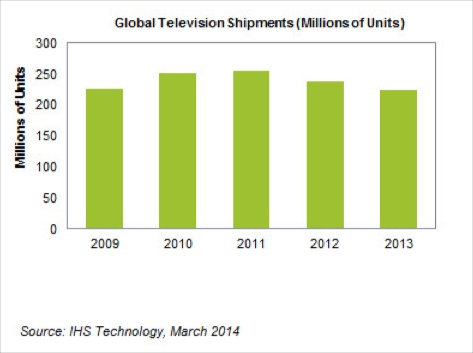
These are highly uncertain times for global TV manufacturers. As IHS reported last week, sales of TVs declined by 6% in 2013 to 225.1 million units, following a 7% contraction in 2012, creating first ever back-to-back down years for the global TV industry. IHS pinned the blame for the declines mainly on market saturation and difficult economic times.
To rebound from the doldrums, TV manufacturers are betting heavily on consumers upgrading to 4K TV and Smart TVs. 4K, or Ultra-High Definition TV, has significant challenges with content availability, price and picture quality differentiation it must overcome to go mainstream. Meanwhile, although the price premium for Smart TVs has shrunk, bringing them closer to conventional HDTVs, their value proposition is still not widely understood by consumers and access to online content is still very limited.
In this already difficult climate, another challenge for TV manufacturers is now taking shape from a whole new category of devices: low cost streaming sticks.Categories: Devices
Topics: Amazon, Chromecast, IHS, Roku
-
VideoNuze Podcast #212 - Comcast Gains Video Subscribers; Can Roku Replace Set-Top Boxes?
I'm pleased to present the 212th edition of the VideoNuze podcast with my weekly partner Colin Dixon of nScreenMedia.
Earlier this week, Roku CEO and founder Anthony Wood, who I interviewed at NATPE, described his long-term vision for Roku to replace pay-TV operators' set-top boxes. Anthony believes that as online video apps become more prevalent, and pay-TV operators want to seamlessly offer them, the logistics for doing so will be so complex, that alternative approaches like using Roku, will become more attractive. Colin and I debate the pros and cons of this vision.
Then Colin walks us through Comcast's stellar Q4 '13 results, announced earlier this week. Of particular note, Comcast added video subscribers in the quarter, the first time in over 6 years. Colin has crunched the numbers and concludes that Comcast will likely have more broadband subscribers than video subscribers by mid-to-late 2014, a stunning development. We explore what this means.
Listen in to learn more!Click here for previous podcasts
Click here to add the podcast feed to your RSS reader.
The VideoNuze podcast is also available in iTunes...subscribe today!Categories: Broadband ISPs, Cable TV Operators, Devices, Podcasts
Topics: Comcast, Podcast, Roku
-
Roku CEO Sees More Roku TV Deals, Set-Top Box Replacements Ahead
Roku CEO Anthony Wood shared company updates and his views on the broader video market in an interview with me at NATPE in Miami Beach on Monday. 2013 was a strong year for the company with 8 million cumulative units sold to date (about 3 million in 2013). Roku delivered 1.7 billion hours of video in 2013.
Interestingly, Anthony said that sales accelerated when Chromecast was introduced. He cited the trio of Roku, Apple TV and Chromecast as now dominating the connected TV device space, each with a relatively well-defined prospective customer.Categories: Devices
Topics: Roku
-
Interviewing Roku's CEO Anthony Wood at NATPE Next Week. Suggestions On What To Ask?
I'm excited to be hosting a one-on-one interview with Roku's CEO and founder Anthony Wood at NATPE in Miami next Monday, Jan. 28th. Anthony is one of the true visionaries in the online video / connected TV device world.
Among the topics on my list to discuss with him are Roku TV (launched with Hisense and TCL at CES last week), how Roku owners actually use the device since there are now over 1,200 channels to choose from, the status of Roku's work with pay-TV operators and whether transactional VOD will play a bigger part in Roku's future. I'm sure we'll also discuss larger industry trends like cord-cutting, the connected TV device landscape, Smart TVs, TV Everywhere and the role of mobile devices.
That's a long list, but what do YOU think I should ask him? Send me suggestions via email or leave a comment! -
Handy Infographic for Picking the Right Connected TV Device for the Holidays
Last Thursday I wrote about how the various connected TV devices are jostling for content deals, creating headaches for content providers and confusion for buyers. Following up that post, yesterday I highlighted holiday deals on Smart TVs which themselves are competing for attention with connected TV devices.
Now, to put a capstone on the discussion, I'm pleased to share a handy infographic that the good folks at Shelby.tv have created, comparing and contrasting 4 of the hottest and most affordable connected TV devices, Apple TV ($99), Chromecast ($35), Roku 3 ($100) and Roku LT ($50). The infographic summarizes key features of each, what content is available (with a nice Venn diagram showing overlaps), capabilities to watch from mobile devices and the web, key drawbacks to each, and which might be most appropriate as a gift this season.Categories: Devices
Topics: Apple TV, Chromecast, Roku, Shelby.tv
-
This Holiday Season, Smart TV Deals Abound, But Competition Increases From Connected TV Devices [CHART]
As online video adoption and longer-form viewing have grown, consumers have become increasingly interested in moving the experience to their TVs. This trend has certainly helped to drive interest in connected TV devices (e.g. Apple TV, Roku, Chromecast, etc.). But even as these devices have proliferated, TV manufacturers have promoted Smart TVs, which connect to the Internet and generally offer a handful of pre-integrated apps, most prominently Netflix, Hulu Plus, YouTube, Pandora and others.
Since connected TV devices are relatively cheap (Chromecast set a new low in 2013 at $35) and are easy to install, no longer must consumers be required to buy a whole new TV simply because they want to stream Netflix, for example. No doubt, this dynamic - combined with the saturation of HDTVs and the adoption of mobile devices for viewing video - all contribute to global TV sales being down in 2013 for the second year in a row, the first time this has ever happened.Categories: Devices
Topics: Apple TV, Chromecast, LG, Roku, Samsung
-
Connected TV Devices Jostle For Content in Another Holiday Season of Fragmentation
This holiday season, connected TV devices are among the hottest items on consumers' wish lists. For content providers eager for a foothold in the "digital living room," surging demand is very good news. The bad news, however, is that due to fragmentation and proprietary approaches among devices, content providers are forced to allocate their scarce resources in a one-by-one development model.
This is highly inefficient for content providers and sharply contrasts with how the web's standards helped to drive massive scale years ago. Beyond the inefficiency for content providers, the resulting fragmentation of content availability undermines the scale required for successful video advertising and also creates confusion among consumers about which device to buy. Unlike the web where you can bring home a computer and get access to ALL content, when you get a device you only get a narrower subsection.Categories: Devices
Topics: Apple TV, Chromecast, Roku, Xbox One
-
Survey: Price Sensitivity and Connected TV Devices Cloud Picture for Smart TV Adoption
Today I'm pleased to introduce the newest VideoNuze contributor, Jose Alvear, who is a research analyst specializing in the pay-TV and online video industries. Jose has authored research reports on content delivery networks, IPTV, OTT video, cloud-based TV and social TV for leading firms in the industry. Jose is currently working on a book focusing on the disruption of the TV industry.
Survey: Price Sensitivity and Connected TV Devices Cloud Picture for Smart TV Adoption
by Jose Alvear
Researcher IHS released survey results earlier this week suggesting a muted forecast for Smart TVs amid rising consumer price sensitivity and a proliferation of inexpensive connected TV devices. IHS found that 73% of U.S. consumers are not interested in buying a Smart TV in the next 12 months. IHS said that once consumers are educated about Smart TVs and learn more about their features, interest does increase. Overall awareness of Smart TVs is high, at 86%, with 30% expressing purchase intent over the next 12 months.
But how intent translates into actual purchase is always tenuous and in this case, particularly so. That's because IHS also found that price has now vaulted to the top position as a driver for TV purchases, surpassing "screen size," which had been cited by more than 50% of respondents in 2012.Categories: Devices
Topics: Apple TV, Chromecast, IHS, Roku
-
VEVO Now Gets 50% of Its U.S. Video Views From Mobile, Tablet and Connected TVs
There was an eye-opening data point in VEVO's viewership report for the first half of 2013, published this week: 50% of its U.S. video views now come from mobile, tablet and connected TV devices. In fact, in an interview on Bloomberg in late August (see below), VEVO CEO Rio Caraeff said non-desktop U.S. views are now over 500 million per month, more than half of its approximately 1 billion U.S. monthly views. He also characterized non-desktop as the fastest growing part of VEVO's business.
The 50% non-desktop number is the highest I've seen disclosed by any online video content provider. Over the past year, when I've informally asked content providers about mobile/connected TV views, I've typically heard 25%-30%. By comparison, YouTube (note, VEVO is the largest partner) says on its site that mobile is 25% of its global watch time.Topics: Apple TV, Roku, Samsung, VEVO, Xbox
-
Net2TV's Portico to Launch on Roku; Ad Insertion Enabled
Net2TV is announcing this morning that its Portico service will be available on Roku in June and that it is enabling dynamic ad insertion. Portico, which I last wrote about here, curates and packages short-form content into longer-form, TV-style programs, for viewing on connected TVs. Portico uses the ActiveVideo CloudTV platform with a thin client, which means it can be deployed and updated quickly on connected devices.
Categories: Advertising, Devices, Startups
-
Roku's Rosenberg: "Pro-Content Provider Strategy" Has Been Big Differentiator [VIDEO]
With over 700 content partners in its channel store, Roku has built out the most extensive set of content choices of any of the over-the-top devices.
And in a recent interview at NATPE, Scott Rosenberg, Roku's VP, Business Development, Content and Services, explains that's because the company has "very deliberately operated with a pro-content provider strategy" and prides itself on being easy to work with, allowing content providers to use the same standard technologies they use on the web and offering favorable economics. Scott contrasts this with the approach other OTT devices have taken.Categories: Devices
Topics: Roku
-
Scrappy Roku Makes More Deals, Keeps Elbowing Its Way Into the Big Leagues
You gotta love Roku. In the insanely competitive world of consumer devices - where the big boys like Microsoft, Google, Apple, Amazon, Samsung, Sony and others have enormous retail, financial and existing customer base advantages - little Roku just keeps on cranking out inexpensive, yet solid products, meaningful partnerships and scads of content deals, establishing itself as a leader in the connected TV space.
The latest evidence of Roku's momentum are two announcements at CES today; first, that it has signed up another 6 "Roku Ready" TV manufactures as partners whose models can accept the company's "Streaming Stick" device and second, that it has signed new video channel partners Blockbuster on Demand, Dailymotion, DISHWorld, Flingo, Fox Now, PBS, PBS Kids, Syfy and VEVO. All of these channels bring to 700 the number of video and audio choices in the Roku Channel Store, a breadth that easily rivals - though is clearly distinct from - today's pay-TV services.Categories: Cable TV Operators, Devices, TV Everywhere
Topics: Roku, Time Warner Cable
-
This Holiday Season, Video Apps' Purpose is to Sell Devices
It's no secret that consumer electronics makers have long relied on content to help sell their devices. After all, people buy devices because of what they can do, or consume, on them, just ask Apple, whose iTunes store is the linchpin to its iOS devices' success. However, as the all-important holiday season approaches, there's new evidence that video apps specifically are being embraced by CE providers (loosely defined) to drive their devices' value propositions.
Categories: Devices
Topics: Amazon, Barnes & Noble, HBO GO, Hulu Plus, Netflix, Roku, Xbox 360
-
HealthiNation Lands on Roku; Now #3 in Health Vertical Due To Syndication Strategy
Health and lifestyle video creator HealthiNation is announcing its availability on Roku devices this morning. The move extends HealthiNation's content syndication approach which helped place it third in comScore's Video Metrix ranking of health-related sites last month. HealthiNation racked up 3.1 million unique visitors, putting it ahead of WebMD and Everyday Health, and trailing only 5Min and HealthGuru. As Raj Amin, HealthiNation's CEO told me last week, the company gains the bulk of its traffic through its third-party syndication network of approximately 25 partners.
Categories: Devices, Indie Video, Syndicated Video Economy
Topics: HealthiNation, Roku
-
Roku Scores Best Buy Distribution Deal
Roku is announcing this morning that its Roku XD streaming player will be available at Best Buy stores nationwide. The deal is a big win for Roku which has primarily relied on online sales to drive over 1 million units to date. The price point for the Roku XD, which delivers up to 1080p HD using 802.11n WiFi will be $79.99, the same as online.
I've been using the XD device for a while now and it performs nicely. The biggest question mark I've had about Roku has been around its ability to compete in a very noisy consumer electronics environment, dominated by giants with well-known brands. Lately the success of Apple TV, which also retails for under $100, has felt like it could squeeze Roku, especially given the popularity of Apple's stores, which have no doubt helped introduce many to the Apple TV product. Because Roku only had limited hands-on opportunities, primarily early adopters would be drawn to its players.
Topics: Best Buy, Crackle, Roku
-
WealthTV-Roku Deal Isn't a Predictor Of An A La Carte Future
(Friday update #3) The was a flutter of excitement this week by some who interpreted a new deal by WealthTV to make its 24/7 linear feed available to Roku users as evidence of an a la carte future. But that hope would be misplaced; WealthTV, a network with minimal pay-TV carriage (though a litany of regulatory appeals), bears no resemblance to widely distributed cable networks like USA, MTV and Discovery whose lifeblood is monthly pay-TV carriage fees.
Even though WealthTV's proposed $2.99/mo subscription fee is more than any of these networks receive, WealthTV's retail model means its subscriber penetration will be a tiny fraction of these cable nets, and that's after necessarily heavy marketing and promotion. Don't get me wrong, Roku and other connected devices are doing a fabulous job of bringing online content to TVs. But getting top-notch, current cable programs is nowhere on the horizon. This is doubly true given that this week's FCC approval of Comcast-NBCU was an explicit blessing of the cable model.
Categories: Cable Networks, Devices
-
Roku Hits 1 Billion Streams; Viewing Time Is 31% As Much As Traditional TV
Connected device maker Roku has announced that it has delivered a cumulative 1 billion video streams to its installed base of media players. Even more interesting though is that the company disclosed that in December 2010, its players were used for an average of 11+ hours of play time per week. Since Nielsen reported that in Q2 '10 that the average American watched about 143.5 hours per month, this would mean that Roku owners on average are watching 31% (i.e. 45/143.5) as much through these devices as they do traditional TV.
Categories: Devices
Topics: comScore, Nielsen, Roku
-
Both Roku and TiVo Get Hulu Plus Access
Hulu is extending access to its Hulu Plus subscription service to Roku devices and to TiVo Premiere. The service will be available to owners of these devices for $9.95/mo. Roku and TiVo follow availability of Hulu Plus on Samsung connected devices, Sony PS3 and the iOS devices.
Of course it's a real benefit to Hulu Plus subscribers to gain on-TV viewing through inexpensive connected devices, and no doubt we can expect more devices to come, with boxee right at the top of the list. Still, with Hulu Plus following Netflix onto these devices, consumers are inevitably going to closely compare the two services. In this respect, as I've pointed out numerous times, most recently in the wake of Netflix's expanded deal with NBCU, Hulu Plus's content is going to look skimpy.
To be fair, for what it is - access to current and past seasons of broadcast programs, Hulu Plus is a great service. The problem is that DVRs already solve the current season episode value proposition for many (40% of homes and growing, according to Leichtman Research) while the prior seasons episodes are increasingly available on Netflix. Meanwhile, with TV Everywhere rolling out, Hulu Plus will be challenged to get access to cable TV network programs.
Expanding the number of devices that can access Hulu Plus is the right move (and a refreshing update after previously blocking free Hulu.com content). Nonetheless the big challenge for Hulu Plus remains getting more content.
What do you think? Post a comment now (no sign-in required).
Categories: Aggregators, Devices
Topics: Hulu Plus, Netflix, Roku, TiVo
-
Roku Refreshes Product Line to Offer 1080p HD Streaming
Roku is once again refreshing its product line, introducing 3 new players, including two that will offer 1080p HD streaming for the first time for Roku. As the chart below shows, the most notable features of the new top-of-the line XDS model ($99.99) are the upgraded HD capability, and a new "Instant Replay" feature on the remote control that allows users to jump back in the stream by 10 seconds without any buffering. The XDS also includes extended-range, dual-band Wireless N connectivity to home networks and a USB drive for portable media (note the existing HDXR model also has USB and will receive a firmware upgrade in the Fall to activate it).
Categories: Devices
Topics: Roku
-
For Connected Devices, To Browse or Not to Browse - That is the Question
If Hamlet were considering what functionality devices connecting the Internet to TVs should have, he might well pose the question, "to browse or not to browse?" In other words, should connected devices come with a browser that allows users to freely the surf the entire Internet - as they do online and on mobile devices - or should they present content and services through walled gardens of approved "apps?"
With new connected devices proliferating (see Apple iTV tomorrow), and becoming less and less expensive (see Roku price cuts yesterday), it's inevitable that massive connected device adoption lies ahead. Yet even as these devices are poised to take on greater importance in consumers' lives and be ever more strategic to any company committed to a three-screen strategy, it is still far from clear which device approach will dominate.
Categories: Devices
Topics: Apple, Espial, Roku, Samsung, TiVo, Vizio
Posts for 'Roku'

Connect with VideoNuze
Exclusive News Roundup
- YouTubers can now include affiliate links to Amazon in their content Engadget
- NWSL adds Roku as new media partner after split with Victory+ NY Times
- YouTube’s Pedro Pina Says Platform Can Fuel Britain’s Next TV ‘Golden Age,’ Unveils $4 Million Pledge: We’re ‘Not the Villain’ Variety
- Hollywood's summer box office is glowing, but the numbers come with startling caveats NPR
- Study: Americans Spend More Time Watching YouTube Than Live TV TV Tech
- Netflix, Disney+ and Amazon price rises in western Europe ‘highest in world’ The Guardian