-
5 Items of Interest for the Week of Sept. 27th
It's Friday and that means that once again VideoNuze is featuring 5-6 interesting online/mobile video industry stories that we weren't able to cover this week. Have a look at them now, or take them with you for weekend reading!
Nielsen Unveils New Online Advertising Measurement
comScore Introduces Digital GRP `Overnights` in AdEffx Campaign Essential
Dueling initiatives from Nielsen and comScore were announced on Monday, aimed at translating online usage into comparable TV ratings information, including reach, frequency and Gross Ratings Points (GRPs). While online video ad buying is ramping up, the tools to measure viewership in a comprehensive way have been lacking. This is one of the main issues holding back content providers from participating in TV Everywhere.
Analyst: Cord-cutting fears overblown
New research shared this week by BTIG analyst Rich Greenfield concludes that less than 8% of the market is actually interested in cord-cutting. The big impediment: losing access to sports and cable programming, which is unlikely to migrate to free over-the-top alternatives. Greenfield's conclusion is that cord-cutting isn't a major threat to pay-TV operators over the next 3-5 years. Notwithstanding the research, another factor I'd point to that could tip cord-cutting the other way is consumers' belt-tightening. Much as nobody wants to lose access to programming, if the price is perceived as too high, they'll make compromises.
Why YouTube Viewers Have ADD and How to Stop It
Abandonment rates for online video have always been a concern, and using new research, Visible Measures CMO Matt Cutler now quantifies the behavior. Expect 20% of the audience to drop out within 10 seconds of hitting play, 33% by the 30 second mark and 44% by 60 seconds in. Pretty sobering data but incredibly important in thinking about content creation and monetization.
Networks Have Sharing Issues With Hulu
Hulu's New Hoop
On the one hand, Hulu's network partners, ABC, NBC and Fox are reportedly pulling back ad inventory that Hulu is allowed to sell, yet on the other, Hulu is reportedly out aggressively selling ads in Hulu Plus, its subscription service. Meanwhile this week Hulu also announced that Hulu Plus will be accessible on both Roku devices and TiVo Premiere, as it continues chasing Netflix in the subscription game.
The New Apple TV Reviewed: It`s All About the Video
Apple TV devices started shipping this week, and reviews began popping up all over the web. This mostly positive review indicates that the user experience is solid, but that content selection is still skimpy. That's no surprise given how few deals Apple has struck to date. Yet to be seen is how Apple TV performs when it can access other iOS apps.Categories: Advertising, Aggregators, Analytics, Broadcasters, Devices
Topics: ABC, Apple TV, comScore, FOX, Hulu, NBC, Nielsen, Visible Measures, YouTube
-
5 Items of Interest for the Week of Sept. 13th
It's Friday and that means once again VideoNuze is featuring 5-6 interesting online/mobile video industry stories that we weren't able to cover this week. Read them now or take them with you for the weekend. Enjoy!
Meet YouTube's Most In-Demand Brand Stars
A fascinating look at how major brands are hiring amateurs who have gained large followings on YouTube to pitch their products. The concept of "celebrity spokesperson" is getting redefined in the online video era.
Logitech Revue with Google TV Coming 9/29 for $299, Dish Network Offering Discounts?
We may be less than 2 weeks away from Logitech's "Revue," the first implementation of Google TV, hitting the market, with Dish Network subscribers possibly getting a deeply discounted $179 offer. The connected device space is increasingly crowded and there's high anticipation to see how Google TV stacks up.
Pre-order a Boxee Box Now
Speaking of connected devices, Boxee announced this week that pre-ordering is available from Amazon for its Boxee Box connected device, manufactured by D-Link. Like Google TV, but unlike Apple TV or Roku, Boxee offers the prospect of browsing the full Internet for video, not just what's been integrated with the device.
Samsung Reveals Tablet Launch Plans
Meanwhile the strongest potential competitor to the iPad, Samsung's "Tab" will begin shipping in just a few weeks, with availability from all 4 major U.S. wireless carriers. The Tab is very focused on mobile video, running Android 2.2 which supports Flash 10.1. That means Hulu and all other Flash-based video should work, significantly expanding the universe of choices beyond what is available on the iPad. No pricing yet, but the Tab looks like a meaningful iPad alternative.
Ivi Seeks to Become an Online Cable System
Can an online service retransmit network TV through the Internet, and charge for it without having any underlying agreements in place with the networks themselves? That's what Ivi, which unveiled its software this week, is attempting to do, pointing to U.S. copyright law as making its offer legit. We'll see; with TV networks gaining no new revenue coming in plus the risk of cannibalization we should expect them to raise vigorous legal challenges.
Categories: Aggregators, Brand Marketing, Broadcasters, Devices, Mobile Video
Topics: Boxee, D-Link, Google TV, Ivi, Logitech, Samsung, YouTube
-
VideoNuze Report Podcast #75 - Sept. 17, 2010
Daisy Whitney and I are pleased to present the 75th edition of the VideoNuze Report podcast, for September 17, 2010.
Daisy gets us started this week, adding detail to her New Media Minute in which she discusses the range of hyper-local online news and advertising initiatives currently underway from companies such as AOL, ESPN, NY Times and NPR. Daisy offers her assessment of the pros and cons of this area which has gained a lot of recent attention.
Speaking of advertising, we then chat about my post from earlier this week, "YouTube Gets Center Stage in Google's New 'Watch This Space' Ad Campaign" which I believe is the first time that Google has heavily promoted the attractiveness of its display ads and more specifically video advertising on YouTube for major brands. With Google TV coming soon and a new head of content partnerships, Google is on the march to the living room.
Click here to listen to the podcast (16 minutes, 2 seconds)
Click here for previous podcasts
The VideoNuze Report is available in iTunes...subscribe today!Categories: Advertising, Podcasts
Topics: Google, Local, Podcast, YouTube
-
Google Poaches Key Netflix Executive to Run Content Partnerships
Here's an interesting executive change: Google has apparently nabbed Netflix VP, Digital Content Acquisition Robert Kyncl to be its new VP, Content Partnerships. AllThingsD.com is reporting the move, though neither side has confirmed. The Google role has been open since David Eun moved over to AOL as President of Media last February.
Assuming the move is true, it would be a key step forward for Google - and more specifically YouTube - in gaining access to premium content. Kyncl would bring not just his relationships with Hollywood, but an insider's understanding of the economics behind all of Netflix's streaming deals with partners such as Epix, Warner Bros., Universal, ABC, Starz and others. That kind of credibility and insight would be a huge boon to YouTube, which has made some progress with premium content providers (e.g. Univision, WWE, etc), but has still had trouble breaking through. Google certainly has the stature to be a major distributor of premium content, but actually getting things done in Hollywood is notoriously tricky for outsiders.
Categories: Aggregators, People
Topics: Google, Netflix, YouTube
-
YouTube Gets Center Stage in Google's New "Watch This Space" Ad Campaign
Last Thursday Google announced a new ad campaign promoting its display advertising opportunities called "Watch This Space." Having seen it in action for the first time, on the AllThingsD.com web site the last 2 days, it is clear that Google is giving YouTube center stage in this campaign. It's the first time I'm aware of that ad opportunities on YouTube have been so heavily promoted and I believe signals the growing importance of YouTube in Google's overall ad business.
The 300x600 Google ad unit (see below) expands to show 3 clickable tabs:
Categories: Advertising, Aggregators
-
YouTube Live Streaming Expansion is Exciting Though Today's Quality Was Spotty
YouTube's newly announced live streaming platform offers video providers an exciting new opportunity to try new programming, connect to their audiences and leverage YouTube's massive reach. YouTube has made it very easy to broadcast live from within a partner channel, and has also adopted a "walk before you run" approach by testing today and tomorrow with 4 partners before expanding any further. That's a good idea, because based on my experience today, streaming quality was still pretty spotty.
For example, I tuned into Howcast's "Magic Secrets Unlocked!" today with celebrity magician Matt Wayne. It was a very cool show where Wayne took questions from a Howcast host and also did some neat tricks with a handful of participants. From a programming standpoint, I think live shows are a winning proposition for Howcast (and the others in the test, Next New Networks, Young Hollywood and Rocketboom), helping expand beyond on-demand programming. In the Howcast show, audience questions were taken and Wayne was interactive and engaging - and he even showed a few secrets to his craft.
Categories: Live Streaming
Topics: HowCast, Next New Networks, Rocketboom, Young Hollywood, YouTube
-
5 Items of Interest for the Week of Sept. 6th
Though it was a short week due to the Labor Day holiday, there was no shortage of online video industry happenings this week. As I've been doing each of the last few Fridays, following are 5-6 noteworthy industry stories for your weekend reading pleasure.
Ooyala Raises $22 Million to Accelerate Global Expansion
Online video platform Ooyala's new $22 million round is a bright spot in what's been a pretty slow quarter for online video industry private financings. Ooyala's new funds will help the company grow in the Asia-Pacific region. Ooyala said it is serving 550 customers, double the level of a year ago.
Google TV to Roll Out World-Wide Next Year
Even though the first Google TV-enabled devices have yet to be deployed, Google CEO Eric Schmidt said this week that he envisions a global rollout next year. The connected device landscape is becoming more competitive for Google TV given the growing number of inexpensive connected device options.
Business Groups Question Net Neutrality Rules
Three pro-business trade groups urged the FCC to drop its net neutrality initiative, citing the "flourishing" broadband market and concerns that regulations will curtail new investments and hurt the economy. It seems like everyone has a different opinion about net neutrality, so the consensus needed to move regulation forward is still down the road.
ESPN, YouTube Link Up for Promo Campaign
This week ESPN and YouTube kicked off their "Your Highlight" campaign, enticing ESPN viewers to upload their own sports clips, with the best ones to be shown on SportsCenter. Then the best of the best will win a trip to ESPN's studios to watch a SportsCenter taping. It's a great promotional concept, using online video to further invest ESPN viewers in the brand. Whoever thought it up deserves a shout-out.
Life Without a TV Set? Not impossible
Another interesting data point to tuck into your back pocket: according to a 2010 Pew study, just 42% of Americans feel a TV set is a "necessity," down from 64% in 2006. Pew interprets this as a loss of status for the TV, as other devices like computers and phones have become video capable. The perception of convergence is taking root.
Categories: Broadband ISPs, Cable Networks, Deals & Financings, Devices, Regulation, UGC
Topics: ESPN, FCC, Google TV, Net Neutrality, Ooyala, Pew, YouTube
-
5 News Items of Interest for the Week of Aug 30th
In a week dominated by Apple's new products, there actually was some other interesting online/mobile video industry news this week. Continuing VideoNuze's new Friday feature of highlighting 5-6 stories that we didn't cover this week, below are a collection of items for your weekend reading pleasure.
YouTube Ads Turn Videos Into Revenue
The 800-pound gorilla of the online video industry is reportedly closing in on profitability, based partly on ads running against user-uploaded copyrighted material. By detecting these uploads and offering the underlying rights owners the choice to have their video taken down or leave it up and generate revenue, many are choosing the latter. YouTube continues to evolve from its UGC roots.
Samsung, Toshiba Unveil Google-Based iPad Rivals
The battle line between Apple's "i" devices and those running Google's Android will ramp up, with mobile video set to follow, as Samsung and Toshiba plan to sell tablet computers in the coming months. Though the iPad is of to a strong start, it looks like it won't enjoy the same market dominance as the iPhone did as competitors jump into the tablet market quickly.
Google TV: Up to $300 Price Premium?
The components to enable Google TV could add $300 to the retail price of a television. If accurate this would put Google TV at a big competitive disadvantage given the trend toward lower-priced connected devices such as this week's $99 Apple TV and Roku's price cuts.
A Look Back: Lessons Learned From TV Everywhere a Year After Deployment
Marty Roberts, VP of Sales and Marketing for thePlatform, which has powered a number of TV Everywhere rollouts, offers insights based on the company's experience. Topics include authentication, content ingest, parental controls, discovery and content security. TV Everywhere is still in a nascent stage, but pay-TV providers should be following early lessons and moving quickly.
ShowUHow Scores $3 Million Series A Backing for Video Instruction Guides
A startup site that offers video instruction guides for various types of products that need to be assembled illustrates how valuable video can be for how-to video applications.
Categories: Advertising, Aggregators, Cable TV Operators, Deals & Financings, Devices, Startups
Topics: Apple, Google TV, Samsung, ShowUHow, thePlatform, Toshiba, YouTube
-
IBM is Turning to Video to Make Its Point
While most of VideoNuze's coverage is of online video's impact on the media and entertainment industries, I'm constantly on the lookout for examples of how video adoption is infiltrating other organizations. Therefore, a new case study about IBM Software Services from Lotus, presented by video platform vzaar, hit my radar. In it, Mark Leaser, Worldwide Offerings Manager, describes how he and others at IBM are increasingly using video for internal sales training and communication, along with external marketing. I caught up with Mark yesterday to learn more.
Categories: Business Apps
-
Is Demand Media's "Factory" Approach the Future of Online Video - or Not?
Friday's $125 million IPO filing by Demand Media, the foremost content "factory" or "farm," raises the question of whether its low-cost, high-volume content creation model is the future for independent online video, or if its specialized approach is just applicable to its chosen how-to/knowledge-oriented niches.
Back in March, '09 I described how Demand's approach had enabled it to become the biggest supplier of online video to YouTube, with its ExpertVillage and eHow brands delivering the highest number of views of any YouTube partner. While not a household name, Demand pioneered a new approach to choosing which content to create, how to create it, and how to monetize and value it.
Based on multiple data sources, Demand developed a set of algorithms that could help predict the likely consumption and monetization potential of video on a given how-to/knowledge topic. When promising ones were identified, assignments would be offered out to a large freelance network of producers who would follow creative guidelines while still enjoying an ample amount of flexibility. Content is published to Demand's own sites and to 3rd parties to whom it syndicates. Social media and user contributions are emphasized as well.
Categories: Branded Entertainment, Indie Video
Topics: Demand Media, Easy to Assemble, My Damn Channel, YouTube
-
Stallone's YouTube Video Ad for "The Expendables" Breaks the Mold
If you haven't seen Sylvester Stallone's new video ad now running on YouTube's home page for his upcoming movie The Expendables, take time to check it out it as it completely breaks the mold. It begins as a large banner on YouTube.com (see below). When you click, a standard-looking sit-down video interview between Stallone and TV personality Shira Lazar starts rolling. Pretty quickly the effects begin and you realize this is anything but a standard interview. I won't spoil the fun for you.
The Expendables ad is yet another example of how dramatically online video advertising is opening up the creative palette, allowing brands to do totally unconventional things that get shared and noticed. Another recent example was the Old Spice man ad, which itself became an online video/social media phenomenon. No doubt others will follow. For brands accustomed to operating within the narrow confines of 30-second TV ads, the world is changing fast, and for the better.
What do you think? Post a comment now (no sign-in required).Categories: Advertising
Topics: Sylvester Stallone, The Expendables, YouTube
-
What's Google Really Up To With Its Fiber-to-the-Home Project?
I continue to be intrigued about what Google is up to with its 1 gigabit/second fiber-to-the-home project that it announced back in February. The latest (non) update is that yesterday the company unveiled a new resource web site for the project, dubbed "Google Fiber for Communities."
While there's an FAQ link for the project, there really isn't much new information provided about the project itself. Instead, the most prominentbutton on the new site says "Take Action Now" (Improve Broadband in Your Community). Clicking it takes you to a site that discusses the cost of laying fiber conduit and gets into the minutiae of digging up streets. There's a button to email your representative to express support for pending federal legislation requiring installation of conduit in federally-funded transportation projects. There's also a lengthy set of recommendations that city-sponsored road projects also include conduit.
What's going on here? Why is Google, which derives the vast majority of its revenues from search advertising, dedicating time and resources to advocating for local fiber conduit? The only thing I can conclude is that Google is trying to lay the groundwork to eventually expand well beyond its upcoming fiber trial. This would be facilitated by having conduit already in place around the country. Even still, as I described in my original post in February discussing the fiber experiment, wiring up communities is tough, tedious and costly work that Google has little experience with.
Categories: Broadband ISPs
-
YouTube Aims for Big Screen and Small Screen Success
Not content to dominate online video viewing, yesterday YouTube unveiled new initiatives for viewing on both TVs and mobile devices. Taken together they demonstrate how aggressive YouTube plans to be in the 3-screen viewership era.
First up, YouTube introduced the beta version of "Leanback," the new 10-foot experience that it introduced at the recent I/O conference. With Leanback, you only need to use the 4 arrow keys and Enter key on your keyboard to navigate the YouTube experience. Video plays in full-screen mode and in automatically in HD when available.
There are different options for what content Leanback delivers: if you have set up subscriptions, it will give you a feed of those videos; in addition, if you've connected your YouTube account to your Facebook account you'll also get a feed of videos your friends are watching/sharing; alternatively, if you've done neither YouTube will simply give you the most popular comedy, entertainment, news, etc. You can also easily search and browse.
Categories: Advertising, Mobile Video
Topics: YouTube
-
YouTube Surges to Almost 15 Billion Views in May
comScore has released its May online video rankings and at the top of the list, as usual, is YouTube. In May it racked up a record 14.6 billion video views, up 11.5% from April. YouTube's market share actually dipped slightly in May, to 43..1%, still its 3rd-highest monthly share since comScore began releasing this data in Jan '07. Total video views were also at a record high of 33.9 billion views in May.
The chart below shows how remarkable YouTube's growth has been since Jan '09. YouTube has more than doubled its monthly views from 6.3 billion. Meanwhile, YouTube's market share has hovered right around 40% each month, with its lowest level at 37.7% in Oct '09 and its highest of 43.5% in April '10. YouTube is generating more than 10 times the monthly views it was when Google acquired it.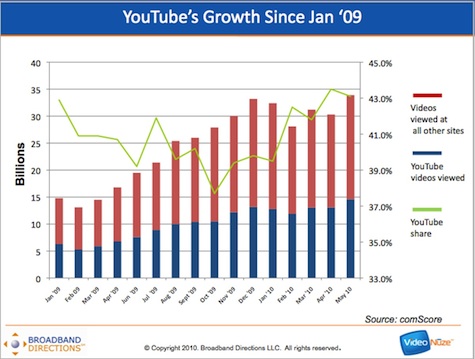
Categories: Aggregators, Music
Topics: comScore, Hulu, VEVO, YouTube
-
Look Who's Advertising on YouTube's Homepage Now: VISA/Toy Story 3 and Xbox's Kinect
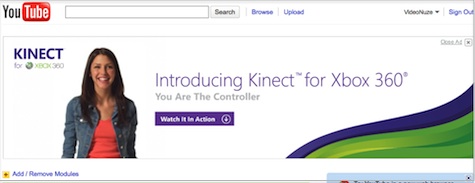
Want a sense of just how far YouTube has evolved from its scruffy user-generated roots to a premier site for big brand launches? Then head over to YouTube.com now and you'll see huge rotating rich media campaigns running for VISA, with a tie-in for the new Disney/Pixar film Toy Story 3 (opening tomorrow) and for Xbox's new Kinect motion-sensing feature (the "Wii-killer" unveiled earlier this week at E3).
From a brand launch perspective, these are about as big as they get, with huge money and franchises at stake for all of the companies involved, not to mention the positive or negative career impact for the marketers driving the media strategies at these companies. The fact that both are advertising prominently on YouTube says volumes about the site's importance in the online advertising world and its evolution from its UGC start.
It wasn't that long ago when YouTube was derided an un-monetizable jumble of amateurish clips. It's also worth noting that, as best I can tell, neither the Kinect nor VISA/Toy Story 3 campaigns are running on Yahoo, AOL or MSN right now, the traditional online homes for big brand launches. Now imagine when YouTube is available on TVs via Google TV and you get a sense of just how important YouTube is going to be, and how strategic it has become for Google which is trying to expand beyond search ads.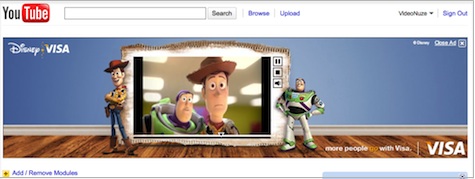
What do you think? Post a comment now (no sign-in required).Categories: Advertising, Aggregators
Topics: Toy Story, VISA, XBox, YouTube
-
Smartphones Poised to Move to Cultural Center Stage?
Yesterday's note in the WSJ's Digits blog about 22 year-old South Korean singer Kim Yeo-hee's move from YouTube viral star to her own record deal is a reminder of the brave new world that aspiring singers now find themselves in. Of course, getting noticed on YouTube as a viral star has been a rage for years now, but what's different for Kim is that what got her noticed online is her use of music apps on 3 different iPhones as her as accompaniment.
It's a somewhat awkward scene, but you have to give Kim credit for being ingenious. And it's a lesson to other up-and-comers - having good pipes is still table stakes, but new technology and devices can help you distinguish yourself in the sea of online performers. That got me to thinking - with smartphones becoming a bigger and bigger part of our culture, what other creative ways might we see them start seeing them appear in performances?
What do you think? Post a comment now (no sign-in required).Categories: Indie Video, Music
-
Total Video Viewership Down Slightly in April; YouTube Share Jumps
comScore has released its new online video rankings for April '10 which show total videos viewed of 30.3 billion, down almost 3% from the prior month's 31.2 billion. As a result, YouTube, which was roughly flat in April at 13.1 billion videos, saw its market share increase to 43.5%, its highest level since July '08. It was also YouTube's second highest share since I started tracking the comScore numbers in Jan '07 (when YouTube had a relatively paltry 16.2% market).
The 3% decrease in total videos from March '10 to April '10, compares with a 5% decrease from March '08 to April '08 and a 16% increase from March '09 to April '10. While it's hard to discern any trends around these 3 year numbers, one thing worth noting is that over the last 6 months, with the exception of blips up in Dec '09 and Jan '10, total video views have stayed relatively stable right around 30 billion. I'm not sure exactly what to conclude from that, but I'll certainly be watching the coming months to see if viewership is flat-lining or just taking a breather.
Categories: Aggregators
Topics: comScore, Hulu, VEVO, YouTube
-
With Leanback, YouTube Could be the First Big Beneficiary of Google TV
A couple of weeks ago at the Google I/O conference, YouTube provided a tantalizing glimpse of a new UI called "Leanback" which optimizes YouTube for viewing on TV.
With Leanback, YouTube videos can be navigated and consumed in more of a TV-like manner - more passively and for longer durations. Converting YouTube - the king of short online video clips - to a more conventional TV experience might seem like a surprising ambition for Google, but in the context of Google TV, it's actually quite strategic. Not only should it help Google TV gain acceptance, it could also position YouTube to be the first big beneficiary of Google TV.
Way back in March, 2008, in "YouTube: Over-the-Top's Best Friend," I argued that providing full, open Internet experiences was the best path for new OTT devices to succeed, and that YouTube would be their perfect partner. YouTube is so valuable for OTT devices like Google TV and others because it dominates the online video world, accounting for 40% of all video views every month for the past 2 years. For many users it is the only online video brand they know and by far the most heavily used.
Categories: Aggregators, Devices
Topics: Google, Google TV, Hulu, YouTube
-
Online Video Viewing Rebounds in March According to comScore; Hulu Performance is Mixed
Online video viewing rebounded to 31.2 billion total streams in March '10 according to comScore's newly-released numbers. The March total marks an 11% increase in streams over February's 28.1 billion. As I wrote a couple of weeks ago, it also continues a leveling-dipping-rebounding pattern that has occurred in the Dec-Mar months for the last 2 years as shown in the chart below. If the pattern holds, we'll see strong growth for the next 6 months or so.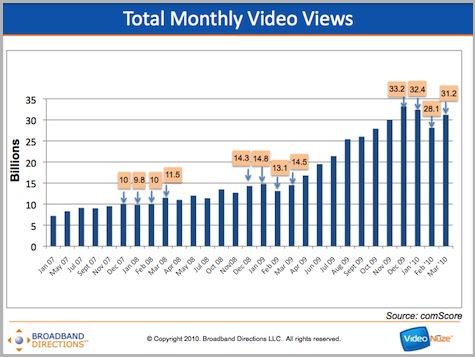
As always, YouTube was the top video site by a wide margin. In March it notched 13.1 billion views, up 10% vs. February's 11.9 billion. Its share was down just slightly to 41.8% from February's 42.5%. Still, it was the 21st consecutive month that YouTube's share has been plus or minus 2-3 percentage points of 40%, a remarkable run.
Hulu also bounced back strongly in March, recording its best month to date with 1.070 billion streams, up 7.5% vs. February's 912.5 million. But with Hulu viewers averaging 156 minutes, the minutes per viewer in March actually slipped to 5.84 from 6.18 in Feb. Hulu's average minutes has stayed stubbornly around 6 minutes for over a year now. In addition, total unique viewers came in at just over 40 million. As I've pointed out in the past, Hulu's viewership has been stuck around the 40 million mark now for a year. Absent a radical change, it seems that neither one of these metrics will break out of their respective range any time soon.
Lastly, on the ad network site, Tremor Media, which earlier this week announced a $40 million financing, saw its reach increase to 96 million viewers.
What do you think? Post a comment now (no sign-in required).Categories:
Topics: comScore, Hulu, YouTube
-
Ooyala Integrates YouTube Access For Customers
Online video platform Ooyala has unveiled an interesting new feature that allows its customers to add videos from YouTube to their Backlot account and then have them displayed right alongside their own videos in their Ooyala player. All of the analytics that are available for the customer's own videos extend to the YouTube videos as well. Alex Holub, senior product manager at Ooyala gave took me on a quick tour last week of how it works. It appears simple and well thought-out.
Alex explained that the impetus here was that a lot of Ooyala customers were already trying to incorporate YouTube videos, but there wasn't an easy or integrated way to do so. With the new feature, a customer can search and gather relevant YouTube videos from within the Backlot platform and then add them to their account, where they can subsequently add metadata. The videos can also be syndicated along with other owned video. The YouTube videos are displayed in a chromeless player, which means the Ooyala look and controls remain. The main thing that separates the YouTube videos is that per YouTube rules they cannot be directly monetized. So Ooyala's ad rules pre-empt any pre-roll or overlays; instead on-page ads only are allowed.
Ooyala's move is further recognition of valuable YouTube's library has become for many publishers. There is just so much content on YouTube, and tons more being added every day that is freely available that for many YouTube is an irresistible augment to their own content. The only other OVP that I'm aware of that has done something like this with YouTube and other sources is Magnify.net, with has been all about enabling its customers to curate the best video from around the web from the outset. I expect we'll see other OVPs offer this capability too.
Ooyala is offering the new YouTube feature free until May 31st for customers.
What do you think? Post a comment now (no sign-in required).Categories: Technology
Posts for 'YouTube'

Connect with VideoNuze
Exclusive News Roundup
- BBC News launches live stream on YouTube in U.S., U.K. The Desk
- Netflix Shocker: Bela Bajaria Leaving After 10 Years Amid Layoffs, Peter Rice to Replace as Chief Content Officer Variety
- YouTube Is Looking to Expand Into Audiobooks WSJ
- YouTube Music launches new labels as AI-generated music floods streaming platforms
- Netflix Eliminates About 6% of Staff in Biggest Cuts Since 2022 WSJ
- Reese Witherspoon and Mediawan Partner to Buy Back Hello Sunshine From Candle Media Variety