-
Major Book Publishers Are Asleep to Broadband Video's Upside
Looking for an industry that is almost entirely asleep to broadband video's upside? Look at the major publishers of fiction and nonfiction books.
I was intrigued about what publishers were doing with broadband when I recently noticed a full page ad for the current #1 fiction book, "The Story of Edgar Sawtelle." Promoted at the bottom of the page was a "live webcast event" with the book's author at www.oprah.com/bookclub.
I thought that seemed like a pretty smart thing to do, and it must be relatively common. However, when I researched the authors' web sites and the respective publishers' web sites for the top 10 hardcover fiction and top 10 hardcover nonfiction books, I was surprised to see how little broadband video is currently being used.Most of these sites offered no video at all and of those that did, only three offered any meaningful amount. Those were the web sites of Ted Bell, author of the #8 fiction book, "Tsar," Thomas Friedman, author of the #1 nonfiction book, "Hot, Flat, and Crowded" and Friedman's publisher Farrar, Strauss and Giroux, all of which offered video galleries of these authors being interviewed mainly on TV shows. That these two authors alone should have strong broadband presences is not that surprising; Bell is a former top advertising executive and Friedman is very plugged into the technology scene.
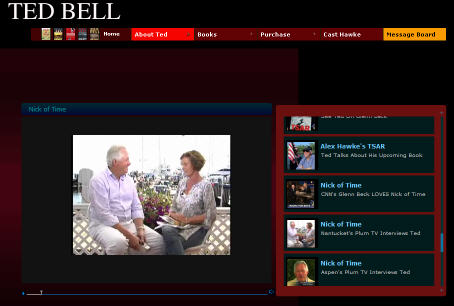
To me it's bizarre that publishers aren't embracing broadband, and it seems like a huge missed opportunity. Book publishing is a brutally competitive industry, where big money is spent promoting primarily well-known authors' latest works (note virtually all the authors on the fiction top 10 list have successful track records). This means there is a built-in audience likely interested in high-quality content related to the author's new work.
Video-based promotion seems like a natural for book publishers. Authors are sent on book tours, where they do local readings and signings. These would provide great fodder for video. They also do a lot of TV interviews, particularly on cable, which could be repurposed. Then there's the infinite number of book groups who meet to dissect these books - how about gathering and posting video of some of their discussions?
There's also the "behind-the-scenes" potential. This one is particularly intriguing as I had a personal experience with it recently. After watching HBO's "John Adams" miniseries on DVD, I also watched the special feature behind-the-scenes profile of author David McCullough. It was every bit as interesting as the program itself.
I think passionate readers of certain authors would love to have an intimate look into how these books come to be. How is the research is done? What moved the author to choose his/her subject? What's the setting look like where they actually type? What are the author's key challenges? And so on. This "meta-story" around the book itself is supplemental content that can be used to promote the book and make it feel more like an event (or a continuation of events if it's a repeat author).
As I've explained in the past, video is becoming table stakes for all product promotion. Books are no different. The key is publishers thinking about how video can new value for readers. Book publishing is one of the most traditional businesses around, and when it comes to its limited pursuit of broadband video, the industry seems to be living up to its reputation. As a result they're missing out on big opportunities to further engage their readers and drive sales.
What do you think? Post a comment now.
Categories: Books
Topics: Farrar, HBO, Strauss and Giroux
-
Early Bird Seating Available for VideoNuze's Broadband Leadership Breakfast
A reminder that early bird seating is available for VideoNuze's inaugural Broadband Video Leadership Breakfast Panel. The breakfast, in association with CTAM's New York and New England chapters, will be held in Boston on Nov. 10th at 7:30am, preceding the first full day of the annual CTAM Summit (separate registration).
I'll be moderating the session which is entitled "How to Profit from Broadband Video's Disruptive Impact" and features an A-list group of executives:
- Deanna Brown - President, SN Digital, Scripps Networks
- Bill Carr - Vice President, Digital Media, Amazon
- David Eun - Vice President, Content Partnerships, Google/YouTube
- Fred Seibert - Creative Director/Co-Founder, Next New Networks
- Peter Stern - Executive Vice President, Strategy and Product Management, Time Warner Cable
Click here to register for the early bird special
This unique event is a must attend for anyone navigating today's broadband video world. We'll examine key broadband topics like business models, syndication, user-generated video and consumer behavior changes. You'll come away with a clear sense of how these 5 companies are benefiting from broadband's growth, and what you too can do to profit from its disruptive impact.
The Leadership Breakfast is generously sponsored by ActiveVideo Networks, Akamai, Anystream, KickApps and Yahoo.
Click here to register for the early bird special
I hope to see you there!
Categories: Events
-
Another Update from the Front Lines of the Syndicated Video Economy
Having staked out the idea of the "Syndicated Video Economy" as a key driver of the broadband video landscape about 6 months ago, I'm continually looking for insights from those companies operating on its front lines. How is it evolving? What are the key challenges and opportunities? How are they being addressed?
I got more feedback yesterday, moderating a session at the Contentonomics conference in LA. On it were:
- Gary Baker, Founder and CEO, ClipBlast
- Jimmy Hutcheson, President, EgoTV
- Damon Berger, Senior Director of Programming & Business Development, Revision3
- Danny Wright, Senior Director, Business Development, Photobucket
Here are a few takeaways I scribbled down during the session:
Revenue issues persist - Jimmy was quick to note that while he's an optimist about syndication, EgoTV's current deals have yet to produce a lot of revenue. I pressed him on the reasons: lack of distributor promotion/traffic, their inability to monetize traffic, both or neither? Jimmy's response was that with so much video flowing through key distributors, gaining solid promotion is a real challenge. A bigger issue is distributors' ability to monetize the traffic they're generating. I've heard this from others as well. This could suggest a continued shift to content providers owning/selling their ad inventory, with distributors focusing mainly on promotion/traffic, and receiving a revenue share for their efforts.
Friction in executing syndication - Though Damon highlighted that Revision3 has 40 distribution partners, that's definitely the exception, not the norm these days; a recurrent SVE theme the panel discussed is the overhead involved in identifying partners, negotiating deals, implementing them, collecting performance stats and doing follow-up analysis. There are no easy answers here. As I've written in the past, some of this just gets resolved as the ecosystem of companies matures.
Brand building takes on greater importance in syndication - There was some consensus on the panel that with content be viewing through multiple outlets, a clear challenge is building a consistent and differentiated brand. The importance of a content provider's own web site magnifies in the SVE. Even though a lot of viewership may occur elsewhere, it's still the best opportunity to control and define the brand for viewers. Further, even if substantial revenues don't materialize from syndication, these deals are still viewed as solid brand-building.
Push to programming quality - As broadband video proliferates, getting noticed is harder than ever. As a result there's a real push to quality video that's underway. In part this involves pulling more high-quality talent into broadband originals. The quality bar is getting ever higher for broadband video especially as better-know talent adopts the medium. Distributors will be in a stronger position to choose which video to include and promote.
That's it for now. I'll keep providing regular updates on the SVE as I gather more information from those fully immersed in it.
What do you think? Post a comment.
(Note: tomorrow's a rare day off for VideoNuze as I observe Yom Kippur)
Categories: Syndicated Video Economy
Topics: ClipBlast, EgoTV, Photobucket, Revision3
-
Time Warner Cable Fostering Cable Bypass in LIN TV Retransmission Dispute?
The latest battle over "retransmission consent" is now underway between Time Warner Cable and LIN TV. These fights crop up periodically, but what's different about this one is that TW is offering instructions to its customers for how to hook their PCs to their TVs so they can view LIN's prime-time programming from the applicable network affiliate's web site.
Time Warner has set up instructional sites, such as http://www.tellthetruthwluk.com/main.phpfor residents of the Green Bay, WI area affected by the outage. Prominently displayed at the site is a 3 minute video with the step-by-step instructions for connecting a PC to a TV. (As a sidenote, the video itself is a great example of a how-to broadband video, but I'd bet that it makes the process look far easier than it is likely to be for most average consumers).

But the all-too-obvious question that I raise: once TW customers get the hookup working, how long will it take them to realize that by bypassing TW's service, some cable network programming can now also be viewed this way, and for free? TW may be inadvertently helping its own customers realize that the $40-$60/month or so they're paying TW may be avoidable.
To my knowledge, this is the first time in these regular retrans flareups involving broadcasters and cable
 operators (mostly) that broadband has been injected into the mix. In these situations the warring companies usually focus on tactics like LIN offering a $50 credit to consumers to sign up for DISH satellite service or Time Warner handing out over 50,000 free antennas to its customers to receive LIN stations the pre-cable TV, over-the-air way.
But now, with broadband access to prime-time network programs rampant, cable operators have a new tactic to buttress their argument that these broadcast programs are available for free already, so they - and in turn the consumer - should not have to pay for them.
This situation underscores what I've been saying for a while: that broadcast networks' and local affiliates' strategic agendas are falling out of line, as the networks have embraced online delivery wholeheartedly and local stations are left without their historical de facto exclusivity to key prime-time programs.
Of course the root issue here is that local broadcasting is a business built on analog-determined geographic markets. With the advent of digital delivery over the Internet, the networks have increasingly realized that they can go direct to their target audiences. Sometimes they've been friendlier to their local affiliates by giving them some branding or cutting them in on the ad revenues. Yet long-term, the schism between networks and local affiliates seems inevitable. That means that these retransmission fights are bound to only get nastier in the future.
(Note: I'll have Peter Stern, Time Warner Cable's EVP of Product and Strategy on my Nov. 10th Broadband Video Leadership Panel in Boston, "How to Profit from Broadband Video's Disruptive Impact." Click here for early bird registration and information.)
What do you think? Post a comment now.
Categories: Broadcasters, Cable TV Operators
Topics: LIN TV, Time Warner Cable
-
Hulu to Stream Tonight's Presidential Debate; Reaction to NYTimes.com Coverage?
There are reports today that Hulu intends to stream tonight's second presidential debate along with the third debate planned for Oct. 15th. VideoNuze readers will recall that I observed two weeks ago that NYTimes.com
 streamed the first debate on its home page. I regarded this as a noteworthy incursion of a print publisher onto broadcast/cable's traditional turf and asserted that the debates give the NYTimes a plum opportunity to use video to expand its audience appeal and ad revenue potential.
 Cause and effect that Hulu, backed by two broadcasters Fox and NBC, is now planning to stream the remaining debates? Hard to say. But no question, if Hulu hadn't done this, it would have been leaving the door open, again, for NYTimes to be a prime destination for live streaming of the debate. For broadcasters fighting for every eyeball out there, that would have been a mistake. More evidence of how broadband is creating competition between previously disparate media worlds.
Categories: Aggregators, Newspapers, Politics
Topics: FOX, Hulu, NBC, NYTimes.com
-
5 Conclusions About the Bad Economy's Effect on Broadband Video
If you're like me - and millions of other Americans - this past weekend likely found you involved in conversations with family or friends about the dismal state of the U.S. economy and where things go from here.
Of course nobody really knows. I've been spending time trying to get my head around what the economy's implications are for the broadband video industry. I've sought out reactions from industry colleagues, read up on what the "experts" say about a typical down economy's impact and considered my own past experiences. I concede my conclusions are anything but rock solid, but here they are for your consideration:
Broadband access is a now a utility, so addressable video universe remains strong - I was heartened by a new study out last week from Jupiter finding that only 2% of survey respondents would cut off their Internet service to reduce expenses in tough times. That affirms two assumptions I've held since helping launch broadband Internet access service for Continental Cablevision back in the mid-90's: once you're online, you're not going to go offline, and once you're on broadband, you're not going back to dialup. A stable universe of broadband homes means plenty of people to target broadband video to.
Free video beats paid video - With experts suggesting consumer spending is going off a cliff, the free, ad-supported video model becomes even more attractive. Some will counter that advertising spending always contracts in tough times, so relying on ads is no sanctuary. True enough, but my sense is that in this downturn, with the cost of so many essential goods (food, gas, health care, etc.) going up, any ad spending downturn may seem modest compared to the downturn in consumer discretionary spending. Another X factor: if you're paying $45-60/month for broadband Internet access, the more you use it, especially for high-quality experiences, the better value it is.
Advertising on broadband video is less affected than in other media sectors - I heard a widely respected industry analyst say last week that broadband ads will get hammered in this downturn, because most broadband spending is still experimental, and these budgets get eliminated first in a downturn. Yet video ad network executives I've spoken to say that while it's still early days for broadband spending, for many we're beyond experimentation. Plus several other fundamentals suggest broadband ads could hold up decently well: tight inventory for premium video, continued audience shifting to online viewing, better targeting and interactivity, relatively small total broadband spending, etc.
Tough holiday season for broadband devices - I see a tough holiday season coming for all discretionary broadband devices meant to bridge broadband to the TV or enable portable viewing. While they may be cool, for all but the least economically-impacted consumers these devices will fail the "Honey, do we really need this now?" test. That means we're likely to see some shaking out in the broadband device space post-Christmas.
Early stage/indie broadband video providers tighten their belts a bit - While major media companies have existing revenues to support their online initiatives, broadband-only players don't have this luxury. I see early stage/indie providers becoming extra judicious in their spending, likely cutting back on their production plans until the ad climate clears up.
That's all that I have for now. The good news is that broadband video's fundamentals are extremely strong. For all of us in the industry, be thankful you're not in autos, home construction, finance, retail or other hard-hit sectors. Still, there are difficult times ahead for everyone, no question about it. Try to remember the old saying: "what doesn't kill you makes you stronger.'
What do you think? Post a comment now.
Categories: Advertising, Devices, Indie Video
Topics: Jupiter Research
-
Inside the Netflix-Starz Play Licensing Deal
This past Wednesday, Starz, the Liberty Media-owned premium cable network, licensed its "Starz Play" broadband service to Netflix. The three year deal makes all of Starz's 2,500 movies, TV shows and concerts available to Netflix subscribers using its Watch Instantly streaming video feature. Very coincidentally I happened to be at Starz yesterday for an unrelated Liberty meeting, and had a chance to speak to Starz CEO Bob Clasen, who I've known for a while, to learn more.
On the surface the deal is an eye-opener as it gives a non-cable/telco/satellite operator access to Starz's
 trove of prime content. As I've written in the past, cable channels, which rely on their traditional distributors for monthly service fees, have been super-sensitive to not antagonizing their best customers when trying to take advantage of new distribution platforms. This deal, which uses broadband-only distribution to reach into the home, no doubt triggers "over-the-top" or "cable bypass" alarm bells with incumbent distributors.
 Then there is the value-add/no extra cost nature of Netflix's Watch Instantly feature. That there is no extra charge to subscribers for Starz's premium content (as there typically is when subscribing to Starz through cable for example) raises the question of whether Starz might have given better pricing to Netflix to get this deal done than it has to its other distributors.
But Bob is quick to point out that in reality, the Netflix deal is a continuation of Starz's ongoing push into broadband delivery begun several years ago with its original RealNetworks deal and continued recently with Vongo. To Starz, Netflix is another "affiliate" or distributor, which, given its tiny current online footprint does not pose meaningful competition to incumbent distributors. With only about 17 million out of a total 100 million+ U.S. homes subscribing to Starz, broadband partnerships are seen as a sizable growth opportunity by the company.
Further, Starz has been aggressively pitching online deals to cable operators and telcos for a while now, though only the latter has bit so far (Verizon's FiOS is an announced customer). Cable operators seem interested in the online rights, but have been reluctant to pay extra for them as Starz requires.
Bob also noted that Starz's wholesale pricing was protected in its Netflix deal, and that for obvious reasons of not hurting its own profitability, Starz has strong incentives to preserve incumbent deal terms in all of its new platform deals.
To me, all of this adds up to at least a few things. First is that Netflix must be paying up in a big way to
 license Starz Play. I assume this is an obvious recognition by Netflix that it needed more content to make Watch Instantly more compelling (see also Netflix's recent Disney Channel and CBS deals). Since it's not charging subscribers extra, Netflix is making a bet that over time - and aided by its Roku and other broadband-to-the-TV devices - Watch Instantly will succeed and as a result, will drive down its costs by reducing the number of DVDs the company needs to buy and ship. That seems like a smart long-term bet as the broadband era unfolds.
And while I agree that Starz Play on Netflix doesn't represent real competition to cable, telco and satellite outlets today, it's hard not to see it as a signal that traditional distributors are losing their hegemony in premium video distribution. (for another example of this, see Comedy Central's licensing of Daily Show and Colbert to Hulu). As I've said for a while, over the long term, the inevitability of broadband all the way to the TV portends significant disruption to current distribution models. I see Netflix at the forefront of this disruptive process.
What do you think? Post a comment now.
Categories: Aggregators, Cable Networks, Cable TV Operators, Devices, Telcos
Topics: CBS, Comedy Central, Disney, Liberty Media, Netflix, Starz, Verizon
-
Comcast's Fancast Becomes Hub for Premieres; But Where's Project Infinity?
Here's a clever move from Comcast's Fancast broadband portal to create new value for users and generate excitement in the broadband market: this week it is running "Premiere Week," an aggregation of 168 premiere TV episodes. The episodes span series premieres ("Desperate Housewives," "Dexter," "The Office"), season premieres ("Fringe," "Sons of Anarchy," "Crash") and classic pilots ("Dynasty," "The A-Team," "Miami Vice"). It's great fun and a visitor could get lost on the site for hours, as I nearly did.
These are the kinds of promotions that Comcast should be all over. Given its extensive reach and programming muscle, the company has definite - though not insurmountable - advantages over other aggregators to pull this kind of promotion together.
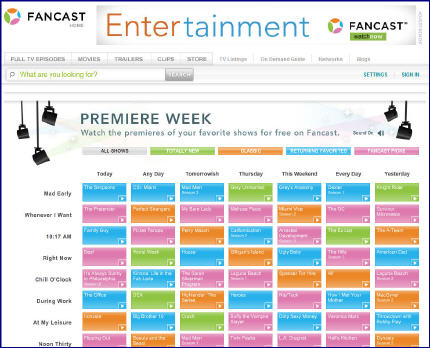
The competition for aggregating premium programming continues to intensify. Business models are all over the board as are approaches for getting video all the way to the TV. For example, last week Amazon launched its pay-per-use VOD initiative which includes a page of info for how to watch using TiVo, Sony Bravia Internet Video Link, Xbox 360, etc. Then yesterday, Netflix announced that it will incorporate about 2,500 of Starz's movies, TV shows and concerts in its Watch Instantly feature, along with a feed of its linear channel. Still other moves are forthcoming.
Comcast's real lever though is unifying its currently siloed worlds of digital TV, broadband Internet access and Fancast. When converged they're a blockbuster; companies like Netflix, Amazon and others cannot replicate this combination. In particular, Comcast, and other cable operators are ideally positioned to bridge broadband all the way to the TV. That's the last big hurdle to unlock broadband's ultimate value. Whether they'll do so is an open question.
Earlier this year Comcast CEO Brian Roberts unveiled the company's "Project Infinity" which suggested Comcast was looking to unify its various video offerings and bring broadband to its subscribers' TV. It seemed like a promising move, though there was no timeline disclosed. Now, nearly 9 months later I can't find any updates on the status of Project Infinity. It would be great for the company to publicly release a progress report or sense of upcoming milestones.
Promotions like "Premiere Week" are a positive step from Comcast, but real competitive advantage for the company lies in launching services which are truly impossible for others to match.
What do you think? Post a comment.
Categories: Aggregators, Cable TV Operators, Portals
Topics: Amazon, Comcast, Fancast, Netflix, Starz, TiVo
VideoNuze Posts

Connect with VideoNuze
Exclusive News Roundup
- NFL Makes Its Case to FCC During Regulatory Scrutiny WSJ
- Peacock gains subscribers, but losses widen in Q1 The Streamable
- Comcast beats revenue, earnings expectations as broadband losses improve CNBC
- YouTube Inks Deal Making SiriusXM Exclusive Audio Advertising Rep in U.S. Variety
- Netflix plans to buy historic Radford Studio Center as Hollywood enters new era LA Times
- Peacock’s Ad-Free Tier Coming To Roku Premium Subscriptions Under New Agreement Deadline