-
September '08 VideoNuze Recap - 3 Key Themes
Welcome to October. Recapping another busy month, here are 3 key themes from September:
1. When established video providers use broadband, it must be to create new value
Broadband simultaneously threatens incumbent video businesses, while also opening up new opportunities. It's crucial that incumbents moving into broadband do so carefully and in ways that create distinct new value. However, in September I wrote several posts highlighting instances where broadband may either be hurting existing video franchises, or adding little new value.
Despite my admiration for Hulu, in these 2 posts, here and here, I questioned its current advertising implementations and asserted that these policies are hurting parent company NBC's on-air ad business. Worse yet, In "CNN is Undermining Its Own Advertisers with New AC360 Live Webcasts" I found an example where a network is using broadband to directly draw eyeballs away from its own on-air advertising. Lastly in "Palin Interview: ABC News Misses Many Broadband Opportunities" I described how the premier interview of the political season produced little more than an online VOD episode for ABC, leaving lots of new potential value untapped.
Meanwhile new entrants are innovating furiously, attempting to invade incumbents' turf. Earlier this week in "Presidential Debate Video on NYTimes.com is Classic Broadband Disruption," I explained how the Times's debate coverage positions it to steal prime audiences from the networks. And at the beginning of this month in "Taste of Home Forges New Model for Magazine Video," I outlined how a plucky UGC-oriented magazine is using new technology to elbow its way into space dominated by larger incumbents.
New entrants are using broadband to target incumbents' audiences; these companies need to bring A-game thinking to their broadband initiatives.
2. Purpose-driven user-generated video is YouTube 2.0
In September I further advanced a concept I've been developing for some time: that "purpose-driven" user-generated video can generate real business value. I think of these as YouTube 2.0 businesses. Exhibit A was a company called Unigo that's trying to disrupt the college guidebook industry through student-submitted video, photos and comments. While still early, I envision more purpose-driven UGV startups cropping up in the near future.
Meanwhile, brand marketers are also tapping the UGV phenomenon with ongoing contests. This trend marked a new milestone with Doritos new Super Bowl ad contest, which I explained in "Doritos Ups UGV Ante with $1 Million Price for Top-Rated 2009 Super Bowl Ad." There I also cataloged about 15 brand-sponsored UGV contests I've found in the last year. This is a growing trend and I expect much more to come.
3. Syndication is all around us
Just in case you weren't sick of hearing me talk about syndication, I'll make one more mention of it before September closes out. Syndication is the uber-trend of the broadband video market, and several announcements underscored its growing importance.
For example, in "Google Content Network Has Lots of Potential, Implications" I described how well-positioned Google is in syndication, as it ties AdSense to YouTube with its new Seth MacFarlane "Cavalcade of Cartoon Comedy" partnership. The month also marked the first syndication-driven merger, between Anystream and Voxant, a combination that threatens to upend the competitive dynamics in the broadband video platform space. Two other syndication milestones of note were AP's deal with thePlatform to power its 2,000+ private syndication network, and MTV's comprehensive deal with Visible Measure to track and analyze its 350+ sites' video efforts.
I know I'm a broken record on this, but regardless of what part of the market you're playing in, if you're not developing a syndication plan, you're going to be out of step in the very near future.
That's it for September, lots more planned in October. Stay tuned.
What do you think? Post a comment!
Categories: Aggregators, Analytics, Brand Marketing, Broadcasters, Magazines, Partnerships, Syndicated Video Economy, UGC
Topics: ABC, Anystream, AP, CNN, Doritos, Google, Hulu, MTV, NY Times, Taste of Home, thePlatform, Unigo, Visible Measu, Voxant, YouTube
-
Key Takeaways from Yesterday's MTV - Visible Measures Deal
Yesterday brought news that MTV Networks has signed a deal with Visible Measures, a third-party analytics firm, to measure broadband video activity across over 340 of its sites. This is by far the biggest deal that Visible Measures has landed to date. And in the torrent of broadband deals and partnerships that hit my inbox each day, I believe this one is noteworthy for 3 reasons:
1. More evidence of syndication's growing importance to major media companies
A number of recent announcements have underscored the broadband market's shift to the "syndicated
 video economy," but this move by MTV demonstrates how the SVE concept is starting to infiltrate major media companies' thinking. To date many of these companies have taken a somewhat informal approach to syndication, giving users embed code or passing clips on to YouTube for promotion, but not diligently measuring the activity or benefits.
 MTV's deal shows serious intent to measure its syndication activity and use the resulting data to help shape its broadband video efforts. As a leader in broadband video, MTV's Visible Measures deal is certain to prompt other major media companies to up their commitment to syndication as well. This would synch with a comment a CEO of a broadband technology vendor told me yesterday: "...every content company we deal with has now prioritized syndication and they are actively addressing the technical, business and political issues."
2. Programming business changing to be more data-centric
You can be sure that when armed with a trove of new Visible Measures-generated data about how its users watch and engage with its video, MTV's programming decisions will be influenced accordingly. As I wrote in my initial post about Visible Measures last June, that's one of the beauties of broadband consumption vs. TV - all user behavior can be tracked and assessed. By knowing - down to the frame - things like when viewers dropped out, what scenes they rewound/viewed repeatedly and what clips they most shared, MTV's programming decisions should become ever smarter.
 Stalwart creatives may decry this research-intensive approach to program development, but in media businesses challenged to reduce costs and increase profitability, anything that helps predict what users will watch (and therefore help drive a higher ROI per program) is invaluable. This is especially true for TV networks trying to rationalize the pilot process. Gauging real-life user reactions to various videos online can only make the pilot process more effective.
3. Ad model becomes even more important, and more refined
Though there's wide consensus that advertising will drive the broadband business for the foreseeable future, there is acute anxiety about how advertising will ultimately work (formats, insertion frequency, etc.) and how much revenue it will produce. While there's been plenty of testing to date, there's also been much guesswork involved. MTV for one will now have a bird's-eye view into its users' reactions to various ad implementations so it can continually refine its approach.
Optimizing the broadband ad model is a key issue for all players in the market. Recently I asserted that Hulu is leaving a lot of money on the table with its current ad approach, and is also pressuring parent company NBC's own ad business. I suggested Hulu could insert more ads, but without hard data, it's impossible to say how much more. Here's another example: all those viral SNL clips of Tina Fey doing Sarah Palin could mean real money for NBC, yet without proper tracking and ad implementations their real value is being underoptimized. The list of examples goes on. More data on video usage can really help the ad model.
In sum, MTV's deal with Visible Measures is both a positive step in the ongoing maturation of broadband video, syndication and advertising and a harbinger of more deals to come.
(Note: if you'd like to learn more about MTV's and others' syndication strategies, please join me for a panel I'll be moderating next Tuesday, October 7th at Contentonomics in LA. Joining me are MTV's Greg Clayman, Revision3's Damon Berger, ClipBlast's Gary Baker and EgoTV's Jimmy Hutcheson. Information and registration is here.)
What do you think? Post a comment.Categories: Analytics, Cable Networks
Topics: MTV, Visible Measures
-
Early Bird Seating Available for VideoNuze's Broadband Leadership Breakfast
A reminder that early bird seating is now available for VideoNuze's inaugural Broadband Video Leadership Breakfast Panel. The breakfast, in association with CTAM's New York and New England chapters, will be held in Boston on Nov. 10th at 7:30am, preceding the first full day of the annual CTAM Summit (separate registration).
I'll be moderating the session which is entitled "How to Profit from Broadband Video's Disruptive Impact" and features an A-list group of executives:
- Deanna Brown - President, SN Digital, Scripps Networks
- Bill Carr - Vice President, Digital Media, Amazon
- David Eun - Vice President, Content Partnerships, Google/YouTube
- Fred Seibert - Creative Director/Co-Founder, Next New Networks
- Peter Stern - Executive Vice President, Strategy and Product Management, Time Warner Cable
Click here to register for the early bird special
This unique event is a must attend for anyone navigating today's broadband video world. We'll examine key broadband topics like business models, syndication, user-generated video and consumer behavior changes. You'll come away with a clear sense of how these 5 companies are benefiting from broadband's growth, and what you too can do to profit from its disruptive impact.
The Leadership Breakfast is generously sponsored by ActiveVideo Networks, Akamai, Anystream, KickApps and Yahoo.
Click here to register for the early bird special
I hope to see you there!
Categories: Events
Topics: Broadband Video Leadership Breakfast
-
Presidential Debate Video on NYTimes.com is Classic Broadband Disruption
Here's a classic example of how broadband is causing traditionally distinct worlds to collide: on Friday night the NYTimes.com opened up a dedicated streaming video window on their home page, where the presidential debate played for the full hour and a half. I watched the first half of the debate there, before switching on the TV and watching it on CNN HD. While HD was obviously superior, the NYTimes.com's video was more than adequate (though disappointing there was no full screen option).
Saturday morning and NYTimes.com is offering the video on demand, with an accompanying full written transcript. You can search (try typing "wrong" to see), to get how many times each candidate used that term, and then jump to the points in the video when it was used (alas, it would be great if the Times gave the ability to clip that specific segment and virally distribute it). The Times does offer a "check point" feature, where it fact checks the candidate's assertions. Note that other sites like ABCNews.com and CNN.com have the debate on demand today as well, but not the interactive features that NYTimes.com has.
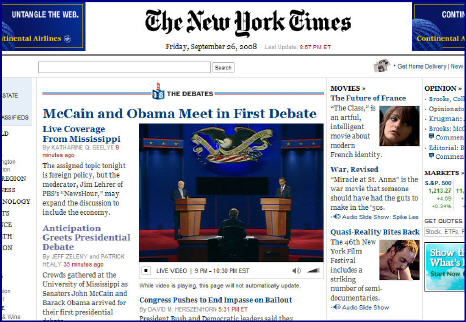
Stop and consider how significant all of this is - a print publisher using broadband to offer a clear alternative to broadcasters and cable networks in carrying high-quality video. It's a great value proposition just for people without access to TVs at the moment of the live event, but more important, it provides a glimpse of some very interesting additional opportunities for NYTimes.com.
For example, the site could host its own post-debate punditry show, assembling its all-star lineup of daily Times columnists. Dedicated Times readers would no doubt love to see a roundtable with Frank Rich, Tom Friedman, William Kristol, Maureen Dowd and others dissect the candidates' performances, rather than waiting for their thoughts to come in columns over the next several days. Also think about how this type of show would scoop Sunday talk shows like NBC's "Meet the Press" or ABC's "This Week with George S." in bringing serious punditry to political junkies who can't wait.
In fact, the NYTimes.com could even offer viewers the ability to interact with their columnists, building on the wildly popular commenting feature already available with each daily piece in the paper itself. This type of immediacy and interactivity would be very compelling. The site could also offer the live debate video stream with a companion chat area that would enable viewer engagement during the debate itself (see Paltalk for an example of how this could work).
And last but not least, NYTimes.com could offer a single premium sponsorship slot to underwrite its whole debate coverage. Think Mercedes, Four Seasons, Cartier or other upscale brands might be interested?
As I've said many times, broadband blurs previously siloed worlds, bringing more competition to traditional players like broadcast and cable networks. They now need to deliver more to stay competitive. For video entrants like NYTimes, broadband creates enormous new opportunities to both leverage core assets/talent and pioneer new and different ways to create value. Another reminder why broadband is so disruptive for so many.
What do you think? Post a comment.
Categories: Broadcasters, Cable Networks, Newspapers, Politics
Topics: ABC News, CNN, NYTimes.com, Paltalk
-
Truveo Helps Clear Video Search Fog with New Study
A couple of days ago, Truveo, the big video search engine owned by AOL, released the results of an internal study which concluded that it provides the most comprehensive search results among 5 companies considered. Before you say, "Duh, Will, what else would you have expected Truveo to conclude?!" it's worth spending a few minutes considering the study's methodology, results and implications. Video search is an extremely strategic space, so all credible data has value.
When it comes to search, there are really two key criteria to judge quality - coverage and relevancy. A search engine can return a million results, but if none are relevant, it's pointless. Conversely, just one spot-on result and you'll rejoice, but you still may yearn for additional, relevant options (since video quality can vary, links may be broken, the user experience at certain sites may stink, etc.). So optimizing both coverage and relevancy must be the goal.
In Truveo's study, it has focused solely on coverage, having deemed relevancy too subjective to credibly
 measure. To quantify coverage from a competitive standpoint, it chose 4 other search engines, Blinkx, Microsoft Live Video Search, Google Video and Yahoo Video. This limited pool immediately begs the question how the many other video search companies not included would have fared. Truveo explained that the testing was very resource-intensive, so they needed to keep the competitive set relatively small.
To measure coverage, Truveo selected 100 top-ranked Alexa sites across 5 categories: news, sports, TV, music and movies. Then they found 10 representative videos from each and ran a query for those videos - using the exact title the site used - on each of the 5 search engines. Scoring was binary - a search engine got a 1 if they returned an accurate result for at least 5 of the 10 queries, a zero if they didn't. Final score from this process, Truveo 86, Blinkx 20, Microsoft Live Video Search 17, Google Video 3, and Yahoo 2.
Having reviewed the test's full methodology and spoken to a Truveo representative, I think for the most part their approach is pretty fair. An obvious limitation is that lots of video search engines (or web search engines like Google) weren't evaluated so the study is by no means conclusive. Further, only premium sites were included (i.e. no UGC, and actually very little indie video either), so one wonders how the results would have changed if sites like Break.com, Heavy and others were also tested. And then there's the small matter of YouTube, the market's 800 pound gorilla, not being included at all. Since for many users video search begins and ends with YouTube, its omission raises a question about just how reflective these results are of real-world user behavior.
Nonetheless, Truveo gets points in my book for shedding further light on a very confusing subject, and also constructing a relatively objective methodology that can be used by others (in fact Truveo is encouraging independent 3rd parties to undertake more testing of this kind).
Video search is one of the most intellectually challenging areas of the broadband video ecosystem, yet as Truveo asserts, there is surprisingly little evaluative data out there. From my standpoint, more data means more informed market participants and therefore continually improving user experiences. That benefits everyone in the broadband ecosystem.
What do you think? Post a comment now.
(Note, the complete methodology can be requested by emailing Josh Weinberg at jweinbergATtruveo.com)
Categories: Video Search
Topics: Blinkx, Google Video, Microsoft Live Video Search, Truveo, Yahoo Video, YouTube
-
Doritos Up UGV Ante with $1 Million Prize for Top-Rated 2009 Super Bowl Ad
The frenzy around user-generated video ads hit a new peak yesterday as Frito-Lay announced it is offering a $1 million prize to an amateur who creates a Doritos ad that scores the highest rank in USA Today's Super Bowl Ad Meter.
I believe the new campaign, which comes on top of 2 previously successful Super Bowl user-generated video ("UGV") ad contests from Doritos, is a sure-fire winner for the brand. It reflects some very smart thinking by Doritos' executives and will further accelerate the very significant trend around brand-sponsored UGV contests (see chart below for examples of UGV contests that have run in the past year). I've been writing about the UGV ad craze for a while now on VideoNuze and I see it driving continued evolution in brand-agency relations.
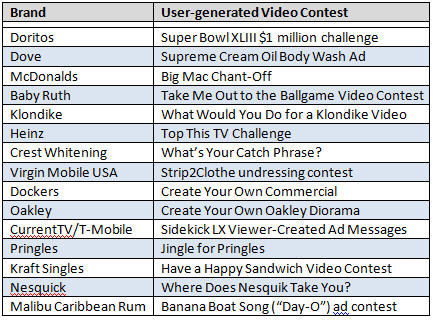
The new Doritos UGV campaign works for a variety of reasons. First and foremost, the top prize, and the four finalist prizes of $25,000 and a trip to the Super Bowl, are all very enticing awards, certain to drive tons of submissions. Winning the top prize - which requires the #1 rank in the USA Today Ad Meter - is a big-time challenge, but it is seriously aided by all the pre-game publicity this contest will be receiving. Doritos is cleverly stoking things by positioning the ad as an opportunity to "take down the big guys" - an obvious reference to Anheuser-Busch which has won the #1 rank for the last 10 years. With "Yes We Can" and "Yes We Will" political slogans ascendant, "power to the people" pitches like the one Doritos is making have a nice tailwind on their side.
This pre-game buzz means Super Bowl viewers are specifically going to be on the lookout for the Doritos UGV ad, helping its rank. Of course if you're an advertiser, especially in this ad-skipping era, viewer anticipation for your ad is close to nirvana as it gets. It builds brand awareness, engagement and presumably sales...3 big wins when you're spending an estimated $3 million for a 30 second Super Bowl ad. And of course, just think about all the free market research Doritos is collecting along the way, as loyal buyers showcase their thoughts and feelings about the product and brand.
In fact, it's Doritos' decision to morph a conventional Super Bowl ad buy into a broadband-centric, user-oriented campaign that's truly noteworthy here. VideoNuze readers know that I've been ranting for 3 straight Super Bowls that broadband opens up all kinds of new creative avenues for brands to extract new value from their game-day spending and generate a far-better ROI on the insane prices they're required to pay for this once a year extravaganza.
I have been appalled at how few Super Bowl advertisers have actually seized their broadband opportunities (note having ads playing in post-game online galleries is nice, but nowhere near what broadband is capable of). All of this has caused me to wonder whether agencies, and brands, were hopelessly oblivious to broadband's emerging role.
Doritos clearly is not among those trapped in yesterday's advertising thinking. It seems to get what broadband can do for its brand and its Super Bowl ad strategy. With its new UGV campaign, the ROI that Doritos will get on its actual game-day spend will far surpass those of its competitors. With luck that should help spur others to focus more on broadband in their future Super Bowl ads.
What do you think? Post a comment!
Categories: Brand Marketing, Sports, UGC
Topics: Anheuser-Busch, Doritos, Frito-Lay
-
Associated Press Ratchets Up Syndication Efforts with thePlatform
Another day, and another milestone reached in the market's ongoing embrace of video syndication.
Yesterday's significant news was that the Associated Press, which has built arguably the largest private broadband syndication network, including over 2,000 affiliates which receive thousands of video clips each month, has signed up thePlatform to power its Online Video Network. The deal effectively replaces Microsoft, which has been AP's partner for OVN for the past several years. AP uses OVN primarily to feed daily video clips to its newspaper and broadcast partner web sites which it monetizes through ads. Yesterday I caught up with Ian Blaine, thePlatform's CEO to learn more about the deal.
Ian explained that while the scale of AP's video syndication model is far more extensive than anything his company has supported in the past, thePlatform's ability to handle similar kinds of issues that AP faces was crucial in winning the deal. First and foremost is providing a workflow model that allows video assets to be ingested, encoded, tagged and distributed to the whole OVN in under 15 minutes. In the news business, obviously every second counts.
Beyond workflow efficiency, Ian explained that AP has a dizzying set of business rules that apply to its
 syndicated video, depending upon the particular outlet. So AP producers also have to be able to expeditiously apply policies and track each video accordingly. AP is also enabling its affiliates to upload their own videos, which are melded with AP video in the affiliate's player. So that required some of thePlatform's tools to be extended to affiliates, along with some basic video player customization.
The obvious question here is whether and when AP will extend OVN to the thousands of sites beyond its 2,000 current affiliates. Like Google Content Network which has virtually infinite end points, or even Anystream-Voxant which has 30,000+ publishing partners, why should AP restrict itself, particularly when news video is one of the hottest categories around? While hesitating to speak for AP's roadmap, Ian's sense was that AP first wants to master syndication to its own affiliates before considering opening up a full-blown video marketplace.
As I've written previously, my enthusiasm for the Syndicated Video Economy is tempered by the reality that significant operational, financial and strategic friction still impedes the model. Coincidentally, late yesterday someone asked me:"How will this syndication friction be resolved and how long will it take?" My response: "I can't say how long it will take, but the more experience the broadband ecosystem gets with real-world syndication, the faster the model will mature." In this respect, partnerships between big content providers like AP and capable technology partners like thePlatform will help move the model forward for everyone.
What do you think? Click here to post a comment.
Categories: Syndicated Video Economy, Technology
Topics: Associated Press, thePlatform
-
Startup Unigo Harnesses "Purpose-Driven" User-Generated Video to Drive Disruption
I was absolutely riveted by an article I read in this past Sunday's NY Times Magazine entitled "The Tell-All Campus Tour," about Unigo, a tiny startup which threatens major disruption to the college guidebook industry. In particular, the company's emphasis on user (i.e. college student) generated video caught my attention. It got me thinking again about the business value that "purpose-driven" UGV has when it is properly channeled.
I've touched on this theme in the past, with respect to brand marketers' UGV contests that have unleashed all kinds of "amateur" creativity (see "Baby Ruth Hits a Home Run..." or "And the Oscar Goes To...Dove"). These contests have demonstrated that, with the proper incentives, users' passions and video know-how can lead to really compelling results. Now, upon reading about Unigo, I've become further convinced that there are bona fide startup opportunities in leveraging purpose-driven UGV.
To put this in context, YouTube struck gold by enabling, for the first time, random, and largely
 unmonetizable, user generated video. Now a new generation of startups like Unigo can build on the YouTube phenomenon by focusing on purpose-driven UGV. To succeed, I think these companies will have 3 common elements: a reasonably large existing market that can be disrupted through the use of purpose-driven video (mixed with other web 2.0 features), a critical mass of amateur video creators who are self-motivated to produce high-quality, authentic video, and a group of advertisers eager to reach targeted audiences through new alternatives to traditional channels.
 That's a mouthful, so let me use Unigo to break this down a bit. For starters, the company was founded by a precocious 23 year-old whose can-do energy and deep understanding of the college market is equally matched by his lack of real-world experience and formal company financing. All of that illustrates lesson #1 for purpose-driven UGV entrepreneurs: the barriers to creating these kinds of startups is shockingly low.
Somewhat buried in the 3,400+ word article is what resonated for me: Unigo bought a hundred Flip video cameras ($90 apiece at Amazon, fyi) and strategically distributed them to students at over 100 campuses nationwide, with no clear instructions on what to do next. The resulting student-created videos (which are continually submitted) span the gamut from slice-of-life to panoramic to comedic to everything in between. Unigo features text-based student submissions and photos, which, when combined with the videos, form an unvarnished - and unprecedented - user-generated multimedia guide to the America's campuses.
Simply put, Unigo is a product created by the YouTube/Facebook generation for the YouTube/Facebook generation. It offers a simple, breakthrough value proposition that will no doubt attract a large audience. And that large audience will be extremely interesting to all manner of advertisers.
Unigo's business value could make it a TripAdvisor-like, must have resource that initially augments, but could eventually squeeze traditional guidebooks and ratings services. While it is still way too early to call Unigo a success by any traditional standards, the work it has done to date offers a fascinating window into the emerging purpose-driven UGV-centric business model. That makes it well worth keeping an eye on.
What do you think? Click here to post a comment.
Topics: TripAdvisor, Unigo, YouTube
VideoNuze Posts

Connect with VideoNuze
Exclusive News Roundup
- NFL Makes Its Case to FCC During Regulatory Scrutiny WSJ
- Peacock gains subscribers, but losses widen in Q1 The Streamable
- Comcast beats revenue, earnings expectations as broadband losses improve CNBC
- YouTube Inks Deal Making SiriusXM Exclusive Audio Advertising Rep in U.S. Variety
- Netflix plans to buy historic Radford Studio Center as Hollywood enters new era LA Times
- Peacock’s Ad-Free Tier Coming To Roku Premium Subscriptions Under New Agreement Deadline