-
Facebook Puts Video Center Stage
Facebook reported record results for 2015 late yesterday and on the earnings call, video was the first thing Mark Zuckerberg highlighted when discussing the company’s product strategy for delivering more engaging experiences. He added that 100 million hours of video are now watched daily on Facebook by 500 million people (though “watch” can be an ambiguous term for Facebook given its autoplay, audio-off format).
Categories: Advertising, Brand Marketing, Social Media
Topics: Facebook, Visible Measures
-
Study: YouTube Beauty Video Views Up 50% In Past 15 Months
Pixability has released its second annual, deep-dive, "Beauty on YouTube" report, finding, among other things that beauty video views have increased by 50% between January, 2014 and April, 2015. Overall, beauty is one of the most vibrant verticals on YouTube, with 1.8 million videos driving 45.3 billion total views to date, of which 55% are now viewed on mobile devices.
There are over 123 million subscribers to YouTube beauty channels. Makeup accounts for 51% of beauty videos, far ahead of hair (28%), nails (10%) and skincare (6%). No surprise, 89% of YouTube's beauty audience is female.Categories: Brand Marketing
Topics: Michelle Phan, Pixability, YouTube
-
Study: Video is Preferred Content Source for Brand Information
A new study from Brightcove has found that 76% of consumers cite video as their preferred content source when consuming brand information, with 79% overall favoring digital content over traditional. In addition, 24% of respondents said video is their "most trusted" source for brand content, with 44% of them saying video was more appealing, authentic (29%), engaging (28%) and shareable (10%) than other communication formats.
Categories: Brand Marketing
Topics: Brightcove
-
Branded Videos Generated 8.3 Billion Views in 2013, Up 44% vs. 2012
People want to skip ads, right? The conventional wisdom is yes, but it turns out the answer isn't quite so simple. In fact, viewers are seeking out, watching and sharing certain types of advertisers' messages in record numbers. According to Visible Measures 2013 Branded Video report, branded videos (video campaigns advertisers posted online, as opposed to video ads that run in-stream, etc.), generated 8.3 billion views, up 44% vs. 2012.
There's huge momentum in branded videos: of the 8.3 billion views, 6.5 billion, or 78%, were for campaigns newly launched in 2013. This compares with 3.8 billion views for new campaigns launched in 2012 and 1.7 billion views for campaigns launched in 2011.Categories: Brand Marketing
Topics: Visible Measures
-
Report: Major Brands Control Just 3% of YouTube's 14.9 Billion Beauty Videos
According to a new report from video analytics provider Pixability, beauty brands are dominated on YouTube by independent beauty personalities and video bloggers ("vloggers") in terms of video views and engagement. Pixability found that major brands have just 3% of the 14.9 billion beauty-related video views on YouTube. YouTube vloggers, "haul girls," and other beauty content creators control 97% of conversations around beauty topics and related brands on YouTube.
Categories: Brand Marketing, Indie Video
Topics: Pixability, YouTube
-
Brightcove Survey: 62% of Viewers Blame Brand if They Experience Poor Video Quality
Poor quality online video experiences cost brands in numerous ways, according to a new Brightcove survey. 62% of respondents are likely to blame the brand, rather than their ISP or video hosting provider such as YouTube, when encountering poor quality video. In addition, 60% of respondents experiencing poor video quality said it would dissuade them from social engagement with the brand, 57% said they'd be less likely to share a low quality video and 23% said low quality would make them hesitant to purchase from the brand.
The Brightcove survey highlights quality issues with YouTube specifically, which brands have aggressively embraced for its massive reach. But while YouTube offers huge audience potential, 75% of survey respondents reported experiencing buffering and freezing on the site, with 33% saying these problems affect half of the videos they watch. This leads to about 1/3 of viewers experiencing problems abandoning the video rather than waiting for the buffering to stop.Categories: Brand Marketing
Topics: Brightcove, YouTube
-
Poll Shows Strong Interest in Building Video Audiences Through Paid Recommendations
Taboola and Kaltura have released the results of a poll taken during a recent webinar they conducted, in which attendees (content publishers and advertisers) were asked about their interest in using paid recommendations/native advertising to build their video viewership. The poll found that while 27% currently use paid recommendations/native advertising, 95% said they would "consider switching from marketing their videos using traditional advertising to paid recommendations/native advertising in the next few years."
(Note a couple of caveats here: the sample size was just 34 respondents, so the results are more directional than statistically significant. Also the webinar itself was focused on content recommendations, so presumably those attending were already interested in the topic.)Categories: Advertising, Brand Marketing
-
Study: 99% of Top Global Brands Embrace YouTube Marketing, But With Divergent Results
Underscoring how important YouTube has become as a marketing channel, a new study (free download here) from Pixability has found that all but one of the Top 100 Global Brands (as identified by Interbrand) now maintain a presence on YouTube. Together these 99 brands have generated 9.5 billion views on YouTube across 2,200+ channels, with over 258K videos posted.
Beyond the overall volume of activity, the Pixability study discloses a wide variation in the activity level and effectiveness of the brands' channels. Most striking is that less than half the brand videos posted gained 1,000 views or more while just 1,300 videos - a tiny fraction of all the total posted - achieved more than 1 million views. Further, 37% of brand channels haven't been updated with new content in over 120 days and many brands' channels were simply inactive.Categories: Brand Marketing
Topics: Pixability, YouTube
-
PepsiCo's Marketing Chief Sees a Huge Opportunity for Episodic Content Online [VIDEO]
Last week at NATPE, I had the pleasure of interviewing Frank Cooper, PepsiCo's Chief Marketing Officer, Global Consumer Engagement. Frank provides great insights into how PepsiCo's brands are evolving from a traditional approach to marketing to the consumer, to one that is more focused on engaging them with the brands. Part of doing this involves adopting a "beta culture" throughout the company, where campaigns are iterative and not necessarily fully polished at the outset.
Frank sees content as a key element in engaging consumers and believes there's a huge opportunity in episodic content online, where PepsiCo brands themselves will become more active. That said, he's very pragmatic about branded entertainment, explaining that these days everyone is vying for the consumer's precious attention. Brands can't do sub-par work if they expect to be competitive in their entertainment offerings.
Among the other topics Frank discusses:
- The increasingly important role of data in informing content choices, channels and other decisions.
- How expectations of those under age 25 differ from those older than 25.
- Success metrics of two recent campaigns, Mountain Dew's "DEWmocracy" and Pepsi Refresh and what the company learned from each of these.
- The organizational challenges consumer packaged goods companies face in adapting their marketing practices.
And more.Categories: Brand Marketing, Branded Entertainment
-
Macy's Marketing SVP: "We Think We're An Entertainment Brand" [VIDEO]
It may be 155 years-old, but Macy's marketing approach is thoroughly modern, as the company has fully embraced mobile and digital technologies to drive its business. In a fireside chat at the VideoNuze 2012 Online Video Advertising Summit, Macy's SVP, Marketing Innovation and Integration, Joe Feczko explains how Macy's sees itself as an entertainment brand, and how it is pushing further into video and branded content.
One initiative in particular that has paid off is the use of QR codes linked to videos about products. Joe said usage has jumped from 15K during the test phase to 750K this past season. Macy's is also leveraging its relationships with celebrities and the new program "Fashion Star" for more interactivity with target customer segments. Joe provides a compelling look inside how an established brand is using all of today's technology tools to keep up with a changing retail landscape.Categories: Brand Marketing
Topics: Macy's
-
Tumi Backs New Bourdain Web Series While Avoiding TV Ads
More proof that online video is opening up new advertising and engagement possibilities beyond traditional TV, as premium travel lifestyle company Tumi - which has never run a TV ad - has opted to exclusively sponsor a new web series called "Bourdain's TV Crew." Tumi's SVP, Brand Management, Alan Krantzler told me last week that its commitment was driven by a desire to increase brand awareness among younger customers and to leverage Bourdain's large Facebook fan base to build its own.
Categories: Advertising, Brand Marketing, Indie Video
Topics: Anthony Bourdain, Outrigger Media, Tumi, Zero Point Zero Productions
-
VideoNuze Report Podcast #105 - Coldwell Banker's On Location - July 22, 2011
Daisy Whitney and I are pleased to present the 105th edition of the VideoNuze Report podcast, for July 22, 2011.
In this week's podcast, Daisy and I broaden our focus beyond how media companies are using online video by discussing Coldwell Banker's "On Location" YouTube channel, which I wrote about earlier this week. The customized mapping unit in On Location allows home buyers to easily find and play videos about homes that meet their criteria as a starting point in their search process. Daisy notes that On Location is another example of how consumers are able to take better control and use online tools to educate themselves. Smart companies like Coldwell Banker are using online video to reinvent the way they do business and stay relevant in the changing digital world.
Click here to listen to the podcast (11 minutes, 56 seconds)
Click here for previous podcasts
The VideoNuze Report is available in iTunes...subscribe today!Categories: Brand Marketing, Podcasts
Topics: Coldwell Banker, Podcast, YouTube
-
Coldwell Banker's On Location YouTube Channel Helping Reinvent Home Search
Never mind that Coldwell Banker is a 105 year-old brand; it is pursuing a thoroughly up-to-date strategy of engaging with its customers through the use of online video. Coldwell Banker's "On Location" YouTube channel turns the process of finding a house from a dry text-oriented approach to one that's graphical and video-based. At last month's ELEVATE: Online Video Advertising Summit, Michael Fischer, Coldwell Banker's Chief Marketing Officer, explained the company's strategy and how it's executing (see below for session video).
One data point has galvanized the company: 73% of homeowners are more likely to work with a realtor who offers to do a video for their listing, however only 12% of the real estate industry currently has YouTube accounts. That disconnect has led Michael and the Coldwell Banker team to see video as the thread that pulls together all of its online efforts. Michael believes that with the explosion of online video viewing, consumers have come to expect a video-based experience and that Coldwell Banker can differentiate itself by delivering it.
Categories: Brand Marketing
Topics: Coldwell Banker, YouTube
-
Coldwell Banker Chief Marketing Officer to Speak at ELEVATE
I'm delighted to announce that Coldwell Banker Real Estate Chief Marketing Officer Michael Fischer will present a case study at ELEVATE: Online Video Advertising Summit on Tuesday, June 7th in NYC. His session, "Brand Innovation with Online Video: A Case Study" will be one of the highlights of an action-packed day of learning and networking.
Since joining Coldwell Banker as SVP of Marketing in February, 2008 and subsequently being named CMO in April, 2010, Michael has been instrumental in driving the company's brand online, including re-launching coldwellbanker.com which includes IDX listings and advanced search capabilities, mobile WAP sites and apps including a video-enabled iPad app. Importantly, under Michael's watch, Coldwell Banker has fully embraced the role of video in its brand messaging by building out its YouTube channel, running viral marketing campaigns and leveraging community involvement.
Michael will share lessons learned and key metrics for how video is helping drive Coldwell Banker's business. Michael's insights will be invaluable for industry professionals looking to increase online video's role in their marketing mix.
Early bird registration for ELEVATE is available now.
Categories: Brand Marketing, Events
Topics: Coldwell Banker, ELEVATE
-
Little League + Facebook + Hilton HHonors = Home Run
One of the things about online video that has always intrigued me is how it gives brands innovative ways to engage with target consumers. Thus, a promotional email I received last night, as a parent of a 9-year old Little Leaguer, caught my attention. Little League has partnered with Hilton HHonors for a "play of the week" contest, which calls for parents to submit videos of their favorite plays (aka their kid's shining moments) to a special section of Hilton HHonors Facebook page. Each week that batch of videos will be judged and a winner will be placed into a group of 20 finalists, eligible for prizes. From my perspective, the contest is a home run for all parties.
Hilton HHonors gains 100% share of voice in a campaign that positions them nicely as a "good guy," helping parents draw attention to their kid's on-field accomplishments. The company also gains all the contact information for each participant, giving it valuable information for future communications.
Categories: Brand Marketing, Social Media, UGC
Topics: Facebook, Hilton HHonors, Little League
-
Magnify.net Lands Patagonia As Video's Role Broadens to Supporting Brands
Magnify.net, a provider of video management and curation services, is announcing later this morning that its platform will be used by Patagonia, the outdoor clothing and gear company, to power a new multimedia gallery on its site.
The video-focused initiative will highlight Patagonia's commitment to environmentalism and reinforce its brand positioning. In explaining the gallery's role and using Magnify, Bill Boland, Patagonia's creative director, online, said, "Together, we expect to build a brand, lifestyle and e-commerce experience that will connect with our customers and provide both knowledge and entertainment for them." The deal is significant because it's yet another example of how video's use is evolving to include non-media companies who see video's strategic video in supporting their brands, not in the traditional ad-based or paid models. I caught up with Steve Rosenbaum, Magnify's founder and CEO yesterday to learn more about the deal and this broader trend.
Categories: Brand Marketing, Technology
Topics: Magnify.net, Patagonia
-
5 Items of Interest for the Week of Sept. 13th
It's Friday and that means once again VideoNuze is featuring 5-6 interesting online/mobile video industry stories that we weren't able to cover this week. Read them now or take them with you for the weekend. Enjoy!
Meet YouTube's Most In-Demand Brand Stars
A fascinating look at how major brands are hiring amateurs who have gained large followings on YouTube to pitch their products. The concept of "celebrity spokesperson" is getting redefined in the online video era.
Logitech Revue with Google TV Coming 9/29 for $299, Dish Network Offering Discounts?
We may be less than 2 weeks away from Logitech's "Revue," the first implementation of Google TV, hitting the market, with Dish Network subscribers possibly getting a deeply discounted $179 offer. The connected device space is increasingly crowded and there's high anticipation to see how Google TV stacks up.
Pre-order a Boxee Box Now
Speaking of connected devices, Boxee announced this week that pre-ordering is available from Amazon for its Boxee Box connected device, manufactured by D-Link. Like Google TV, but unlike Apple TV or Roku, Boxee offers the prospect of browsing the full Internet for video, not just what's been integrated with the device.
Samsung Reveals Tablet Launch Plans
Meanwhile the strongest potential competitor to the iPad, Samsung's "Tab" will begin shipping in just a few weeks, with availability from all 4 major U.S. wireless carriers. The Tab is very focused on mobile video, running Android 2.2 which supports Flash 10.1. That means Hulu and all other Flash-based video should work, significantly expanding the universe of choices beyond what is available on the iPad. No pricing yet, but the Tab looks like a meaningful iPad alternative.
Ivi Seeks to Become an Online Cable System
Can an online service retransmit network TV through the Internet, and charge for it without having any underlying agreements in place with the networks themselves? That's what Ivi, which unveiled its software this week, is attempting to do, pointing to U.S. copyright law as making its offer legit. We'll see; with TV networks gaining no new revenue coming in plus the risk of cannibalization we should expect them to raise vigorous legal challenges.
Categories: Aggregators, Brand Marketing, Broadcasters, Devices, Mobile Video
Topics: Boxee, D-Link, Google TV, Ivi, Logitech, Samsung, YouTube
-
JetBlue Uses Customer Video to Tell Its Story Well
Long-time VideoNuze readers know I'm continuously following how brands are reinventing the way they communicate with customers and prospects through the use of online video. The latest example to hit my radar is JetBlue, which has just launched a video-rich area of their web site called "Experience JetBlue." As this article notes, JetBlue has recognized that customer testimonials about tangible attributes (e.g. more leg room, on-board TV, etc.) provided in an authentic, non-interruptive way, resonate well. Beyond the four current testimonials, there is also a ton of background video in the mini-site.
Coincidentally, I just flew JetBlue back and forth from Boston to the west coast this week. One other thing I'd say about why this customer testimonial/online video approach works is that they're true and accurate, which speaks to the opportunity and risk of this approach. When real people are featured, they better be telling the truth, or trust in the brand will be seriously damaged. But if they are, then there's a lot of upside. The success of user-review sites like TripAdvisor, Yelp and others shows that people really do care what other people have to say. Video just enhances things further. As a result, I expect we'll see more brands go this route.
What do you think? Post a comment now (no sign-in required).Categories: Brand Marketing
Topics: JetBlue
-
YouTube As the Ultimate Brand Engagement Platform
Surfing over to YouTube the other day, I was struck by how the site could well become the ultimate brand engagement platform. Below is a screen shot of what I found - nearly all the visible real estate showcased 2 different brand contests encouraging users to submit videos for a chance to win prizes.
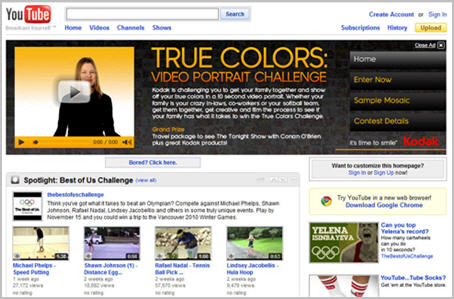
The first contest, the "Kodak True Colors: Video Portrait Challenge," was just kicking off, and therefore had prominent positioning. The contest urges users to submit as many 10-second videos as they'd like in pursuit of a grand prize including 2 tickets to a taping of the "Conan O'Brien" show. The other contest, "The Best of Us Challenge," by the International Olympic Committee, shows athletes doing something outside their specialty (e.g. Michael Phelps doing speed putting, Lindsey Jacobellis doing the hula hoop) and asks user to emulate these or create their own challenge. The winner receives a trip for 2 to the 2010 Vancouver winter games. The contest was featured in YouTube's "Spotlight," a section on the home page populated by YouTube's editors based on user ratings.
These types of brand contest are not necessarily new, nor are their inclusion in YouTube. Over a year ago I suggested there was real opportunity in what I called "purpose-driven user-generated video" - the idea that with YouTube turning millions of people into amateur video producers, their enthusiasm and skills could be channeled to specific purposes. The success of campaigns like Doritos' $1 Million Super Bowl challenge has amply demonstrated that great creative and great buzz can be generated from a well-executed UGV campaign.
What YouTube's home page that day demonstrated to me is that as brands continue embracing online video and user participation, the go-to partner will be YouTube. There's simply no better way to reach a broad audience of likely contestants than by making a big splash on YouTube. While YouTube's monetization challenges have become one of the most-talked about industry topics this year, I'd argue there's been insufficient focus on the fact that since May '08, YouTube's share of overall video viewing has stayed right around 40%, at least according to comScore. In that time, YouTube's videos viewed per month have more than doubled, from 4.2 billion, to 10.4 billion in September '09.
Even as sites like Hulu and others have launched and promoted new and innovative sites, YouTube continues to retain its share of the fast-growing online video market. YouTube has also matured considerably, with its Content ID system largely sanitizing the site from pirated video and helping change its perception among copyright owners. (Note that on my recent visit to YouTube I searched in vain for a video of Johnny Damon's double steal in Game 4 and found nothing but "This video is no longer available due to a copyright claim by MLB Advanced Media." In the old days a video like that would have been available all over the site.)
While YouTube has made headway adding premium content partners, a significant part of its appeal remains users uploading and sharing videos. YouTube's combination of massive audience, ubiquitous brand, user interactivity and promotional flexibility make it an ideal partner for brands looking to engage their audiences through video.
Last summer I got plenty of flak for my post, "Does It Actually Matter How Much Money YouTube Loses?" in which I argued that YouTube's long-term strategic value (and Google's financial muscle to support the site's short-term losses) superseded the company's current losses. While I didn't mean to suggest in that post that a company can afford to lose money forever, I was trying to contend that YouTube, the dominant player in a fast-growing and highly disruptive market will eventually find its way to profitability and is well worth Google's continued investment.
YouTube is a rare example of a "winner take all" situation; there is no other video upload and sharing site even on the radar. As video becomes ever more strategic for all kinds of brands, they will increasingly recognize that YouTube is a must-have partner. If Google can't figure out how to make lemonade out of YouTube's lemons, then shame on them. I'm betting, however, that they will.
What do you think? Post a comment now.
Categories: Aggregators, Brand Marketing, UGC
Topics: Doritos, Google, IOC, Kodak, YouTube
-
4 Items Worth Noting for the Oct 26th Week (Counting online video views, Zappos prank videos, 3DTV, 2010 trends)
Following are 4 items worth noting from the Oct 26th week:
1. Online video viewership claims are murky - Props to Jim Louderback, CEO of Revision3, for his opinion piece in AdAge this week, "Where's the Outrage Over Online Video Viewership Claims" in which he cites multiple examples of how content providers' hyperbole and the media's lack of fact-checking/analysis allow all kinds of ridiculous viewership numbers to gain traction as fact. Compounding things is the inconsistent definition of what even constitutes a "view." Jim notes that a fraction-of-a-second play start often can be enough. For advertisers in particular, trying to understand where to place their spending in the emerging online video medium, it is "buyer beware." A great reminder of how immature the online video industry remains.
2. Zappos's "world's fastest nudist" viral video campaign adds to media's gullibility - The NY Times had a great item this week on Zappos's "world's fastest nudist" campaign, a series of humorous videos on YouTube showing a guy named Donnie streaking around the streets of New York with nothing but a fanny pack on.
While the videos are clever, the media that picked them up and ran with them as being real are now looking decidedly dim. CNN's Anderson Cooper surely tops the gullibility list, as he and anchor Erica Hill featured one of the videos (showing Donnie buying a taco at a food stand) on AC 360's nightly "The Shot" feature. Cooper blithely passes on that Donnie "holds over 400 nude speed records..." One suspects Walter Cronkite would have dug in and not have been duped by Zappos. However, I'm hardly one to talk, as I was taken in by the "Megawoosh Waterslide Video" this past summer. The old adage "don't believe everything you read" really needs to be updated to "don't believe everything you watch." Meanwhile, Zappos undoubtedly loves all the free publicity.
3. Enough of HDTV, get ready for 3DTV - Speaking of not believing what you watch, and shifting focus somewhat from online video, I got my first peek at what 3DTV looks like earlier this week. 3D has become a mini-rage recently, with various TV set manufacturers launching 3D-enabled models, looking to drive content creators to jump on the 3D bandwagon. The catch to 3D video is that it's much more expensive to produce because of the need for multiple cameras. That may be OK for movies where the extra cost can be recouped through higher ticket prices, but for regular TV shows it's been a serious obstacle.
However, the approach used by a small NJ-based company named HDLogix, whose demo I saw, introduces a workaround to this issue. Instead of requiring original production to be shot in 3D, the company runs existing video through its algorithms to dynamically generate 3D effects (I saw segments of the movie "300"). That means no additional production expense is incurred by the content creator. Don't ask me any more about how it works, as the technology is way outside my sweet spot. I will say this, it's pretty cool stuff and I could see 3D adding a lot of new value to online video, especially advertising.
4. What to look for in 2010 - One last follow-up to the CTAM Summit panel I moderated on Tuesday. My last question to the panelists was to name 1 thing that the 1,500+ cable industry attendees in the audience should be paying most attention to in 2010. These were their answers:
Paul Bascobert (Chief Marketing Officer, Dow Jones & Company) - e-book readers make huge advances, especially with a new Apple product hitting the market
Matt Bond (EVP, Content Acquisition, Comcast) - the "customer is king" - stay focused on that
Andy Heller (Vice Chairman, Turner Broadcasting System, Inc.) - the advent of 4G mobile networks and adoption of the "mobile Internet"
Jason Kilar (CEO, Hulu) - follow your companies on search.twitter.com to stay in touch with what your customers are saying
David Preschlack (EVP, Disney and ESPN Networks Affiliate U.S. Sales and Marketing) - the number of access points for content providers will continue to explode
Peter Stern (EVP & Chief Strategy Officer, Time Warner Cable) - make every interaction with customers an opportunity to build a positive relationship
Great food for thought.
Enjoy your weekends!
Categories: Brand Marketing, Indie Video, Predictions, Technology, Video Sharing
Topics: CNN, CTAM, HDLogix, Revision3, Zappos
Posts for 'Brand Marketing'

| Next
Connect with VideoNuze
Exclusive News Roundup
- WBD Reveals First-Party Data Platform to Unify Buying Across Its Portfolio Adweek
- Digital Video To See Higher 2024 Ad-Spend Share Than Linear TV: IAB Mediapost
- YouTube Q1 Ad Revenue Climbs 21% to $8.1 Billion, Well Above Wall Street Forecasts Variety
- Tubi Partners With Sports Streaming Platform DAZN The Hollywood Reporter
- What to expect in the NBA’s next media deal: Amazon, NBC contenders to join The Athletic
- FIFA Said to Be Close to TV Deal With Apple for New Tournament NY Times