-
Survey: Consumers Eager for Branded Videos, But Marketers Reluctant
Here's further evidence of video's rising importance for marketers seeking to build relationships with consumers: a survey of 1,000 American consumers and 500 marketers by Levels Beyond, a video content management provider, found that 59% of consumers are likely to watch a brand video when they visit a web site and 40% prefer watching a video vs. reading the same information. For millennials, 51% prefer watching a video to reading content.
As far as the types of video consumers like, 67% chose "how-to or instructional," followed by "comedy or spoofs" (42%), "product/informational" (34%), "micro-documentaries" (33%) and "animations/infographic videos" (30%).Categories: Branded Entertainment
Topics: Levels Beyond
-
Nike's World Cup Campaigns Cap Record Quarter for Branded Videos
Late last week, Visible Measures released its quarterly Branded Video Report for Q2 '14, finding that branded videos were watched 2.8 billion times, an increase of over 50% vs. Q2 '13. The big driver of the record quarterly views was the World Cup, with videos related to it accounting for 19%, or almost 555 million of the views.
Nike was by far the biggest winner of World Cup related branded videos, with nearly 259 million True Reach views during the quarter, 84% of which were from its eight World Cup videos. Nike wasn't even an official World Cup sponsor, but its videos received 2.5x the 103.7 million views of adidas, which was the official sponsor and landed the brand in 3rd place for the quarter.Categories: Branded Entertainment
Topics: Adidas, Dove, Google, Nike, Samsung, Visible Measures
-
Case Study: Quiznos Toasty.TV and the ROI of Branded Entertainment [AD SUMMIT VIDEO]
Connecting with consumers has become harder than ever for brands. Fortunately, online video has opened up a whole new opportunity for brands to act more like publishers than advertisers, doing more storytelling than just advertising. A prime example of a brand that recognized this and developed a winning branded entertainment strategy is Quiznos, which launched "Toasty.TV," a destination for original and curated video.
Toasty.TV hit it big with its first original video, "House of Thrones," a hilarious mashup between Netflix's "House of Cards" and HBO's "Game of Thrones" generating almost 1.6 million views to date. In this case study presented at the recent Video Ad Summit, Quiznos' VP of Advertising and Marketing Chris Ruszkowski and agency partner Moz Miraba from Windowseat, detail the strategy behind Toasty.TV, how it reached its core millennial audience and the specific results it has driven.Categories: Branded Entertainment, Events
Topics: Quiznos, VideoNuze 2014 Online Video Advertising Summit
-
UM's Chief Content Officer Scott Donaton Articulates the Value of Branded Entertainment [VIDEO]
At NATPE recently, I interviewed Scott Donaton, Global Chief Content Officer for UM (Universal McCann) and head of UM Studios. The agency has clients including L'Oreal, BMW, Johnson & Johnson and many others. In the interview, Scott articulates very well the value of branded entertainment and why so many brands are now getting involved.
Scott explains how brands are seeking to move from traditional interruptive advertising experiences to ones where they can add value to conversations that audiences are already having. A great example Scott describes is UM's work with BMW to develop branded content in support of the new bobsled it designed for Team USA in the Sochi Olympics. Importantly, Scott also details how brands measure the success of their branded entertainment initiatives.
The interview runs approximately 7 minutes and is well worth watching for anyone interested in how branded entertainment is evolving.Categories: Branded Entertainment
-
JWT's Mike Wiese Explains Role of Branded Entertainment [VIDEO]
While at NATPE last week I did a short video interview with Mike Wiese, director of branded entertainment for JWT New York. In the interview Mike talks about how clients are approaching branded entertainment projects, how these align with traditional paid advertising, how one of his clients, Macy's, is succeeding and where branded entertainment is heading in 2014.
The edited interview is below and runs 5 minutes, 47 seconds.Categories: Branded Entertainment
-
PepsiCo's Marketing Chief Sees a Huge Opportunity for Episodic Content Online [VIDEO]
Last week at NATPE, I had the pleasure of interviewing Frank Cooper, PepsiCo's Chief Marketing Officer, Global Consumer Engagement. Frank provides great insights into how PepsiCo's brands are evolving from a traditional approach to marketing to the consumer, to one that is more focused on engaging them with the brands. Part of doing this involves adopting a "beta culture" throughout the company, where campaigns are iterative and not necessarily fully polished at the outset.
Frank sees content as a key element in engaging consumers and believes there's a huge opportunity in episodic content online, where PepsiCo brands themselves will become more active. That said, he's very pragmatic about branded entertainment, explaining that these days everyone is vying for the consumer's precious attention. Brands can't do sub-par work if they expect to be competitive in their entertainment offerings.
Among the other topics Frank discusses:
- The increasingly important role of data in informing content choices, channels and other decisions.
- How expectations of those under age 25 differ from those older than 25.
- Success metrics of two recent campaigns, Mountain Dew's "DEWmocracy" and Pepsi Refresh and what the company learned from each of these.
- The organizational challenges consumer packaged goods companies face in adapting their marketing practices.
And more.Categories: Brand Marketing, Branded Entertainment
-
AdoTube Launches A2O Productions to Help Brands Become Media Companies
Continuing the trend of brands creating their own online video content, video ad technology provider AdoTube has launched A2O Productions and has also released a new branded campaign for the Malibu Rum Station Invasion Tour. AdoTube has had an in-house creative services department, but A2O represents a deeper commitment to helping brands create their own experiences vs. running video ads on others' sites. A2O is run by Vincent Lambino, who was previously the company's VP of sales. AdoTube was recently acquired by Exponential Interactive.
For more on what's motivating brands to pursue branded entertainment projects, here is a podcast interview I recently did with Russ Axelrod, Director, Branded Entertainment and Experiences at Microsoft and Mike Wiese, Director of Branded Entertainment at agency JWT.Categories: Branded Entertainment
Topics: A20 Productions, AdoTube
-
MyDamnChannel Shows That Persistence Pays When Pursuing Brand Dollars
MyDamnChannel's CEO Rob Barnett was the featured speaker at last night's Multi-Screen Mix-Up in NYC and his short presentation and Q&A with Tubefilter's Josh Cohen underscored how persistence pays when it comes to pursuing brand dollars. Rob was pretty candid is explaining that in the beginning it was nearly impossible for MyDamnChannel to attract brand attention, so it settled for low-five figure deals to get the ball rolling and develop its content model. Flash forward to today and Rob says he and the team are now getting in to see chief marketing officers at Fortune 500 companies (and sometimes even the CEO himself/herself) to discuss brand entertainment projects.
Categories: Branded Entertainment, Indie Video
Topics: MyDamnChannel
-
VideoNuze Report Podcast #108: Deep Dive Into Branded Entertainment
More than ever brands are trying to break through the clutter of traditional advertising by leveraging online video and social media to create their own "branded entertainment" properties. On today's VideoNuze Report podcast, we take a deep dive into this burgeoning area with two experts, Russ Axelrod, Director, Branded Entertainment and Experiences at Microsoft and Mike Wiese, Director of Branded Entertainment at JWT, a large agency based in New York, who have worked with clients such as Toyota, Macy's, J&J, Rolex and others on branded entertainment projects.
Russ and Mike explain more about why branded entertainment projects are being pursued, how these efforts fit with the traditional marketing mix, specific projects they've worked on and the metrics used to measure their success and what the future holds for branded entertainment.
If you're interested in learning more, Russ and Mike will be part of the full-day program at the NATPE Brand Innovation Summit, next Thursday, September 22, in NYC. Discounted registration of $195 is available using the code "INNOVATE" when prompted.
Click here to listen to the podcast (25 minutes, 32 seconds)
Click here for previous podcasts
The VideoNuze Report is available in iTunes...subscribe today!Categories: Branded Entertainment, Podcasts
Topics: JWT, Microsoft, NATPE, Podcast
-
Old Spice Nails It Again; Generates 22 Million Views for Last Week's Fabio "Challenge"
P&G's Old Spice is quickly becoming the poster child for branded entertainment success, as its latest campaign, featuring a challenge from "New Old Spice Guy Fabio" against Old Spice Guy Isaiah Mustafa generated 22 million views on YouTube last week according to YouTube Trends. In the challenge, dubbed "Mano a Mano En El Bano," viewers were asked to vote on a series of videos of Fabio and Mustafa (which Mustafa won).
Categories: Branded Entertainment
-
Meredith and AlphaBird Partner For Branded Video Distribution
Meredith Video Studios, the branded entertainment division of magazine giant Meredith Corp. and AlphaBird, a click-to-play video syndicator, have partnered to distribute advertisers' branded video across the Meredith Video Network. Chase Norlin, AlphaBird's CEO explained that the company will become Meredith's branded video sales agent, and MVS will offer video production as part of packaged deals.
Categories: Branded Entertainment, Magazines, Syndicated Video Economy
-
Electus, Ogilvy, Deep Focus Executives on Branded Entertainment Panel at ELEVATE
If you think the pre-roll ads are all there is to online video advertising, then think again. "Branded entertainment" - the creation of original web series sponsored by specific brands - has become one of the most exciting new ways to break through and reach specific audiences. Major brands including Denny's, Sprite, Ragu, IBM, Hellman's, Kraft, Lexus, Royal Caribbean, HP, Mitchum and many others are already achieving success. But despite branded entertainment's growing popularity, it's still a relatively new format with lots of unknowns.
To tackle the issues and explain why branded entertainment is such a compelling new opportunity, I'm pleased to announce "Branded Entertainment's Role in the New Marketing Mix," a featured panel discussion at ELEVATE: Online Video Advertising Summit on Tuesday, June 7th in NYC. The session includes some of the most experienced, active executives leading the branded entertainment charge:- Jordan Hoffner - President, Digital Media, Electus
- Ian Schafer - CEO and Founder, Deep Focus
- Doug Scott - President, OgilvyEntertainment
- Josh Cohen - Co-Founder, Tubefilter (moderator)
Categories: Branded Entertainment, Events
Topics: Deep Focus, Electus, ELEVATE, OgilvyEntertainment, Tubefilter
-
Hulu Also Making Move Into Original Video Production
While Netflix got a lot of attention this week for possibly moving to distribute an original TV series, "House of Cards," an interesting scoop in Adweek notes that Hulu may also be looking to ramp up its original production efforts. According to the article, Hulu has been building two content groups, one focused on branded entertainment and the other on niche comedy and documentaries.
Categories: Aggregators, Branded Entertainment, Indie Video
Topics: ABC, FOX, Hulu, NBC, Netflix
-
Newspapers Cranked Out More Online Videos In 2010 Than Any Other Media Vertical
U.S. newspapers uploaded approximately 2.4 million videos in 2010, more than 3x the volume of the next-closest industry verticals of broadcast and online media, according to the latest "online video & the media industry" report from Brightcove and TubeMogul for Q4 '10. Newspapers uploaded 1.2 million titles in Q4 alone, a 147% increase in volume over Q3. The accelerating trend suggests newspapers are deepening their commitment to online video as a way of boosting online engagement and increasing ad revenue. The new data also seems to offset recent news that newspapers are reducing their involvement with online video.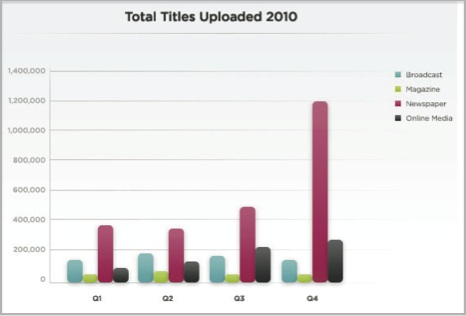
Categories: Branded Entertainment, Broadcasters, Newspapers, Online Publishers
Topics: Brightcove, TubeMogul
-
Sharethrough Is On A Roll As Brands' Social Video Surges
Sharethrough, the social video ad platform and distribution network, is on a roll as brands of all sizes are shifting some of their focus to creating their own immersive video experiences that go far beyond traditional 15 and 30-second TV spots. Sharethrough's role is to help get branded content into the social media slipstream, to be viewed and shared by target audiences. Earlier this week Sharethrough's CEO and founder Dan Greenberg brought me up to speed on the company's progress and also the changes he's seeing in the market.
Dan reports that in 2010 Sharethrough grew its agency client base by 43%, adding to its roster firms such as Pereira & O'Dell, Universal McCann, Evolution Bureau and Goodby, Silverstein & Partners. As Dan explained, agencies are increasingly being called upon by their brand clients to create distinctive video campaigns that capitalize on the trends toward online video and social media. In this way brands themselves are becoming content creators, moving from an "interrupter mindset" to an "entertainment mindset." For the agency creative teams, this shift is extremely liberating; the expanded format lets them flex their creative muscles to a much greater extent. A terrific recent example of this is the gorgeous 2-minute Chrysler "Imported from Detroit" spot with Eminem that aired during the Super Bowl (already with 4.5 million YouTube views). It feels totally different than any car ad and much more like a short film.
Categories: Branded Entertainment, Social Media
Topics: Sharethrough
-
Visible Measures Introduces "Share of Choice" Metric
Media measurement firm Visible Measures has introduced another clever way for brands to follow the success of their online video initiatives, called "Share of Choice." A play on the "Share of Voice" concept in the offline media world, Share of Choice measures the frequency of consumer viewership of brands' online video ads and content. Share of Voice lets brands measure their own success as well as track competitors' efforts.
By understanding consumers' online preferences and social behavior, brands get up-to-date insight on how well their video is performing, and what potential changes should be made. Because online video is driven entirely by users' interests, Share of Choice becomes a really good gauge not simply of what ads are running (as in traditional TV), but who's choosing to watch and how often. Visible Measures has segmented Share of Choice into 12 different industry reports with subscriptions available to each. Subscription pricing wasn't disclosed.
What do you think? Post a comment now (no sign-in required).Categories: Analytics, Branded Entertainment
-
Sharethrough Raises $5 Million For Branded Content To Go Social
Sharethrough, a social video advertising network, is announcing this morning that it has raised a $5 million Series A round led by North Bridge Venture Partners and Floodgate. Co-founder and CEO Dan Greenberg brought me up to speed last week on the company's strategy.
Sharethrough is focused on providing distribution in social networks for branded content. This has become an increasingly popular format for brands that want to go beyond traditional 15 and 30-second TV advertising to use online video to create more engaging messages. Dan points out that the really hard part for these brands is actually creating an audience for their branded content. Unlike traditional TV where a certain number of TV spots or impressions are simply purchased, Dan's view is that branded content, when placed in suitable social media contexts, can generate high sharing rates and viewership.
Categories: Advertising, Branded Entertainment, Deals & Financings, Social Media, Video Sharing
Topics: Sharethrough
-
5 Items of Interest for the Week of Oct. 4th
It's Friday and that means that once again VideoNuze is featuring 5-6 interesting online/mobile video industry stories that we weren't able to cover this week. Have a look at them now, or take them with you for weekend reading!
Verizon to Launch 4G LTE Networks in 38 Markets
Verizon will enable 5-12 megabit/second mobile data speeds in 38 markets, reaching 110 million Americans by the end of the year. The 4G technology, known as "LTE" promises a major new growth opportunity for HD mobile video, making smartphones and tablets even more appealing as video viewing devices.
Time Warner Sees Ally in Web
Time Warner's CEO Jeff Bewkes understands the Google TV value proposition, explaining that it will help program discovery and provide another option for paying subscribers to view. Those sentiments echo what I said in my initial thoughts on Google TV, that incumbent TV networks should be enthusiastic about Google TV because it doesn't disrupt their business models, but - by fully tying in the Internet - creates all kinds of new on-screen engagement opportunities. I expect other TV networks will follow soon.
Sony's Crackle movie and TV streaming service debuts on Android phone app
In a sea of new Android app releases, the new app from Crackle stands out because it offers streaming of full-length TV shows and movies on all Android devices. I sampled it this week on my Droid X and the video quality was outstanding. With the launch of LTE from Verizon later this year (see above), the quality bar will be raised further. Given Android's momentum, all premium quality video providers (e.g. TV networks, Hulu, Netflix, Amazon, etc.) should be optimizing their content for it.
Rupert Murdoch: Simultaneous Theater-VOD Release 'a Big Mistake'
A word of caution from News Corp head Rupert Murdoch: so-called "premium VOD" - where theatrical release windows shorten to allow for a new high-priced home VOD option - is a mistake. Murdoch didn't give further details, though he does see some window compression happening. I continue to argue premium VOD would be a wrongheaded move by pay-TV operators who should be focusing on new ways to deliver more programming for lower prices (to compete better with Netflix, etc.) than less programming for higher prices.
Ford revs up Web series
The latest branded entertainment entry is from Ford, which has partnered with the producers of "The Amazing Race" to create "Focus Rally: America" a new series serving as pre-launch marketing for Ford's new Focus cars that will be featured on Hulu. Ford will use the series to highlight the SYNC and MyFord Touch entertainment/navigation options. Branded entertainment continues to gain steam as an augment to traditional TV advertising as the format allows brands to tell a fuller story in a more immersive context than 30-second TV spots allow.
What do you think? Post a comment now (no sign-in required).Categories: Branded Entertainment, Cable Networks, Devices, FIlms, Indie Video, Mobile Video, Video On Demand
Topics: Android, Crackle, Ford, Google, News Corp, Sony, Time Warner, Verizon
-
NYTVF Digital Day Highlights: Indie Success through Branded Entertainment, Syndication
Originally conceived four years ago as a platform for burgeoning independent television producers, the New York Television Festival (NYTVF), which just finished up this weekend, has jumped ahead of the looming convergence by giving online video a progressively larger focus, particularly through its "Digital Day."
Started in 2008, Digital Day is a daylong event with panels discussing the digital entertainment landscape. This year's panels included producers and executives from MSN/Bing, Blip.TV, Next New Networks, Digitas' The Third Act, NBC Universal, and Electus' Ben Silverman. The topics discussed were primarily monetization through brand integration and syndication on major portals.
Categories: Branded Entertainment, Syndicated Video Economy
Topics: New York Television Festival
-
Is Demand Media's "Factory" Approach the Future of Online Video - or Not?
Friday's $125 million IPO filing by Demand Media, the foremost content "factory" or "farm," raises the question of whether its low-cost, high-volume content creation model is the future for independent online video, or if its specialized approach is just applicable to its chosen how-to/knowledge-oriented niches.
Back in March, '09 I described how Demand's approach had enabled it to become the biggest supplier of online video to YouTube, with its ExpertVillage and eHow brands delivering the highest number of views of any YouTube partner. While not a household name, Demand pioneered a new approach to choosing which content to create, how to create it, and how to monetize and value it.
Based on multiple data sources, Demand developed a set of algorithms that could help predict the likely consumption and monetization potential of video on a given how-to/knowledge topic. When promising ones were identified, assignments would be offered out to a large freelance network of producers who would follow creative guidelines while still enjoying an ample amount of flexibility. Content is published to Demand's own sites and to 3rd parties to whom it syndicates. Social media and user contributions are emphasized as well.
Categories: Branded Entertainment, Indie Video
Topics: Demand Media, Easy to Assemble, My Damn Channel, YouTube
Posts for 'Branded Entertainment'

| Next
Connect with VideoNuze
Exclusive News Roundup
- YouTube Rolls Out Shopping Tools To Boost In-Stream Commerce Mediapost
- Quibi redux? Short drama apps saw record revenue in Q1 2024 TechCrunch
- Prime Video Advertising "Off To A Strong Start," Amazon CEO Andy Jassy Says Deadline
- Showtime Streaming Service Is Shutting Down at the End of April Variety
- Roblox Users Battle Tornadoes and Raise Pets. Will They Watch Ads, Too? WSJ
- Adobe Is Buying Videos for $3 Per Minute to Build AI Model Bloomberg