-
VideoNuze Report Podcast #82 - Dec. 17, 2010
Daisy Whitney and I are back this week for the 82nd edition of the VideoNuze Report podcast, for December 17, 2010. This will be the final podcast of 2010 and we both want to wish our listeners happy holidays. Daisy and I have have had lots of fun cranking out 32 podcasts this year on all the most important industry topics. We're looking forward to continuing on in 2011.
And speaking of 2011, in this final podcast of the year we turn our sights ahead and discuss the 6 key online/mobile video trends that The Diffusion Group's Colin Dixon and I outlined during Wednesday's webinar (replay and slides available here). Daisy and I focus the bulk of the podcast on two of these predictions: how Netflix will strain under its spectacular growth, and how pay-TV subscriber losses will mount and cord-cutting perceptions could become reality.
Click here to listen to the podcast (13 minutes, 16 seconds)
Click here for previous podcasts
The VideoNuze Report is available in iTunes...subscribe today!Categories: Aggregators, Podcasts, Predictions
Topics: Netflix, Podcast, Predictions
-
Fanhattan Targets Content Discovery On Connected Devices
Combine all those new connected devices being deployed with the byzantine world of movies' and TV shows' rights windows and you get a pretty confusing landscape. That's where a new service called Fanhattan, being announced today, comes in. Fanhattan is a cloud-based app for connected devices that is dynamically updated according to the ever-changing rights windows. CEO Gilles BianRosa, who has run sister company Vuze, gave me a rundown yesterday.
Fanhattan has acquired The Open Movie Database (TMDb) to power the listings and is augmenting them with related assets and information from around the web to create what Gilles calls an "entertainment graph" connecting content, metadata, sources and device availability in one database. For the user, the experience could be compelling; say you want to watch "Inception." Is it on Amazon, Vudu, Netflix, iTunes, Hulu or elsewhere? And what is the best price? Fanhattan would expose the various choices that your connected device is eligible for and offer 1-click purchase or rental access. That improves upon today's connected device user's experience of having to check across multiple options or maybe just defaulting to what's easiest, say what's on Netflix.
Categories: Startups, Video Search
Topics: Fanhattan
-
6 Key 2011 Trends in Online and Mobile Video
Yesterday Colin Dixon from The Diffusion Group and I presented a webinar describing our 6 key trends for 2011 in online and mobile video. Colin is one of the sharpest analysts of the pay-TV and online/mobile video industries and we had no shortage of ideas to sort through. Our list is a joint effort, and during the webinar we each presented the 3 trends we felt the strongest about. In today's post I share and explain each one. At the end of the webinar we conducted a poll asking attendees whether they agreed or disagreed with our predictions. I've noted those results in bold font. If you want to download the slides and/or hear more of our detailed discussion, just register for the on-demand version of the webinar and you'll be emailed a link.
Categories: Aggregators, Broadband ISPs, Cable TV Operators, Mobile Video, Predictions, Regulation, Satellite, Technology, Telcos
Topics: FCC, Google, Net Neutrality, Netflix, TV Everywhere
-
New "ACC Vault" Launches With Classic Men's Basketball Games
Online video continues to make reliving the best moments of your favorite sports teams easier and the latest example is the new "ACC Vault" launching today. Through a partnership of the Atlantic Coast Conference (ACC), Raycom Sports and Thought Equity Motion, an archive of full-length, classic ACC Tournament and regular season men's basketball games from the 12 member programs dating to 1983 are now freely available to visitors (for an example, see the below clip of UNC's Michael Jordan hitting a nice jumper against Duke in 1984). The partners plan to add more sports highlights over time and envision ACC Vault eventually becoming an "all sport video Wikipedia."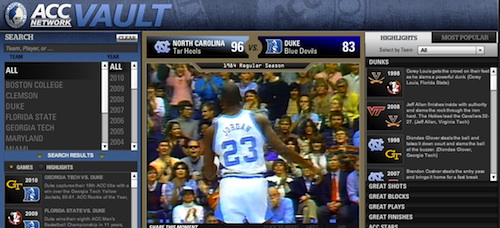
Categories: Sports, Technology
Topics: ACC, ACC Vault, NCAA Vault, Raycom Sports, Thought Equity Motion
-
Online Video Ad Network SpotXchange Raises $12 Million
Online video ad network SpotXchange is announcing this morning that it has raised $12 million from H.I.G Growth Partners, in its first round of institutional capital. Proceeds will be used to further build-out its video ad solution and also to expand internationally. SpotXchange is ranked as one of the top 5 video ad networks by comScore and recently launched SpotMarket RTB, a real-time auction-based market where buyers can bid on an impression-by-impression basis.
The SpotXchange news further underscores a sizzling year of financings and M&A for video ad networks. This space is attracting strong investor attention because of the growing recognition that huge online video audiences and ever-improving content is inevitably going to draw more ad dollars to the medium. In addition, online video advertising offers clear benefits over traditional TV advertising such as better targeting and interactivity. Just last week eMarketer forecast 30+%/year annual growth in online video ad spending, driving the category up to $6 billion by 2014. Throughout the year I've noted various innovations in online video ad units and I expect this will continue alongside the online video industry's rapid growth next year.
What do you think? Post a comment now (no sign-in required).
Note: SpotXchange is a VideoNuze sponsor.Categories: Advertising, Deals & Financings
Topics: SpotXchange
-
"Demystifying 2011" Complimentary Webinar is Tomorrow
As a final reminder, tomorrow (Wed) Colin Dixon from The Diffusion Group and I will be hosting our final complimentary webinar of the year, titled "Demystifying 2011: Key Trends in Online and Mobile Video." The start time is 11am PT / 2pm ET.
Colin and I will be sharing our 6 most important online/mobile video predictions for 2011 as well as thoughts on lots of other key industry trends. For anyone trying to get insights into what's in store for next year, it will be a valuable, interactive hour with plenty of time to ask questions. We're also planning to do a couple of surprise gadget giveaways in the holiday spirit! I hope you can join us.
Click here to learn more and register for the complimentary webinarCategories: Events, Predictions
Topics: Webinar
-
Comcast Testing Connected Set-top Box; Would Netflix Be Included?
The WSJ is reporting that Comcast is testing a new connected set-top box that offers a selection of online video alongside traditional linear, VOD and DVR programming. The project is part of Comcast's "Xcalibur" initiative headed up by Sam Schwartz and would follow other connected set-tops already in the market from competitors like Verizon, AT&T, DirecTV and others. It's a smart move by Comcast; many of its subscribers have been buying inexpensive broadband set-top boxes so why shouldn't Comcast just offer the online services itself and simplify its subscribers' lives?
While it's not clear what online video would be offered, if it's a "closed" model, where only certain apps/sites are available, then it would be akin to boxes like Roku, Apple TV and the connected Blu-ray players, among others. This approach would contrast with "open" boxes that allow full Internet browsing such as Google TV and boxee's new box from D-Link. My hunch is that Comcast would focus on a closed box to start. That would also reduce the complexity of delivering online video in a consistent, high-quality manner, especially given the numerous formats, encoding levels, etc. It's also not clear that consumers yet want a full Internet experience on their TVs and Comcast more than likely would look to be a fast follower rather than a pioneer.
Categories: Aggregators, Cable TV Operators
-
The World According to Time Warner's Jeff Bewkes, Pay-TV's Staunchest Defender
I finally got an hour over the weekend to listen to the replay of last week's UBS media conference keynote discussion with Time Warner's CEO Jeff Bewkes. His comments strongly reinforced my perception of him as the pay-TV (cable/satellite/telco) industry's staunchest defender as well as the leading Netflix skeptic. Bewkes is worth paying attention to not just because Time Warner owns the Warner Bros. studio and several leading cable networks, but because his approach is a barometer for many other content providers as well.
In Bewkes' world view, the majority of consumers are willing to pay a premium price to get the best, most comprehensive experience of the highest-quality, current content, and distributors are willing/able to pay content creators top dollar for it - in short, a snapshot of the way the pay-TV world has worked for a long while. To Bewkes, digital distribution represents "more opportunity than challenge" in its ability to drive new business models and windows, enhance existing distributor relationships and deliver more value to consumers. To be clear, Bewkes isn't a Luddite, he doesn't oppose digital innovation, he just wants to see the benefits of it accrue to incumbents, not upstarts.
Categories: Aggregators, Cable Networks
Topics: Netflix, Time Warner
VideoNuze Posts

Connect with VideoNuze
Exclusive News Roundup
- BBC News launches live stream on YouTube in U.S., U.K. The Desk
- Netflix Shocker: Bela Bajaria Leaving After 10 Years Amid Layoffs, Peter Rice to Replace as Chief Content Officer Variety
- YouTube Is Looking to Expand Into Audiobooks WSJ
- YouTube Music launches new labels as AI-generated music floods streaming platforms
- Netflix Eliminates About 6% of Staff in Biggest Cuts Since 2022 WSJ
- Reese Witherspoon and Mediawan Partner to Buy Back Hello Sunshine From Candle Media Variety