-
TV and Broadband: Who's Morphing into Whom?
Does TV programming beget broadband video programming or is it the other way around?
If you were expecting a simple answer, recent evidence suggests that none will be forthcoming. Step away from the relatively straightforward model of streamed or downloaded TV episodes, and the question of how original video content will be produced and distributed between broadband and TV is whole lot more complicated. Layer on the writers' strike and the world only fogs up further.
For those who see broadband as a pathway to TV, Quarterlife's deal announced last Friday with NBC to bring their new Quarterlife series to the network following its run on MySpace offers encouragement that Internet programming can move to the TV (bear in mind that Quarterlife was originally pitched as a TV series however).
Another example is TMZ.com, which has been successfully syndicated as TMZ TV this fall by Warner Bros. TMZ shows us that a brand that was created and built solely online can make the leap to TV. And just last week TV Week reported that Twentieth Television and Yahoo were close to a deal to create a new syndicated series based on popular broadband videos that they've collected.
On the flip side, there is plenty of evidence of opportunities for TV programs spinning off broadband programming, or existing TV producers with assets and skills pushing into broadband as a first outlet for their work.
Consider Sony's Minisode Network, with distribution on MySpace, Joost, AOL and Crackle. In an effort to squeeze more life out of its library of classics, in June Sony launched abbreviated versions, for broadband "snacking". This initiative is being closely watched as a model for how to repurpose existing assets to make them more palatable for attention-challenged online audiences.
And Endemol's recent deal with Bebo to produce "The Gap Year" series for exclusively for Bebo's audience shows that a successful TV producer is turning its sites on broadband as a first outlet.
All of these deals underscore broadband's disruptive nature - its ability to create new opportunities for incumbent players, and also for new entrants. My read is that most (though not all) broadband producers would love to make the leap to the TV. In the mean time, broadband offers a low-cost, interactive distribution path to experiment with more engaged audiences.
Many key industry players are now waking up to the idea that broadband is fundamentally re-writing traditional equations of how to extract value from well-produced video. But these equations are not yet well-understood. Some of the early deals, as outlined above, will be showing everyone the way.
Categories: Broadcasters, Indie Video, Partnerships, Video Sharing
Topics: AOL, Bebo, Crackle, Endemol, Joost, MySpace, NBC, Quarterlife, Sony, TMZ, Twentieth Television, Warner Bros, Yahoo
-
MySpace-VIBE-KickApps Deal May be a Harbinger of What's to Come
Traditional relationships between content providers and powerful aggregators/distributors are being fundamentally challenged broadband video. That's because broadband is an open medium, allowing content providers and brands to enjoy unprecedented direct access to their target audiences. This diminishes a lot of the leverage that aggregators/distributors have traditionally had.
Yet, as I have said for a while, I believe that there's a place for direct-to-consumer and third party distribution/promotion to co-exist harmoniously. But finding good examples has been a challenge. That's why a deal that KickApps announced today with MySpace and VIBE for its "Vibe Verses 3" promotion resonated strongly for me.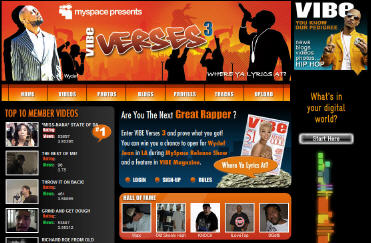
In a nutshell here's how the deal works: a major social networking site (MySpace) has partnered with a specialty publisher (VIBE) for a user generated video-dominated contest (VIBE Verses 3) to build a long term user-generated franchise (powered by KickApps), which will be mainly supported by ad sales.
To understand the deal better, I talked to Michael Chin, SVP of Marketing at KickApps earlier this week. For those not aware, VIBE is a major brand for the urban scene and VIBE Verses 3 is the third round of a contest that "challenges aspiring rap artists to upload videos of themselves performing original lyrics over pre-selected music tracks." Basically you can think of it as an "online-only, urban American Idol." All of the video uploads and social networking is powered by KickApps.
What's interesting to me is that MySpace is involved as the main promotional partner, seeking to build out its strength in this key category. As a large general purpose community site, they're partnering with VIBE, a well-known brand in the category, to bring more value to their members. As Josh Brooks at MySpace puts in the release, "VIBE is a pillar in hip hop and this partnership will help solidify MySpace as the place online for established and developing hip hop artists."
And according to Michael, this was done as a biz dev deal, not an ad sales deal. MySpace and VIBE believe that together they can build a franchise in hip hop that generates longer term value by creating a large, engaged audience of interest to other brands (e.g. Coke, Nike, etc.).
Of course none of this would be possible without broadband - it's the enabler for the user-generated videos that are at the heart of the contest.
In the open broadband video era where direct access to the consumer is ubiquitous, it's going to take more creativity to make deals work for everyone. I think this one is a good example of what can succeed. The deal serves as a template for how other specialty content providers and aggregators/distributors might work together, tapping user participation to build franchises that leverage each party's core skills and assets.
Categories: Aggregators, Brand Marketing, Partnerships, UGC
Topics: KickApps, MySpace, VIBE, VIBE Verses
-
Red Lasso: Exclusive First Look

Red Lasso is a stealthy company that's been around for about 2 years, though only now coming up to the surface. I did a phone briefing earlier this week with Kevin O'Kane, President/founder and Al McGowan, COO. They also gave me access to the private beta and I've been playing around with it for the last couple of days.
Red Lasso's goal is "to help broadcasters extend the life of their content, legitimately." They're positioning themselves as "an anti-YouTube", allowing broadcasters to proactively contribute long form video and audio, which users can then search and clip for exactly the content they're looking for. The video can simply be watched or it can be embedded. Though they don't want to be seen as an "online DVR", it is tempting to see them as such. Monetization is most likely through advertising, though a licensing model is possible as well.
Red Lasso's playing in the same basic space as Voxant (note: a VideoNuze sponsor) and Clip Syndicate (see this for more), with a key differentiator being the long form content availability and clipping feature. Red Lasso is currently taking 150 different broadcast feeds from around the country, and their ability to get the industry to cooperate is helped by the fact that Al and Kevin are broadcast veterans.
Red Lasso is trying to appeal to at least 3 types of users: broadcasters seeking to flexibly publish specific video clips on their own sites, independent web sites trying to feature key segments of their own video (e.g. sports teams) and bloggers seeking to embed video. They believe this third group is the most fertile territory and I agree.
Bloggers across the spectrum (politics, entertainment, sports, etc.) have been hungry for video clips to enhance their sites. I believe this demand will only increase. If you're a blogger looking just for the "money quote", clipping from long form assets provides a lot of value. I did some searching and clipping (below is one result).
I found the clipping pretty straightforward, and I liked the fact that I could save mine, which I can also publish to the community for widespread viral use if I choose to. The searching is based on phonetic and closed caption text. It was not quite as accurate as I hoped, but video search is a very tough nut to crack, and so I'd expect room for improvement there.
At a strategic level, Red Lasso again demonstrates how broadband's influence is going to be felt in the broadcast TV industry. I think traditional concepts of appointment viewing, geographic constraints and local ad sales are all going to seem quaint as broadband allows quality video to fly around the net. I'd urge broadcasters to be looking closely at all the players in this space.
Red Lasso has a staff of about 20 and is based in King of Prussia, PA. It has raised $6.5M from investors including Pat Croce (former head of Philadelphia 76ers), Anthem Capital, Osage Ventures and the Guggenheim Opportunity Fund.Categories: Broadcasters, Technology, Video Sharing
Topics: Anthem Capital, Clip Syndicate, Guggenheim Opportunity Fund, Osage Ventures, Pat Croce, Red Lasso, Voxant
-
Movielink-Target Download Promotion Makes No Sense to Me
Yesterday I received the below email from Movielink promoting a "Steal of a Deal" offer with Target. Here's how it works: I purchase an Ocean's Thirteen DVD at a Target store and I receive a code that then entitles me to download Ocean's Thirteen from Movielink.
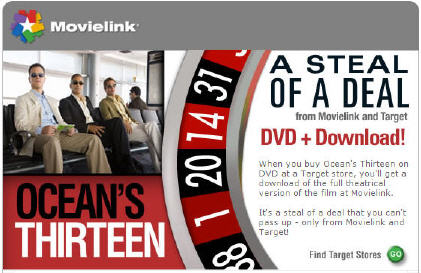
Maybe I'm missing something (and please let me know if I am), but this promotion makes no sense to me and instead seems to possibly undermine the value of the Movielink service.
As with all marketing and promotional efforts, the starting point must always be "What's our objective?" So what is Movielink's objective here?
To expose people to the Movielink brand and service? That wouldn't make sense since I only received the email because I was on their email list in the first place.
To demonstrate there's consumer appetite for downloading the same that was just bought on DVD? That seems like a silly and sort of pointless thing to prove in the first place if you believe the ultimate opportunity for digital downloads is to be a DVD substitute, not a compliment.
To expose people to the breadth of Movielink's service? That's worthy, but the offer is limited to downloading the same title that was purchased, so the user isn't incented to browse and see the full breadth of the Movielink catalog.
Maybe there's another objective, but if so I don't see it. Instead I think the campaign ends up detracting from Movielink by confusing the user and not creating any really new distinctive value. Think about it - if you're a consumer that just bought the Ocean's Thirteen DVD, what new value is the download providing you? (Let me know if you can think of anything, I can't)
Movielink could have enhanced this campaign to greater effect in lots of different ways. Ideas: Open the download choice to anything in the catalog. Or make the download easily giftable to a friend to virally increase Movielink's awareness. Or create a rewards-style program that gives DVD purchasers credits toward subsequent downloads. And so on.
I'm not trying to pick on Movielink's marketers, I see this kind of thing all the time. Murky objectives coupled with confusing/underwhelming offers. For broadband video to succeed - either in paid or ad-supported, marketers must be extremely thoughtful and precise about what they're trying to incent their target audiences to do, and how that specific action helps build the business.
Categories: Brand Marketing, Downloads, Partnerships
-
Exclusive Brightcove Update with Jeremy Allaire

Yesterday I did an hour-long briefing with Jeremy Allaire, Brightcove's CEO/founder at their Cambridge offices.
Background
If I were to make a list of the 5 questions I've been asked most frequently over the last two years, "What do you think about Brightcove?" would easily be on the list. Certainly a lot of the attention Brightcove has generated relates to its fund-raising leadership. Through three rounds, the company has raised $82 million, including the monster $59.5 million C round closed in January 2007.
By my count the only pure-play, private broadband video company that has raised more is Hulu, which raised $100M in one round from Providence Equity. But Hulu's probably not a fair comparison given that NBC and News Corp are the company's primary owners and are contributing exclusive content. (btw, if anyone has a different take on who's raised more, please leave a comment)
So this briefing was a great opportunity to get a first-hand update and also channel many of the follow-on questions I've been asked about Brightcove. (Full disclaimer, Brightcove is a VideoNuze sponsor.) Jeremy also shared some new stats with me that haven't been disclosed before.
Positioning
Brightcove's positioning has shifted around in the 18 months since its official launch causing many industry tongues to wag.
Jeremy explained that in the summer of 2007 the company did a candid assessment of its competitive standing across areas in which it was involved. While his original vision included a consumer-facing destination site (named Brightcove TV), this assessment concluded that with YouTube's dominance, Brightcove's goal to be number 1 in that business was unlikely to ever materialize. Further, the potential for conflict with its own media customers had become real. So though Brightcove TV had 8 million unique visitors in August, 2007 according to comScore (making it the number 5 player in that space), Brightcove decided to de-emphasize it and reduce investment spending on it to zero. As a result, Brightcove TV now functions mainly as a showcase site.
The company narrowed its focus to its broadband media publishing and management platform, which Jeremy says is now used by 4,000 professional publishers (sample list here), which Brightcove thinks makes it number 1 among its competitors. These publishers operate 7,000 web sites with an estimated combined reach of 120 million unique visitors per month.
The platform business model includes an annual software licensing fee with upside revenue based on the customers' usage. Jeremy denied that the company is taking ad revenue shares in lieu of platform fees, a rumor that has persistently circulated in the market. Brightcove has also continued to build out a professional support team serving the gamut of design, support, integration and customization required by customers.
Broadband Video Market and Advertising
From Jeremy's vantage point the major media companies Brightcove is serving are aggressively focused on building out their direct-to-consumer broadband video destinations, and only recently have they begun also considering syndication. Brightcove's customers' business models skew overwhelmingly in favor of advertising support, with only negligible interest being shown in Brightcove's commerce capabilities.
On this point Jeremy and I have been in agreement for a long time - the macro factors driving ad-supported broadband businesses are very strong, while those driving paid downloads continue to be challenged. The key catalysts for paid models will be mass connections from broadband to TVs, better portability and improved competitiveness with the DVD platform. In the longer-term all of these will no doubt fall into place, however, for as far as the eye can see, broadband is going to remain an ad-dominated industry.
The follow-up question of course is, what kind of advertising will predominate? Brightcove supports a range of options and Jeremy said that recently interest in overlays is running very high, though 15 second pre and mid-rolls are still used by 99% of its customers today. There's a lot of planning or rolling out of overlays coming shortly by Brightcove customers. People.com was shown as an example of a hybrid pre/mid-roll and overlay model that Jeremy thinks will become more prevalent.
Syndication
Brightcove is also starting to see heightened interest in syndication, and the company offers a set of tools to support it. One example Jeremy showed which I haven't followed is Sony BMG's "MusicBox" service, which offers an array of syndication options. Sony BMG demonstrates that for sites serious about syndication, it's about far more than moving video files around to third parties. Of course the goals of syndication are still to proliferate the content and brand to drive new revenues from far-flung corners of the Internet, but the mechanisms for optimizing this can be quite involved. There's integration of players, advertising, widgets and more. I've been very bullish on syndication for a while, and the actions by Hulu and CBS's Audience Network to distribute their content show real signs of life in the syndication model.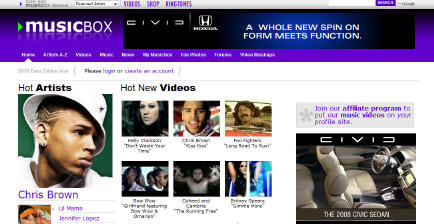
Going Forward
Not surprisingly, Jeremy's extremely bullish on broadband's future growth and sees opportunities galore to grow Brightcove's revenues by deepening its penetration of existing customers, driving more international business, especially in Asia, and expanding its fledgling presence in the enterprise/government sectors, where there's also been a lot of recent interest.
Regarding competition, Jeremy says Brightcove still sees internal development as an alternative being considered by some major media companies, though to a lesser and lesser extent recently. He also volunteered that both Maven and thePlatform are two companies Brightcove sees most often competing for deals. When asked what differentiates Brightcove, Jeremy cites product quality, ease-of-use, customer/market leadership, quality of its people and R&D. On this last point, he believes Brightcove's relatively deep pockets have helped it maintain a far more aggressive R&D budget, which grew by 300% this year.
Key upcoming priorities include launching "Brightcove Show", its new HD initiative, "Aftermix", its mash-up feature, which just finished up its beta test, multimedia capabilities (photos and audio) and enabling a slew of social/sharing features.
I couldn't resist asking Jeremy about Brightcove's last round valuation rumored to be north of $200 million. I've heard much skepticism in the market that the Brightcove's platform-centric strategy does not justify this lofty figure.
Jeremy's response is that based on the company's current revenue and recent growth trajectory, it has "grown into" its valuation and that its multiple is comparable to others he's aware of. His main objective is building a "significant global business" and if that's accomplished then there will be numerous options open for what ultimately happens with the company. He wouldn't comment on M&A, IPO or other potential exits, only saying that he feels no pressure from his investors to liquify their positions any time soon.
To achieve his global ambition, Jeremy says he's focused primarily on what actions Brightcove needs to make to dramatically scale the business, which he thinks can drive a real premium for Brightcove's valuation. To the extent that broadband remains mainly an ad-supported business, I think Jeremy correctly understands that scale - in customers, streams, usage, geographic reach, etc. - are absolutely central to success. When asked the classic "what keeps him up at night?", he cites as his chief source of insomnia the challenge of building out every part of the organization to support his goal of massive scale.
As Brightcove continues to evolve and grow, one thing is for certain - all eyes in the broadband industry will be watching its progress.
Categories: Technology
Topics: Brightcove, CBS, Hulu, Maven, Providence Equity, Sony BMG, thePlatform
-
Broadband Video's Not For Media Companies Only

While the majority of my focus is on media companies' use of broadband video, a presentation by executives of Wachovia Bank last week at the VeriSign customers' meeting served as a reminder that broadband is being used successfully by non-media companies as well.
Wachovia, which is America's third largest bank by deposits, is making strong use of broadband, particularly as an internal communications vehicle, now turning out 800 individual video "programs" per year. These include, "Take 5," a five minute daily broadcast on their internal "V-Net" network, continuous video pumped into all of their branches, customer podcasts and support for live shots of their analysts from Wachovia's trading floors when interviewed on business news broadcasts.
All of this is managed by an impressive staff of 18 full-time staffers, 10 full-time contractors and 20-30 freelancers. They're managing a state-of-the-art digital production facility in Charlotte that is likely comparable to anything found in the broadcast industry. The company has also deployed 80,000 desktops using VeriSign's Kontiki commercial P2P platform, which it says is highly reliable and scalable.
Patty Perkins, a Wachovia VP who's been the key evangelist for video's growth, noted in her presentation that senior executives video consider video a critical mechanism in keeping the bank's far-flung employee base informed and up-to-date. In fact, Patty said that in internal surveys, the Take 5 program is consistently cited as the number 1 driver of employees feeling more connected to the bank and its goals.
Patty and many of the others in Wachovia's enterprise video group are broadcast veterans. This got me to thinking, maybe with there's a new revenue opportunity for broadcast professionals to help enterprises understand how to leverage broadband for internal communications. If Wachovia's any example, there may be a lot of upside.
Categories: Broadcasters, Enterprises
Topics: Wachovia
-
Net Neutrality in 2008? Let's Hope Not.
Network or "net" neutrality, a confusing legislative concept being promoted by large online and content players, may be the hottest broadband video topic in 2008, at least according to Jeff Richards, VP of VeriSign's Digital Content Services, who makes his case at his blog Demand Insights.
I had the pleasure of informally debating net neutrality's merits with Jeff (who's officially neutral on the subject by the way) over cocktails at a VeriSign customer event I just spoke at. Jeff is persuasive about why net neutrality is such a hot button issue, and that its resolution - one way or another - has broad repercussions across the technology, content and Internet industries.
First, a primer for those not familiar with net neutrality. To date the Internet has functioned as a level playing field of sorts. Anyone putting up a web site could be confident in the knowledge that broadband ISPs would neither favor nor disadvantage one player's access to users over another's.
Big online content and technology companies now want to codify this tradition in legislation commonly referred to as net neutrality. Big broadband ISPs (i.e. cable operators and telcos) regard this as needless regulatory meddling, a classic "solution in search of a problem" that would unnecessarily limit their future business dealings and influence their investment decisions.
Interest in net neutrality legislation has waxed and waned, as lobbyists for the pro-net neutrality side (content and technology firms) try to convince legislators that this really is an important issue for constituents and that this isn't just a "rich vs. richer" debate that should be left to the industry's participants to figure out, while anti-net neutrality lobbyists (cable and telco firms) argue the opposite point of view.
So what might precipitate the resurgence of interest in passing net neutrality legislation? In two words, broadband video.
As Jeff points out, the massive adoption of broadband video, which still disproportionately comes from illegal video file-sharing networks, is motivating ISPs to reevaluate current policies. Stoking this reevaluation is the awakening that the really big money is now being made by legitimate companies like Google (current market cap $200+ billion) which ride freely over ISPs' networks. As such, ISPs are wondering whether the balance of economics has gotten out of whack and if they can get a bigger share of the pie.
Some ISPs are now blocking or "shaping" certain types of traffic. The most recent example that came to light was Comcast, who the AP recently found is blocking BitTorrent's traffic in the Bay Area. Comcast's vague response, coupled with ill-thought out earlier remarks from telco executives about their own business intentions, have inflamed conspiracy theorists' worst fears about what kind of world could result absent immediate net neutrality action.
Yet for me, preemptive net neutrality legislation can only be justified if you buy into one or both of the following two assumptions.
First, that any new premium tier of service ISPs may want to sell to certain preferred providers (e.g. Google is search engine of choice, so its results somehow load faster) must, by definition, mean that some other provider is disadvantaged as a result. But this presupposes a zero-sum ISP network, which is not true. To enable a high quality-of-service ("QOS") tier for preferred partners does not technically necessitate a degrading other non-preferred services. Not to mention degrading other services would be a foolish, provocative thing for ISPs to do.
The second assumption is that regardless of whether ISPs create QOS-enabled premium tiers, they cannot be trusted not to block or harmfully shape traffic, whether it's legitimate or not. While there have been random acts of blocking by smaller ISPs, this does not seem to be a rampant problem right now. And it's important to distinguish between blocking legitimate vs. illegitimate traffic. For instance, when Comcast blocks illegitimate P2P file-sharing traffic then to me that's a good thing. It frees up network resources for the rest of us who are paying to use the network for legitimate purposes. I'm not going to cry for some 15 year-old kid who can't speedily download a pirated copy of the latest Hollywood thriller, nor should you.
While the pro-net neutrality folks obviously believe ISPs will be bad actors, to my mind, even if you make the above assumptions, this does not form the basis for preemptive net neutrality action now. Sure it's tempting to believe that cable and telco companies, still with plenty of monopolistic DNA flowing through their corporate veins, would indeed act unfairly, for now it is most appropriate to give them the benefit of the doubt.
Washington's laissez-faire attitude toward Internet regulation has been one of the key reasons for the Internet's continued innovation and growth. Attacking broadband video and the Internet, which are among the last few bastions of economic growth left in America is unwise, particularly given the fact that the "law of unintended consequences" is virtually synonymous with all recent telecommunications regulation. Preemptively impose network neutrality and who knows what the actual result will be.
So for now net neutrality regulation should stay on the backburner. When and if it's appropriate, it can be re-prioritized. Instead, I'd prefer keeping Washington's focus on cleaning up a separate, larger and far more pressing problem caused by another rush to preemptive government action (hint, it starts with an "I" and ends with a "Q").
Categories: Broadband ISPs, P2P, Regulation
Topics: BitTorrent, Comcast, VeriSign
-
Google's Android: Striving for Broadband's Openness
Google's announcement on Monday of its "Android" mobile operating platform is another example of open platforms' appeal and underscores why broadband video has grown so quickly and is so compelling.

For those who missed the news, on Monday Google announced its Android mobile platform and the Open Handset Alliance, with 33 other companies, aiming to accelerate innovation and application development for mobile devices. In essence the goal is to develop a widely-deployed open platform,
 comparable to the Internet itself. Mobile video would certainly be a key beneficiary if Android succeeds.
This push to openness in mobile can be seen as an attempt to emulate what's unfolded in the broadband video industry over the last 5 years. The result of broadband's openness has been nothing short of staggering, Whether it's video found at YouTube, iTunes, Hulu, NYTimes.com, MLB.com, Cosmopolitan.com or countless others, the torrent of video that's been unleashed, the shift in consumer behavior that's ensued and the capital that's been invested in this sector are all the direct result of broadband's open pipe.
In fact, as I have said innumerable times, the reason why broadband video delivery is the single most disruptive influence on the traditional video industry is precisely BECAUSE it offers an open platform for producers to send video directly to their target audiences. As such, it eliminates the requirement for video producers to land a deal with a traditional gatekeeper to the home such as a broadcast or cable TV network, or a cable TV, satellite or telco service provider.
In short, the ability for producers to connect directly with their audiences strikes at the heart of the traditional video distribution value chain, threatening a permanent re-ordering of the economics of the video business. It enables all kinds of players who have been shut out of the video game to now jump in.
And while broadband video is admittedly still in its embryonic stage from a revenue standpoint, its long-term appeal portends vulnerability for those who cling too long to the traditional closed, walled-garden model. The Internet has shown us all the power of open over closed models, of interoperability over proprietary approaches, and of often chaotic, but user-centric growth over top-down control.
Broadband's ecosystem is experiencing a rapid "layer-cake" effect where new technologies and applications are being built on top of preceding ones. The result is a vibrant, entrepreneurial culture in the broadband sector. If Android succeeds the same will be true in the mobile video sector as well.
Categories: Mobile Video, Partnerships
Topics: Android, Cosmopolitan, Google, Hulu, iTunes, MLB.com, NYTimes.com, Open Handset Alliance, YouTube
VideoNuze Posts

Connect with VideoNuze
Exclusive News Roundup
- NFL Makes Its Case to FCC During Regulatory Scrutiny WSJ
- Peacock gains subscribers, but losses widen in Q1 The Streamable
- Comcast beats revenue, earnings expectations as broadband losses improve CNBC
- YouTube Inks Deal Making SiriusXM Exclusive Audio Advertising Rep in U.S. Variety
- Netflix plans to buy historic Radford Studio Center as Hollywood enters new era LA Times
- Peacock’s Ad-Free Tier Coming To Roku Premium Subscriptions Under New Agreement Deadline