-
Survey: Broadband To Lag TV in 2012. Forget It.
This piece in today's Hollywood Reporter about a newly-released survey ("Broadband Won't Overtake TV, Execs Say") caught my eye because it continues a highly speculative, and largely irrelevant debate pervasive throughout the industry about future video consumption patterns.
Why's the debate highly speculative? Because truly, none of us has any idea how people will consume video in 2012. There are just too many variables and too many unknowns to make an accurate prediction. Here's a point of comparison: let's say 5 years ago, in 2002, you were asked what percentage of Americans would consume broadband video in a given month? How many (or few!) of us would have predicted a whopping 75%? (the correct answer according to comScore in July '07). Better yet, how many of us would have guessed that over 25% of this consumption would be at just one site (YouTube) - a site that didn't even exist in 2002? Given these examples, who's to predict what 2012 will bring?
And why's the debate largely irrelevant? Because, in my opinion, it presupposes a continuation of the existing paradigm: an either/or choice of TV consumption OR broadband consumption. Yet these traditional lines of demarcation are already fading. Broadband programming is starting to migrate to networks, as in the recent case of Quarterlife's move from MySpace to NBC, while at the same time network TV programming is increasingly being consumed online. Meanwhile shorter form programming, not bound by traditional advertising pods is on the rise, further confusing industry definitions. Sites like Metacafe, blip.tv, Veoh and others are driving a whole new category of video that could eventually be a more popular format than 30 or 60 minute programs.
These days consumers themselves are driving this "broadband or TV" debate into irrelevance. They're busy accessing programming on demand - whether "broadband" or "TV" - through a host of devices and services whose popularity is only going to skyrocket in the future. These include TiVo, Xbox, Netflix, Amazon Unbox and many others. Yet traditional thinking is still pervasive. For example, just this week, the chairman of the FCC has attempted to enact new regulations governing how cable programming might be unbundled. Fortunately this initiative collapsed, but take heed, market forces will eventually cause cable operators to offer programming as consumers want it, not how tradition dictates.
I think Jim Denney, a TiVo product management VP whom I spoke with yesterday hit the nail on the head. Jim said TiVo's philosophy is to have their users "not worry about where any particular video's coming from, but rather just have all choices easily available." That strikes me as a winning business approach for the turbulent and converging 5 years that lie ahead. In my view, those companies which think about how to deliver value to consumers on their terms, rather than being guided by increasingly artificial distinctions, will be the ones to emerge as the winners in 2012.
Categories: Broadcasters
Topics: blip.TV, comScore, MetaCafe, MySpace, NBC, Veoh, YouTube
-
ExtendMedia Powers SanDisk Broadband Video Initiatives
I recently caught up with Keith Kocho, founder of ExtendMedia to discuss how Extend is supporting SanDisk's recently announced Sansa TakeTV player and companion Fanfare application. In a recent review, I was impressed with SanDisk's approach, which is somewhat akin to the iPod-iTunes pairing. Extend (disclaimer, a VideoNuze sponsor) is playing a key behind-the-scenes role, which will become especially important as FanFare transitions from its current trial model to a hybrid ad-supported and paid download approach.

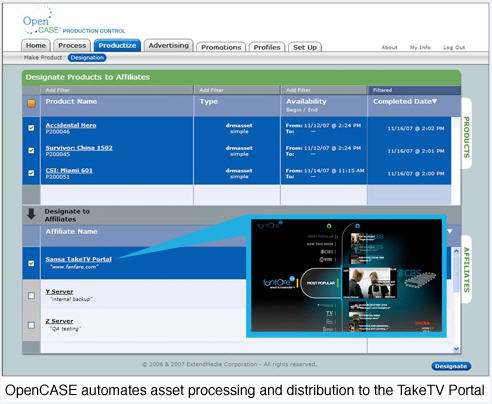
Keith explained that Extend's OpenCASE product is providing the ability for SanDisk to manage Fanfare's content catalog, create the business rules for each piece of content and deliver encryption depending on the rules. OpenCASE also allows SanDisk to bake ads into the video file as its currently doing, or dynamically insert them as SanDisk intends to do in the next phase.
The screen grab below illustrates how a piece of content uploaded to OpenCASE can be delivered into Fanfare with appropriate rules.
Kate Purmal, SanDisk's SVP/GM for Digital Content offered this perspective, "OpenCASE is seamless and flexible and has proven to be truly 'plug and play; with our encryption and DRM software with Extend's business rules layered on top. As we expand into our next phase with more content and commerce options, OpenCASE is going to be able to easily scale up with Fanfare."
I think Kate's latter point hits the nail on the head: in the future, for any of these digital video stores to succeed - whether they are tied to a device, as Take TV is to Fanfare, or they aren't - the digital video stores of the future are going to all offer hybrid approaches for consumer to access content.
The concept of an iTunes, which only offers an a la carte purchase/download model is going to quickly become antiquated. Instead consumers will be offered choices including a la carte downloads, ad-supported downloads, ad-supported streaming, ad-supported and paid subscriptions and more. This is one of the hallmarks of broadband - that it offers content providers and aggregators unlimited monetization flexibility depending on the circumstances and rights. As such, I think that platforms such as OpenCASE and others that can support flexible models are going to become increasingly valuable.
Categories: Devices, Technology
Topics: ExtendMedia, SanDisk
-
YouTube Used for Toy Safety Advocacy
YouTube's role in our lives just keeps expanding.
A little blurb I read in the newspaper lead me to this humorous/serious video created by a liberal group named Campaign for America's Future now posted at YouTube.

The video spoof shows Ken and Barbie hooking up in a bar and then talking by phone a week later. In that conversation, Barbie tells Ken that she's having some "symptoms", but the twist is they are not what you're expecting. She says she is suffering from lead poisoning.
The video then cut to messages focused on the importation of 2 million toys from China with toxic levels of lead paint, why our inspection regulations aren't sufficient and that Nancy Nord, Acting Chairman of the Consumer Product Safety Commission should be dumped.
Regardless of where you are on these questions, this little video again demonstrates how ingrained YouTube has become in our lives. It also illustrates how video is the most persuasive method for advocacy. How long will it be before producing videos for YouTube distribution is a standard part of any PR/advocacy campaign? Not very.
Categories: Video Sharing
Topics: YouTube
-
CIT "Behind The Business" Exploits Broadband
Tracking the innovative use of broadband video by brand marketers is an ongoing focus for me and I'm always on the lookout for great examples. The latest I found is a campaign from CIT, a global commercial finance company, that has just introduced the third installment of "Behind the Business", a broadband-based interview series with notable business leaders. If you haven't seen it, it's well worth checking out. This particular installment is a series of interviews with the co-founders of Intrepid Pictures, Marc Evans and Trevor Macy.
The press release states that CIT is "reaching out to its client base through various initiatives that will highlight key business issues facing middle market executives today." Having watched a number of the videos available at the site, it is evident that CIT is taking a soft-sell approach, with the interviews focusing
 on Intrepid and the founders, with no overt CIT plugs. The video player window is embedded in a page that has strong CIT branding and links to learn more, but that's about it. The idea is to inform and educate the target audience, with CIT branding wrapped around the experience.
Another aspect of the campaign is its multi-platform nature. CIT hooked up with Conde Nast Media Group, which is promoting the video heavily in its publications. This follows a separate video initiative that Grey Goose Entertainment and Sundance Channel are pursuing with their "Iconoclast" series, in which Conde Nast is also a partner. Conde's involvement shows that when big brands are going to invest real money in broadband-centric campaign, promoting in relevant print publications is an important key to driving awareness.
CIT is following a list of other brand marketers who want to expand beyond traditional 15 and 30 second TV spots to use video to drive deeper engagement with their target audiences. This artful blending of entertainment, information and advertising is at the heart of how I believe broadband will be used by smart brand marketers. With broadband's unlimited shelf space, marketers have a new and unprecedented palette to promote their brands. Behind the Business shows that savvy brands are beginning to take advantage of it and that there are a plethora of opportunities unfolding for skilled producers.
Categories: Brand Marketing
Topics: CIT, Conde Nast, Grey Goose Entertainment, Sundance Channel
-
Rigging Viral Video Success at YouTube
While most of the world was de-stuffing itself from Thanksgiving over the last few days, a firestorm was raging at TechCrunch, a popular blog, over a guest post that described how you can rig YouTube to drive viral video success. The post was written by Dan Ackerman Greenberg (don't know him) who is co-founder of The Commotion Group and a graduate student at Stanford. His original post is here and his follow-up post is here.
The original post in particular is well worth reading. While it's easy to focus on the author's integrity (and many of the comments following the post do so), the most interesting takeaway for me is how YouTube, and broadband in general, is still a "wild west" environment, where popularity isn't always what it seems and knowing how to play the game can be a key to success.
Greenberg runs through a litany of "strategies" which his firm has used (or not used depending on how you read his follow on post) successfully to drive his clients' videos to huge success. These include using catchy titles, manufacturing dialogue around the video using fake identities, embedding videos in others MySpace pages, optimizing thumbnail descriptions, emailing the clips to everyone possible, manipulating tags, etc.
Of course there are no laws against any of this stuff, in my view it's an extension of guerilla marketing techniques seen elsewhere. It's using the full range of tactics available to achieve a client's goals and a stark reminder that consumers must always have their BS antenna up.
But whether you think it's unseemly or just an extension of guerilla practices long established in the offline world is beside the point. It's easy to tisk-tisk others for their business practices. But the reality is that if viral video success is important to you then you'd better be well-versed in the rules of the game and be prepared to play it like the winners do.
Categories: Video Sharing
Topics: YouTube
-
A Thanksgiving Thank You to VideoNuze's Sponsors
In the spirit of the season, I'd like to offer a huge THANKS to VideoNuze's outstanding sponsors. Below they are listed along with their own descriptions:
Akamai - Akamai is the leading global service provider for accelerating content and applications online. click here for more
ExtendMedia - ExtendMedia provides software and media services that enable content providers and distributors to quickly and securely create, deliver, manage and monetize online content offerings over many devices. click here for more
thePlatform - thePlatform, a subsidiary of Comcast, is the leading broadband video ASP for content providers, broadband media sites, and mobile businesses. click here for more
Voxant - Voxant is building a new kind of network that delivers unparalleled licensed content, advertising and services to millions of web sites and niche communities throughout the Web. click here for more
Atlas Venture - Atlas Venture is an international early-stage venture capital firm that invests in communications, information technology and life sciences companies. click here for more
Brightcove - Brightcove is an Internet TV service that empowers video producers and programmers to build broadband businesses while giving viewers more choices and control over their use of video and television. click here for more
Digitalsmiths - Digitalsmiths is the company behind VideoSense, the first universally compatible and future-proof broadband video contextual ad-matching system. click here for more
ICTV - ICTV provides the technology and distribution network that enables television programmers and Web publishers to deliver broadband video and other media to television in an engaging, immersive TV-quality viewing experience. click here for more
PermissionTV - PermissionTV offers a flexible platform for delivering innovative and interactive video experiences on the Web. PermissionTV tools empower companies to use video to capture new audience, enhance relationships and maximize customer value. click here for more
Please take a moment to check them out!
Categories: Miscellaneous
-
Warner Bros. International Television's On-Demand Rollout Seems On Track
A piece in Variety yesterday describing WBITD's aggressive new strategy to mine on-demand opportunities in cable, satellite and broadband underscores how technology is driving new distribution options and revenue opportunities, while at the same time posing new challenges to traditional business models.

The article, entitled "WB Shows Go On-Demand" outlines how WBITD is launching "Warner TV" branded on-demand initiatives in Europe and Asia. That Warner will be offering its library of films and TV programs Warner entirely on-demand is a clear acknowledgement that consumer behavior has shifted beyond the "appointment viewing" paradigm of linear TV.
This shift, along with scarce channel capacity and resistant service providers, have all contributed to the fact that launching new cable networks here in the U.S has all but dried up. The recently unveiled Fox Business Channel is a huge exception; behind the scenes there are scores of people who aspired to launch their own cable networks who have now shifted their focus to on-demand, or increasingly to broadband.
Jeffrey Schlesinger, WBITD's president put his finger on why the on-demand and broadband models make so much sense, "The costs here are much lower than creating a linear channel. You don't have as much on-air promotion that you have to do. You don't have as much scheduling or advertising sales infrastructure. You don't have to worry about commercial insertion."
Building a new programming franchise today is more about nimbleness and experimentation than big structure and deliberative scheduling. WBITD seems to recognize this and also seems to be willing to test lots of different models depending on the opportunities and circumstances it encounters in each local market.
Of course the key balancing act for WBITD here is pursuing these new initiatives without disrupting existing revenue streams and relationships. That's the first thing I hear from all content providers who have a vested interest in existing models, but a hunger for new revenues. WBITD is sensitive to this: its plan is to offer library titles or a secondary window on current programming,
Add WBITD to your "watch list" of companies pioneering how distribution will work in the broadband era.
Categories: International
Topics: Warner Bros.
-
Adap.tv Improves Broadband Video Ad Targeting with CPC Approach
As the broadband video world continues to coalesce around advertising as its primary business model, there is a flurry of companies seeking to improve the monetization process. As I've written before, this is critical work, because at some point the bloom will be off the broadband video rose if participants can't earn an attractive ROI.
Enter Adap.tv, which is addressing the ad monetization challenge. The company was founded last year and is based in San Mateo, CA. It is backed by Redpoint and Gemini and now has 20 employees.

CEO/co-founder Amir Ashkenazi recently gave me a run-down on Adap.tv's approach and progress. Amir was the founder of Shopping.com, which was acquired by eBay and he has brought together many former colleagues for his experienced management team.
Like its competitors, the heart of Adap.tv's model is its ad targeting and relevance engine. Adap.tv uses a "multi-disciplinary approach": analysis of the video/audio (context, metadata, etc.), analysis of the ad (keyword submission, etc.) and analysis of the user (demographics, location, etc.). This data is then fed to a matching engine to pair ads with the most relevant video. Over time the system optimizes based on actual click behavior.
Adap.tv is highly focused on overlays (Amir believes this will be the "de-facto standard" soon), and provides a series of customizable templates for advertisers (see below Kayak overlay). It is also positioning itself as a cost-per-click model, so there's no fixed cost to advertisers. In fact, advertisers can power Adap.tv ads using the same keyword feeds they use for their keyword campaigns.

So far publishers have been responsive to the CPC model because they see overlays as opening up a lot of untapped inventory. Obviously implementing overlays needs to be done judiciously or the viewer experience will become cluttered and broken. Amir believes the whole broadband video ad model will move to CPC over time as advertisers become more sophisticated and focused on performance. This Google-like model would be very good news for advertisers, but would be a brave new world for traditional broadcast and cable networks long accustomed to CPM approaches in their traditional businesses.
While I think a more performance-based broadband ad environment would be welcome, I continue to believe a CPC/overlay approaches will ultimately co-exist with CPM/pre-rolls. There's a lot of interest in overlays, yet there are too many great 15 and 30 second TV spots not be re-used online and the CPMs are way too rich for big branded content providers to walk away from.
Other companies that are in the contextual analysis and/or overlay space include: ScanScout, Digitalsmiths (note: a VideoNuze sponsor), YuMe, blinkx, VideoEgg, YouTube, Brightcove, AdBrite, Viddler (which TechCrunch just wrote about yesterday) and others I'm sure I'm missing or are yet to surface.
Categories: Advertising, Startups, Technology
Topics: Adap.TV, AdBrite, Blinkx, Brightcove, Digitalsmiths, ScanScout, Viddler, VideoEgg, YouTube, YuMe
VideoNuze Posts

Connect with VideoNuze
Exclusive News Roundup
- NFL Makes Its Case to FCC During Regulatory Scrutiny WSJ
- Peacock gains subscribers, but losses widen in Q1 The Streamable
- Comcast beats revenue, earnings expectations as broadband losses improve CNBC
- YouTube Inks Deal Making SiriusXM Exclusive Audio Advertising Rep in U.S. Variety
- Netflix plans to buy historic Radford Studio Center as Hollywood enters new era LA Times
- Peacock’s Ad-Free Tier Coming To Roku Premium Subscriptions Under New Agreement Deadline