-
Food2: A New Example of How Cable Networks Leverage Broadband
(note: I've been under the weather this week, which explains yesterday's absence of VideoNuze. I'm getting back on my feet and hope to be resuming regular publication)
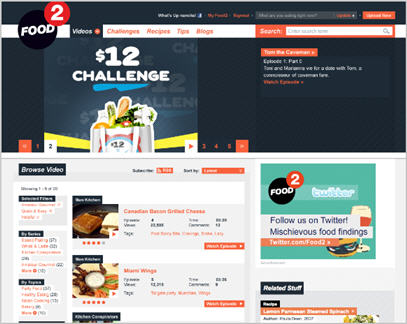
Late last week Scripps Networks, parent of cable networks Food Network, HGTV, FLN and others, launched Food2, a web site targeting the 21-34 demo. Scripps has long been a leader among cable networks in capitalizing on online/broadband's potential, and this newest entry is yet another example of how important broadband is to cable networks' future growth. I spoke with Bob Madden, GM of Food's online properties to learn more.
First and foremost, Food2 is distinguished by its focus on the 21-34 demo. One of the interesting things about Food Network on air has been its appeal to younger audiences (this will likely resonate with those of you who have teenagers). But based on research it conducted Food executives realized that - no surprise - younger audiences want to experience food-related content in different ways: with shorter form non-linear content, more emphasis on experimental tastes and increased access to social/content sharing tools.
So Food2 was conceived as an effort to "super-serve" this audience. Scripps defines Food2 as "designed to be a social experience - just like food itself. It's the intersection of food, drink and pop culture." With a heavy emphasis on Facebook/Twitter integration, tons of short videos featuring hip young culinary talent and original webisodes plus challenges, recipes and tips, Food2 seeks to live up to its goal of experiencing food through the eyes of millennials.
To me, Scripps' real insight from a business perspective is recognizing that broadband creates new "shelf space" for them to launch properties that target specific audiences and in turn specific advertisers seeking to reach those audiences. This matters a lot because due to existing contracts with cable/satellite/telco operators, cable networks have been constrained, at least relative to broadcast networks, in their ability to fully distribute online their popular full length programs (for example, there is no Food Network content on Hulu). While these contracts have led cable networks to achieve highly stable financial performance in this rocky economy, it has deprived them of fully serving their audiences.
Food2 demonstrates that there's online value to be built separate and aside from simply distributing full-length programs online. And because Food2 will be promoted on Food Network's air, and will have some of its advertising sold in packages with Food Network and other Scripps properties, it is off to a running start. Lastly, while Scripps doesn't want Food2 to be seen as a "farm team" for Food Network, there's no question that if talent gets traction on Food2, it has the potential to migrate to the 90M homes that Food Network is carried in, offering lots of interesting upside.
Food2 is a tangible example of a traditional media company recognizing that younger audiences want to consume media differently and that broadband is a new kind of medium that can serve them accordingly. With practically all cable networks savoring access to younger audiences, I expect Food2 will be watched by others and eventually spawn similarly targeted sites.
What do you think? Post a comment now.
Categories: Cable Networks
Topics: Food Network, Food2, Scripps Networks
-
April '09 Recap - Innovation is Alive and Well in the Broadband Video Space
Looking over last month's posts with an eye for 2-3 themes to extract for my recap post today, I was instead struck by one overarching theme: innovation is alive and well in the broadband video space. Other sectors of the economy may have ground to a halt in the current recession, but whether it's new technologies, new service models or new approaches by traditional media companies, the pace of innovation in all things related to broadband video seems only to be accelerating.
Here are some of the examples from last month's posts:
New technologies
- SundaySky - a new approach to dynamically generate videos out of web site content
- HD Cloud - cloud-based encoding and transcoding plus 3rd party syndication
- Market7 - web-based platform for collaboratively creating and producing video
- FreeWheel - ad management/distribution company raises another $12M
New service models
- Sezmi - next-gen video service provider aiming to replace cable/satellite/telco
- TurnHere - distributed video production services for the corporate market
- Babelgum - premium-quality content destination for independent producers
- YuMe Mindshare iGRP - new measurement unit to compare on-air and online ad performance
- YouTube-Disney - short-form promotional deal
New approaches by traditional media companies
- Disney-Hulu - Exclusive 3rd party online distribution for established broadcast network
- Cable networks launching webisodes - online initiatives to attract and retain new online audiences
- New York magazine video re-launch - emphasis on curating best-of-the web videos with brand
- WWE Smashup - fan-submitted video mashup content driving awareness of on-air special
Now granted I have an eye out for broadband innovations so this list is somewhat self-serving. But remember that for every item above I was probably pitched on 2-3 others that I didn't write about due to time limitations. Some of these other items may have been picked up by other news outlets and captured in the news aggregation side of VideoNuze, while plenty of them likely received little attention.
My point is that throughout the whole broadband video ecosystem there is a vibrant sense of entrepreneurialism that is slowly but surely remaking the traditional video landscape. To be sure, not all of this stuff is going to work out; either business models will be faulty, technologies won't deliver as promised or consumers will reject what they're being offered. Nonetheless, from my vantage point, the wheels of innovation continue to spin faster. That makes it a very exciting time to be part of the industry.
What do you think? Post a comment now.
Categories: Aggregators, Broadcasters, Technology
Topics: Babelgum, Disney, FreeWheel, HD Cloud, Hulu, Market7, New York, SezMi, SundaySky, TurnHere, WWE, YouTube, YuMe
-
OK, Hulu Now Has ABC. But When Will It Prove Its Business Model?
OK, Hulu now has ABC in its corner for the next 2 years, along with a re-upped program exclusivity commitment from NBC and Fox. But the nagging question remains: even with all its premium content, fabulous user experience and surging traffic, when will Hulu prove its business model? How that question gets answered will be the real test of Hulu's ultimate success. And with 3 of the 4 broadcast networks now hitching themselves to the Hulu locomotive, the answer is also going to be pivotal to how the industry navigates the broadband video era.
To be clear, VideoNuze readers know that I've been a big fan of Hulu from Day 1. The site has only gotten better over time, not only with more content added, but by continued improvements in the user experience. All of this has no doubt contributed to Hulu's rapid rise up the usage rankings, landing it in the top 3 for the first time in March, with 380M views, according to comScore.
A source familiar with the Disney deal told me the deal was entirely predicated on Disney's desire to tap into Hulu's audience in order to increase ABC's online reach. Among other evidence indicating Hulu's upside potential, comScore data apparently showed that only 8% of the ABC.com audience visits Hulu and only 13% of the Hulu audience visits ABC.com.
To me, three indicators of how much the Hulu deal meant to ABC are the 2 year exclusivity commitment, the
 redistribution rights for ABC programs to 3rd parties Hulu gained (except for grandfathered ABC partners), and that ABC will allow its programs to be viewed outside of its much-celebrated video player for the first time.
 Importantly, the former two terms effectively foreclose any full-length program distribution deal with YouTube and others. For now at least, ABC will limit its relationship with YouTube to clips only. That's a pretty big call; remember YouTube is the category leader that not only has a 40% share of the market, but is also currently over 15 times the size (in streams) of Hulu. There's also YouTube's relationship with Google, which of course has the most formidable online monetization engine (albeit one that hasn't been fully leveraged by YouTube as yet).
The YouTube decision underscores my ambivalence about the broadcast networks' singular embrace of Hulu because there's little evidence that Hulu has yet developed a profitable or sustainable business model. I've written previously about the paucity of ads in Hulu (and broadcasters' own sites for that matter) and how this is creating user expectations that are going to be hard to reset when more ads are inevitably loaded in. One of the reasons users love Hulu is because it is so light on ads. But will Hulu's traffic flatten or decline when the non-skipppable ad load is 2x, 3x or 4x what it is currently?
Increasingly though, it's not just the ad quantity that's an issue for Hulu, it's also its ad quality. I took some time last night to sample a number of programs on Hulu ("Fringe," "Family Guy," "The Office," "The Daily Show," "Bones"). What I found were the same repetitious ads running throughout all the shows, from a relatively small number of advertisers such as Nissan, AT&T and Swiffer. I detected no meaningful targeting (e.g. I saw a number of Swiffer ads that seem misdirected at this 45 year-old male viewer). Worse, there were an alarmingly high number of PSAs (likely unpaid) from the likes of the Ad Council, Goodwill, One Laptop Per Child, American Diabetes Association, etc. In some cases these were the only ads playing during an entire episode.
Further, there was no evidence of customized ad creative or formats meant to incent deeper engagement (unless you count the companion banners prompting users to click to learn more). Deeper engagement and interactivity are supposed to be the calling cards of broadband video advertising. But the ads on Hulu appear to be the same as seen on-air, suggesting Hulu hasn't been able to persuade its brand advertisers to invest in custom creative to leverage the Hulu environment.
Now I know we're in a recession, but still, over a year since Hulu's official launch, and with its tremendous traffic growth, I think all of this is cause for real concern. Hulu is being embraced by the broadcast industry as its main online video vehicle, yet it isn't close to proving it has a model that can actually make money. I don't have insight as to what's going on here, but I hope the networks that are exclusively entrusting their prized programs to Hulu - and consequently incenting huge real-time shifts in viewer behavior - do.
Longer term of course, the networks' bet on Hulu becomes even more profound. That's because as convergence devices of every stripe bring broadband viewing all the way to users' TVs, there's going to be inevitable cannibalization of viewing traditionally done through linear on-air/cable delivery. (Btw, despite much-heralded research to the contrary, anecdotal evidence suggests this is happening already. Just go ask any college student about their viewing behavior.)
Down the road, networks are going to be increasingly reliant on broadband-based ad revenue as their main meal ticket. And if all that's being served up are digital pennies, nickels or dimes - as I believe Hulu is delivering today - then even all the usage in the world will still leave the networks very hungry indeed.
Now that ABC has thrown in with Hulu, you have to believe CBS will as well. With all of the networks on board, they're increasingly betting the industry on the hope that Hulu can figure out its business model. For their sake, let's hope it can.
What do you think? Post a comment now.
Categories: Aggregators, Broadcasters
Topics: ABC, CBS, FOX, Hulu, NBC
-
VideoNuze Report Podcast #14 - April 30, 2009
Below is the 14th edition of the VideoNuze Report podcast, for April 30, 2009.
After a couple weeks away from this podcast, Daisy Whitney and I are back. This week we discuss our observations from the recent NAB Show and also the larger issues affecting the broadcast TV industry. Both of us have been watching the trends closely and will continue to report on them.
Click here to listen to the podcast (14 minutes, 36 seconds)
Click here for previous podcasts
The VideoNuze Report is available in iTunes...subscribe today!
Categories: Podcasts
Topics: Podcast
-
Disney to Buy Into Hulu
Here I am at BWI airport getting ready to send today's VideoNuze email and in pops the news that Disney is taking an equity stake in Hulu, bringing lots of its prized programming along. The rumor mill has swirled for a while that a deal was forthcoming, now it's here. The press release is not yet up on the Disney site. I'll have more thoughts later.
Categories: Aggregators, Broadcasters, Deals & Financings
-
Sezmi Update: Fall '09 Commercial Rollout Planned
I chatted with Sezmi director of product marketing Barbara Cassidy at the NAB Show last week and had a follow up call with co-founder/president Phil Wiser yesterday to get an update on the company's progress.
Sezmi is now aiming for a Fall '09 commercial rollout. Phil explained the launch was pushed back by roughly 6 months. The company is continuing to optimize the user experience. It is also being conservative with
 resources in the wake of staff reductions last Fall (and the economic slowdown), and is seeking to align with the '09 holiday season/its channel partners' goals. In the meantime the Seattle trial is continuing.
I've been enthusiastic about Sezmi as a full-on, next-gen alternative to cable/satellite/telco service, assuming it its "FlexCast" distribution technology performs as expected. The short demo I saw at NAB looks much as at it has in the past and is quite slick. Sezmi has a hugely ambitious vision, but if it delivers as planned, it is going to offer a pretty compelling alternative for consumers. Lots more to come on this story.
What do you think? Posta comment now.
Categories: Devices, Technology
Topics: SezMi
-
FreeWheel Raises $12M Series C Round, Video Sector Stays Strong
The syndicated video ad management company FreeWheel has announced that it has raised a $12M Series C round led by new investor Foundation Capital and existing investor Battery Ventures (prior funding
 rounds have not been disclosed). The up round provides continued evidence of fundraising strength in the broadband video sector, coming on top of at least $80M raised by industry companies in Q4 '08 and Q1 '09. Doug Knopper, co-founder/co-CEO gave me some additional background this afternoon.
Funds will be used primarily for building headcount, integrating with broadband video ecosystem partners and continued product development. The company is up to 70 employees, spread between the U.S. (25 total between NYC and Silicon Valley) and China (45, all in development).
Doug echoed what industry CEOs have been telling me for months now - it's a brutal fundraising climate, but the video sector is very hot and companies with real traction are still highly sought-after. Investors recognize the shifts in consumer behavior and ad dollars and think we're still on the front end of these trends. While content investments have cooled, enabling technologies and services are still very attractive. At the NAB Show last week I got a heads up on additional financings to be unveiled soon.
FreeWheel has been very quiet about announcing customers, but Doug says there's plenty in the hopper and some news to come soon. No doubt there is given investors' continued confidence in the company.
What do you think? Post a comment now.
Categories: Advertising, Deals & Financings
Topics: Battery Ventures, Foundation Capital, FreeWheel
-
Grab Networks, Syndicaster, Others Offering Local TV Stations Opportunity to Reinvent Themselves
Last Friday, in "Broadcasters in Transition at NAB Show. But to What?" I painted a pretty downbeat picture of local broadcast TV stations' prospects in the broadband era. Coincidentally this week I had briefings with Syndicaster and Grab Networks, two companies offering technology solutions that could set local stations on the path to reinventing themselves and capitalizing on the Syndicated Video Economy.
Though quite different in the scale and scope of their product offerings, Syndicaster and Grab share a common starting point: local stations need to learn how to better leverage and distribute their video content into the broadband ecosystem. Doing so means local stations must have the right tools to ingest, prepare, distribute, track and monetize their content - all steps that go far beyond their traditional and well-understood broadcast work flows.
For its part, Syndicaster capitalizes on its parent company's (Critical Media) position of capturing and digitizing hundreds of local stations' broadcast signals. Syndicaster providers a web interface to transcripts
 of each on-air segment, which an editor is then able to easily edit into clips, generate metadata and distribute online. The process is very straightforward, and in the demo I saw, clips from various stations already using Syndicaster were being added in real-time.
 More recently Syndicaster has added the ability to upload video directly from the field to further compress the time required to get video up online. It has also integrated with Brightcove, YouTube, Yahoo and others for one click 3rd party syndication. It plans for user-captured video to be incorporated into the video catalog and a widget distribution model. Yesterday the company announced Journal Interactive is using the platform, along with other customers Bloomberg Television, LIN TV and Bonneville.
Separately, Grab Networks, a company that was formed from the merger of Anystream and Voxant last Fall has in the last 60 days begun taking the wraps off its integrated solution, with plans for a formal announcement later this quarter.
Grab too, begins with multiple ingestion options. But a key difference is that Grab auto-generates clips from
 the video feeds, assigning metadata to them and indexing them for editorial review or straight publication. This process, which Anystream has been working on for a long while, uses its own algorithms to analyze 40 different "tracks" of information about the video (e.g. speech-to-text, scene detection, facial recognition, close captioning, etc.). It then statistically distills the information gathered to generate the clips, metadata and index.
 Grab believes this core proprietary process is the heart of its value proposition and persuading broadcasters of its efficacy has been a key part of its early sales efforts. Grab executives explained that many customers are initially skeptical that all of this can be done by without human intervention, but upon seeing the results have become believers. (I only saw a limited demo, but it looked pretty darn good). Recognizing that some producers will want to refine clips further, Grab offers an editing module. It's important to understand this process doesn't just make publishing clips more efficient, it also creates more inherent value in each clip as the greater intelligence each clip now has enhances its discovery and monetization potential.
Beyond clip generation, Grab's solution encompasses capabilities that many other companies offer as their primary business (transcoding, video CMS and player, ad insertion, DRM and rights control, pre-integrated syndication to multiple 3rd party distributors, etc.) And via the Voxant deal, Grab also offers a large (Feb comScore rank #26, 6M uniques) built-in syndication network for broadcasters to distribute into and obtain rights-cleared content from. Grab's executives said its comprehensive approach is a response to customers' requests for all-in-one solutions.
Grab is in trials with 5 large station groups and anticipates announcing its first deal for the solution in the next 30 days (remember though that Anystream is building off a core transcoding business that has 700+ customers). Beyond local broadcasters, Grab thinks it will be appealing to other media segments like newspapers, cable networks, magazines, etc. - basically anyone that needs a full solution to power their video efforts ("an operating system for the syndicated video economy" as Grab CEO Fred Singer puts it)
A bold vision indeed. But for local stations ready to acknowledge the urgency of their situations, quite possibly a technology lifeline.
What do you think? Post a comment now.
Categories: Broadcasters, Technology
Topics: Critical Media, Grab Networks, Syndicaster
VideoNuze Posts

Connect with VideoNuze
Exclusive News Roundup
- NFL Makes Its Case to FCC During Regulatory Scrutiny WSJ
- Peacock gains subscribers, but losses widen in Q1 The Streamable
- Comcast beats revenue, earnings expectations as broadband losses improve CNBC
- YouTube Inks Deal Making SiriusXM Exclusive Audio Advertising Rep in U.S. Variety
- Netflix plans to buy historic Radford Studio Center as Hollywood enters new era LA Times
- Peacock’s Ad-Free Tier Coming To Roku Premium Subscriptions Under New Agreement Deadline