-
Sansa TakeTV + Fanfare Should Have Stocking Stuffer Appeal
Today SanDisk officially announced its "Sansa TakeTV' USB PC to TV device, which is married to its "Fanfare" digital download store. As "convergence devices" go, this is about as straightforward as it gets. Fanfare is still pretty lean on content, but that will no doubt change quickly.
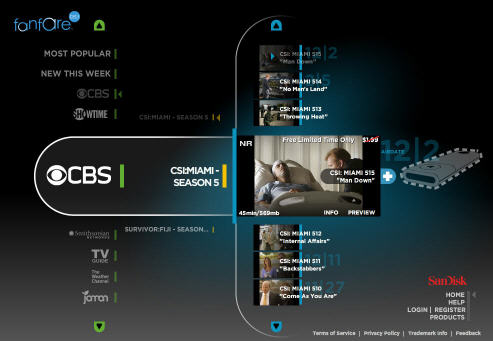
I saw an early version of this product at the NAB Futures Summit last April (CNET's Brian Cooley brought one along) and for simplicity it's hard to beat. You download the Fanfare software (a snap), plug the device into your USB, download files, and then plug the device into its cradle, which is connected to your TV. What I haven't seen is the UI for the TV, so I can't comment on that.
Considering I witnessed my 8 year-old nephew figure out how to plug his digital camera into his TV to do slide shows, I'd expect Sansa TakeTV to appeal to a pretty wide audience of non-techies. And at $100 for the 4GB model (saves about 5 hours of video), it's a solid "stocking stuffer" for the upcoming holiday season.
Sansa TakeTV is another example of the limitless innovation underway to converge the PC/broadband video world with the TV world. To date most of the solutions here (except AppleTV and Xbox probably) have been pretty techie, requiring some degree of user intervention to marry the PC and the TV over the home wireless or wired network. It's safe to say that none of these devices has yet caught on.
Sansa TakeTV's issue is whether it can be anything more than a short term, low end solution. A lot of the answer is wrapped up whether USB Flash storage can scale up to inexpensively handle lots of video. For example, the low-end AppleTV holds 40 GB and costs $299, while the 16GB USB Flash drives I found online approach $200 alone, never mind the software and other component costs in the Sansa Take TV package. (see below).
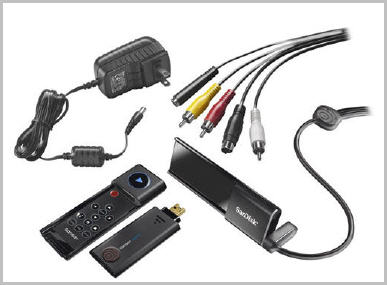
However, if anyone's going to figure out how to make USB Flash storage competitive for video, it'll be SanDisk. In the meantime, there's nothing wrong with accepting Sansa Take TV for what it is - an easy-to-use, low end product for the masses to watch high-quality broadband video on their TVs.
Categories: Devices
Topics: Apple, AppleTV, SanDisk, TakeTV
-
Red Sox Triumphant, Celebration Continues at FoxSports.com
Ok, pardon me for a minor diversion from the all-important subject of broadband video.

But up here in New England, in Red Sox Nation, there's no more important priority. We're all sleepy but exuberant after our awesome Sox came back from being down 3 games to 1 to crush the Indians 11-2 last night. Next stop Colorado. Hey, Sox in the Series, Patriots 7-0 and by the way it's going to be 79 degrees on Monday. Alright, enough gloating.
And just to prove that everything comes back to broadband, credit to FoxSports.com for its post game show that continued the celebration after the game. For fans the opportunity to see the player interviews, catch the replays and just bask in the glorious win, FoxSports.com delivered a great package.
Now back to business.
Categories: Sports
Topics: Boston Red Sox, FoxSports.com
-
Quick Thoughts on VideoNuze's First Week
As Friday winds down, I wanted to share a few quick thoughts on VideoNuze's first week.
First, a huge thanks to the many of you who have emailed or called with positive feedback on VideoNuze. It looks like the site's analyses and news aggregation are addressing real marketplace needs, as I hoped they would. It's also been gratifying to hear favorable reactions to the site's design and usability, about which my development team and I sweated every detail. I'm a big believer that no matter how great the content, if it's not easy to find and digest, it just doesn't matter.
A number of folks have called out the "Categories" feature on the site as especially useful for doing research, while others have cited the Search feature on the main nav, which returns results from both the Analyses and News Roundup sections of the site, as very handy. Type your company's name in and see!
Meanwhile, on the "needs improvement" side, I've heard from a number of you that you're receiving multiple copies of the daily email. Please contact me if this is happening to you. I'm troubleshooting this now with my email vendor and it's possible that it's an Outlook issue. If so, there's a fix.
Some of you have contacted me about email formatting issues. Regrettably, this is an agonizing area which can never be 100% resolved. Outlook '07 does not support many basic formatting functions, while other email programs also have limitations. We're working to optimize as much as possible, but in the meantime, I've found Yahoo and Gmail seem to handle formatting the best. If you have an account with one of them you may want to receive VideoNuze there. Or you can sign up for the VideoNuze RSS feeds or just come to the web site (also good alternatives if a daily email is too much to handle).
I've received recommendations for analyses from quite a few of you. Keep those coming, I'm always eager to hear your ideas. I can't act on all, but will do my best.
Lastly, I've heard lots of positive reaction from current sponsors and expressions of interest from potential sponsors. Sponsor support is of course critical to VideoNuze's success, so if reaching a highly engaged, broadband video decision-maker audience is key to your business plan, by all means drop me a line.
I have lots more exciting things planned for VideoNuze in the coming weeks and months, so please keep on visiting. And don't be shy about giving me your feedback!
Categories: Miscellaneous
Topics: VideoNuze
-
Dailyshow.com: Third-Party Distribution Isn't an Either/Or Decision
 First things first, congrats to the folks at MTVN, Comedy Central and The Daily Show. The newly unveiled Dailyshow.com is fabulous. It is the best TV program-centric web site I have yet seen. As a long-time Jon Stewart fan, being able to see all the old clips is nirvana, and will no doubt send fans over the moon.
However, a bigger picture question that Dailyshow.com's launch raises is how these direct-to-consumer initiatives work vis-a-vis third-party distribution deals. With media companies newly empowered to engage directly with their audiences using the Internet and broadband, many analysts have predicted the result will be diminishing relevance of third-party aggregators, including everyone from Comcast to Yahoo to Joost to you name 'em.
It's pretty apparent that MTVN/Comedy Central is coming down on the side of heavily emphasizing direct-to-consumer as its broadband video strategy when you combine Viacom's ongoing lawsuit against Google/YouTube, MTVN EVP Erik Flannigan's comment ("People should be reacting to 'The Daily Show' on its own site...God bless them for doing it everywhere else, but this should be the epicenter of it") and a company spokesman's comment ("that a few selected clips could become available on sites through syndication deals").
Count me among those who think this is both the wrong approach and one that will ultimately under-optimize the value of the Daily Show and other franchises in the broadband era. Quite simply, building out a strong direct-to-consumer presence like Dailyshow.com is NOT an either/or decision relative to also developing strong third-party distribution relationships.
In fact, the reality is that strong third-party distribution is essential in the Internet era, because Internet usage is both highly distributed among millions of web sites and also concentrated at a few large portals. Media companies' goal should be to proliferate their content (under the right deals of course) into all the nooks and crannies of the Internet while also striking deals with big portals to maximize exposure, usage and ad revenue.
But don't think distributors get a free ride in the Internet era. They need to prove they can leverage their audience devotion and traffic to drive value for content providers. Those that do will succeed. Proof of this is already emerging. One senior broadband executive recently told me that over 80% of his traffic comes from YouTube and other distribution partners, with his own site's traffic in the minority.
Not aggressively pursuing third-party distribution, as it appears is MTVN's plan, in essence requires that users reorient their behavior to come solely to one uber destination site like Dailyshow.com. To me this smacks of classic traditional media thinking where consumer convenience or preference gets short shrift in the name of what's supposedly "best" for the brand. My guess is if you asked Jon Stewart off the record what his preference is, he'd likely say, "make my stuff available everywhere!"
So kudos to the folks behind Dailyshow.com. But don't let your good works end now. Go out and find the best third-party distributors you can and let them help you extend the Daily Show franchise even further.
Categories: Cable Networks, Portals
Topics: Comedy Central, Daily Show, Google, Jon Stewart, MTVN, Viacom, YouTube
-
Broadband Video vs. IPTV, The Differences Do Matter
It's funny how often I'll be talking to someone and they will casually start interchanging the terms "IPTV" and "broadband video/online video/Internet TV".
The fact that many people, including some that are actually well-informed, continue doing so is a reminder of how nascent these delivery platforms still are, and how common terms of use and understandings have yet to be established.
Yet it's important to clarify that there are differences and they do matter. While some of the backend IP transport technology is common between IPTV and broadband video, the front end technology, business models and content approaches are quite different.
In presentations I do, I distinguish that, to me at least, "IPTV" refers to the video rollouts now being pursued by large telcos (AT&T, etc.) here in the U.S. and internationally. These use IPTV-enabled set-top boxes which deliver video as IP packets right to the box, where they are converted to analog video to be visible to the viewer. IPTV set tops have more capabilities and features than traditional MPEG set-tops, and telcos are trying this as a point of differentiation.
However, at a fundamental level, receiving IPTV-based video service is akin to subscribing to traditional cable TV - there are still multi-channel tiers the consumer subscribes to. And IPTV is a closed "walled garden" paradigm - video only gets onto the box if a "carriage" deal has been signed with the service provider (AT&T, etc.). IPTV can be viewed as an evolutionary, next-gen technology upgrade to existing video distribution business models.
On the other hand, broadband video/online video/Internet TV (whatever term you prefer) is more of a revolutionary approach because it is an "open" model, just like the Internet itself. In the broadband world, there's no set-top box "control point" governing what's accessible by consumers. As with the Internet, anyone can post video, define a URL and quickly have video available to anyone with a broadband connection.
The catch is that today, displaying broadband-delivered video on a TV set is not straightforward, because most TVs are not connected to a broadband network. There are many solutions trying to solve this problem such as AppleTV, Microsoft Media Extender, Xbox, Internet-enabled TVs from Sony and others, networked TiVo boxes, etc. Each has its pros and cons, and while I believe eventually watching broadband video on your TV will be easy, that day is still some time off.
Many people ask, "Which approach will win?" My standard reply is there won't be a "winner take all" ending. Some people will always prefer the traditional multichannel subscription approach (IPTV or otherwise), while others will enjoy the flexibility and features broadband's model offers. However, for those in the traditional video world, it's important to recognize that over time broadband is certainly going to encroach on their successful models. Signs of change are all around us, and many content companies are now seizing on broadband as the next great medium.UPDATE: Mark Ellison, who is the SVP of Business Affaris and General Counsel at the NRTC (National Rural Telecommunications Cooperative, an organization which delivers telecom solutions to rural utilities) emailed to clarify that it's not just LARGE telcos that are pursuing IPTV, but many SMALLER ones as well. Point well taken Mark, it was an oversight to suggest that IPTV is solely the province of large telcos like AT&T.Categories: Cable TV Operators, IPTV, Technology, Telcos
Topics: Apple, AppleTV, Media Extender, Microsoft, Sony, TiVo, XBox
-
Meet in NYC on Tues. (10/23) or Wed. (10/24)?
I'm in NYC next Tues. and Wed. for some meetings, but have a few openings in my schedule.
If you'd like to get together to update me on your company's activities, exchange notes on the industry or just chat, drop me a note or call me (contact info here).
Categories: Miscellaneous
-
Bud.TV + New Yorker = ?
Thumbing through the latest version of the New Yorker I noticed the ad shown at right (scanned B&W
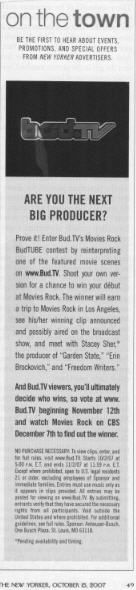 version, a little hard to read online). It's an intriguing invitation to enter something called the "Bud.TV Movies Rock BudTUBE" contest (that's a mouthful). It goes on to ask you to "reinterpret" one of the featured movie scenes on Bud.TV. The winner gets a trip to LA and a possible meeting with producer Stacey Sher.
So I go to Bud.TV to learn more and all I can find is a small icon on the home page that leads to this contest landing page.

It doesn't say when this contest will launch, doesn't ask me to submit an email address or to sign up to be notified when the contest goes live and doesn't provide any additional teaser information beyond what was in the New Yorker ad (like how about at least showing a few of the featured movie scenes?).
At first I thought the New Yorker magazine, with its liberal-minded, somewhat elitist audience, seemed like an odd place to be marketing a contest sponsored by a beer brand, but maybe there was something I was missing. But now seeing this underwhelming landing page, my conclusion is that this whole Bud.TV contest is a misfire so far. Wouldn't you expect a marketer of Anheuser-Busch's stature to execute the details better than this? I would.
Bud.TV has been widely criticized, but it remains a bold attempt by Bud to use broadband to change the marketing equation and improve engagement with its customers. However, if it's going to be effective, it's going to have to execute far better than it has with this contest. A lesson to all brand marketers experimenting with broadband - try your best to create a cohesive and memorable user experience.
Categories: Brand Marketing, Magazines
Topics: Anheuser-Busch, Bud.TV, New Yorker
-
Magnify.net: A Long Tail Matchmaker
 Yesterday I had a chance to catch up with Steve Rosenbaum, CEO and Co-Founder of Magnify.net.
One of the things I really enjoy about being an analyst in the burgeoning broadband video industry is getting first-hand exposure to all the clever innovation that's going on. I find it endlessly fascinating to hear directly from entrepreneurs on the front lines where the kernel of their idea came from which led to their business plan. A user experience issue? A technology deficiency? A business model flaw? Over the years I've heard many stories. Some kernels have real weight, while some don't quite resonate for me.
Magnify.net falls into the former category. My read is that this is a company trying to solve a real problem with a very clever solution and the right "corporate attitude" to make it a likely winner.
Magnify is actually solving a number of real problems, many of which relate to the highly distributed or "Long Tail" nature of the Internet and broadband video. First is that while consumers love broadband video, finding what they want is problematic. Novelty quickly turns to frustration when rummaging through big video sharing sites to find something relevant. No matter how much users want choice, some level of editorial or "curation" is essential to optimize their experience.
Magnify enables existing enthusiast or vertical web sites (whether independent or major media) to obtain video from the best video sharing sites (YouTube, Metacafe, etc.) and coherently present a screened assortment to their users. The sites' use their editorial skills to sort the wheat from the chafe, with easy-to-use admin tools ensuring that no offending video slips through the cracks.
So the second problem Magnify solves is enabling thousands (17,500 and counting to be exact) of sites to provide quality video to their users without the hassle and expense of creating it themselves (the "matchmaker" role). These sites get 50% of the revenue from the ads Magnify sells around the video (or they can keep up to 50% of the inventory to sell themselves), leveraging their audience and subject matter expertise. Incorporating video into web sites is becoming online table stakes. I agree with Steve, in the years ahead, sites without video are going to look "charming".
The only real hole I can find in Magnify's model is that it doesn't currently compensate the content creators themselves (a la Revver for example). However I'd expect that to change as creators upload directly to Magnify and the company's network and traffic builds out over time.
Lastly, I like Steve's attitude. He views the market as an incredibly expanding pie, and not "winner take all." As a result, while there are others who touch on Magnify's space (Brightcove, ROO, VideoEgg, Ning, KickApps, etc.), he's less concerned about competition per se and matching feature-for-feature, but rather on responding to the needs and wants expressed directly by their own user base. Companies that do this ultimately win, regardless of competition.
The Magnify story plays into a number of areas I follow closely - the changing role and power of video distributors, the continued "nichification" of video, the challenge of video discovery and the reliance on ads, not subscription fees. To the extent that their approach succeeds it will further morph traditional video models. For a 10 person company that's only done an angel round, they've accomplished a lot in addressing genuine Long Tail issues in the broadband video industry. (Btw, TechCrunch has 2 great reviews, here and here).
Categories: Aggregators, Indie Video, Startups, UGC, Video Sharing
Topics: Brightcove, KickApps, Magnify.net, Ning, ROO, VideoEgg
VideoNuze Posts

Connect with VideoNuze
Exclusive News Roundup
- NFL set for first-ever game in Melbourne, Australia, in international expansion CNBC
- MrBeast partners with Gemini to turn impossibly big ideas into reality Google blog
- The Athletic Expands Live Video Push With Nightly Streaming Show The Wrap
- VodafoneThree Launching Vodafone TV In The UK, Bundling Netflix, HBO Max & Live Channels Deadline
- Prime Video Grabs Local Streaming Rights for Six NHL Teams The Hollywood Reporter
- ESPN Unlimited is now available on YouTube TV YouTube blog