-
Disney/ABC's Stage 9 Launches, With YouTube
Disney/ABC Television Group's official announcement this morning of Stage 9 Digital Media, an experimental new media content studio, is another key milestone in the fast-moving broadband video industry.
I got a short briefing about Stage 9 late yesterday from Disney/ABC because it asked me to provide some analyst context to the LA Times' Dawn Chmielewski, who's done a great piece here. Stage 9 is Disney/ABC's key initiative to reach the coveted 18-34 audience in synch with this audience's unique media consumption patterns. Programming will be short, funny, well-produced, episodic, and widely distributed through popular broadband sites, social networks, mobile and download services.
I interpret Disney/ABC's move, when coupled with recent initiatives by other big media companies into original broadband video production, as further evidence of two key trends: that broadband video has come of age as a key priority for the largest media companies and that it is impossible to appeal to today's younger audiences simply by hewing to the traditional rules of the media game.
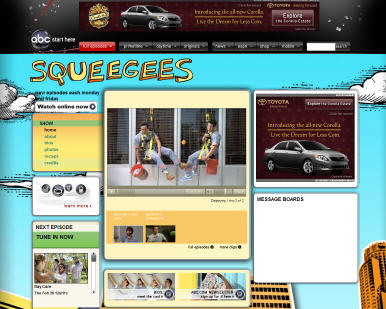
Also of significance is that Disney/ABC announced that "Squeegees," which is Stage 9's first release, will be co-exclusively premiered on ABC.com and YouTube starting today and sponsored by Toyota. Yes, you read that right. YouTube! The scruffy user-generated phenom that big media was threatening to sue out existence not so long ago, and which of course is now owned by Google, big media's most anxiety-inducing "frenemy," has been elevated to launch partner status for Stage 9's first program.
The "Squeegees" co-premiere is quite an accomplishment for YouTube. It shows that YouTube's methodical efforts to gain legitimacy (and a business model!) by establishing partner channels with media companies are beginning to pay off. David Eun, Google's VP of Content Partnerships has repeatedly explained this game plan to me, and others over the last year. The Stage 9 launch partnership should certainly be regarded as a major win for the young company. It is also another data point I'd use to support my contention that in the broadband age, traditional conceptions about copyright monetization need to be radically re-thought (Viacom, are you listening?).
I'm enthusiastic about the Stage 9 initiative, as I believe it holds lots of potential for Disney/ABC. It gives the company inroads to the elusive 18-34 set, offers the prospect of innumerable and invaluable insights about how to effectively program in the broadband age, provides a whole new internal breeding ground for developing new on-air programming (a possible double win, as this might help fix the broken and expensive traditional pilot process, though my enthusiasm on this point is tempered by news today of Quarterlife's NBC ratings fiasco) and creates new and exciting multi-platform sponsorship opportunities.
In short, the strategy is sound and the upside significant. Now for the hard part: Stage 9 needs to execute and actually deliver on all this potential.
What do you think? Post a comment now!
Categories: Broadcasters, Indie Video, UGC
Topics: ABC, Disney, Stage 9, Toyota, Viacom, YouTube
-
CES 2008 Broadband Video-Related News Wrap-up
CES 2008 broadband video-related news wrap-up:
Panasonic and Comcast Announce Products With tru2way™ Technology
Panasonic And Comcast Debut AnyPlay™ Portable DVR
NETGEAR® Joins BitTorrent™ Device PartnersD-Link Joins BitTorrent™ Device Partners
Vudu Expand High Definition Content Available Through On-Demand Service
Sling Media Unveils Top-of-Line Slingbox PRO-HD
Open Internet Television: A Letter to the Consumer Electronics Industry
Paid downloads a thing of the past
Samsung, Vongo Partner To Offer Movie Downloads For P2 Portable Player
Comcast Interactive Media Launches Fancast.com
New Year Brings Hot New Shows and Longtime Favorites to FLO TV
P2Ps and ISPs team to tame file-sharing traffic
ClipBlast Releases OpenSocial API
Categories: Advertising, Aggregators, Broadband ISPs, Broadcasters, Cable Networks, Cable TV Operators, Devices, Downloads, FIlms, Games, HD, Mobile Video, P2P, Partnerships, Sports, Technology, UGC, Video Search, Video Sharing
Topics: ABC, BitTorrent, BT, Comcast, D-Link, Disney, Google, HP, Microsoft, NBC, Netgear, Panasonic, Samsung, Sony, TiVo, XBox, YouTube
-
Microsoft Flexes Broadband Muscles at CES
Microsoft grabbed the early PR spotlight at the Consumer Electronics Show (CES), now underway in Las Vegas, announcing a variety of deals across the broadband video spectrum. The deals, announced by Bill Gates in his traditional night 1 keynote, reinforce Microsoft's intentions to play multiple roles in what Gates calls the "first true Digital Decade."
Here's a look at Microsoft's deals and why they matter:
NBCU 2008 Olympics on MSN, using Silverlight
Microsoft and NBC, which has the broadcast rights to the '08 Summer Games from Beijing, announced that MSN would be the exclusive partner for NBCOlympics.com including thousands of hours of live video
 coverage, and that Silverlight, which is Microsoft's "Flash-killer", would be used. As I mentioned in my "6 Predictions for 2008", the '08 games are going to be the biggest broadband video event yet. The deal gains MSN lots of traffic and Silverlight lots of exposure and downloads, not to mention serious validation as a live streaming platform if it executes well.
ABC/Disney and MGM content on XBox LIVE
In a further move to bolster the premium-quality content available in XBox LIVE (the content offering that accompanies XBox 360), Microsoft announced that both ABC/Disney and MGM would now be providing both SD and HD content. These moves bring XBox LIVE's catalog closer to parity with iTunes, while
 keeping up the competition with Amazon Unbox and other stores. Separately, Microsoft said that XBox racked up 17.7 million units sold during the '07 holiday season.(correction, Microsoft press release misstated this number. Holiday sales were actually 4.3 million units, bringing cumulative units sold to date to 17.7 million, thx Karl)
XBox users have been remarkable active purchasers and downloaders using XBox LIVE, and previous briefings I've conducted with XBox executives suggest that the initiative has been particularly successful with HD. Since Xbox is purchased primarily as a gaming platform, it serves as a great Trojan horse opportunity for Microsoft to gain broadband access to the TV.
 Meanwhile, XBox LIVE has served as the deal unit for Zune's library as well, so these moves are important to watch as they benefit Microsoft's efforts to dislodge iPod from its perch as the leading digital media player. Only disappointment here is no ad-supported counterpart was announced for ABC programs, leaving AOL as ABC's only announced broadband syndication partner, as best I can tell.
BT and XBox 360 Integration
Microsoft leveraged Xbox 360 for another convergence play, announcing with BT that the company's "BT Vision" IPTV service would be available for XBox 360 owners as an integrated service offering. This means that no separate set-top box would be required for BT Vision subs. Though the box won't roll out until mid '08, this concept has compelling upside for both sides and could be a nice blueprint for future IPTV deals. It eliminates set-top capex for BT, while providing strong marketing benefits to both parties, helping drive broadband/TV convergence on the back of the popular XBox gaming console.
Showtime, TNT and CNN with new apps on Mediaroom, Samsung supporting Extender
Elsewhere, Microsoft announced that Showtime, TNT and CNN would be creating new apps for Microsoft's Mediaroom IPTV platform, which it says is now installed on 1M set-tops globally. And lastly, that Samsung will support Extender for Windows Media Center, which means that HD content can be sent over wired or wireless-N networks from PC to TV. Extender hasn't caught on yet, but Microsoft is continuing to push it as a bridge device. I've yet to test it, but have that on my list of to-do's.
Taken together, these announcements from Microsoft show the company's vast resources allow it to play a role in all aspects of the broadband era - software, devices, services, content, gaming, etc. Less pronounced in these deals was the company's recently added online advertising prowess, which will soon be applied to broadband video as well. Stay tuned for news on this front as '08 unfolds.
Categories: Aggregators, Broadcasters, Cable Networks, Downloads, FIlms, Games, HD, International, IPTV, Partnerships, Sports
Topics: ABC, BT, CNN, Disney, MGM, Microsoft, NBC, Olympics, Samsung, Showtime, TNT, Xbox 360, Xbox LIVE
-
Move Networks $40.1M Round Could Increase, '08 Expansion Planned
Move Networks, which quietly closed on a recent $40.1 million second round, may expand it further pending diligence being conducted by one more investor. Move CEO John Edwards shared the information with me in a briefing. The company still hasn't officially announced the round or its participants. John did say they're mainly strategic investors and the official word should come in a couple of weeks. The funding comes on top of its $11.3 million first round announced in February '07.
 Move is focused on high-quality broadband video delivery, especially for long-form content, and optimizing the user experience. It is clearly gaining traction with both customers (e.g. Disney, Fox, CW, Discovery, etc.) and users. Move's client runs its proprietary adaptive "stream selection protocol", which dynamically detects the user's bandwidth and CPU, thereby optimizing the video experience. This leads to low video stall-out or re-buffering incidents, which Move believes is the #1 cause for terminating video sessions.
John shared a few interesting statistics. Its customers have delivered Move-powered video to a cumulative 27 million users since March '07. Using its client, Move can track all manner of user behavior including time spent with the selected video. This yields another stat: for a single one hour episode delivered, approximately 60% watch longer than 30 minutes, with an average session length of 53 minutes.
Demonstrating that it can deliver higher-quality video and consistently longer viewing is at the heart of Move's value proposition, as it allows content providers to sell more ad inventory, driving top line revenue and ROI. Move also offers an ad module, allowing improved targeting and insertion of flexible cue points based on user behaviors plus a drag-and-drop syndication feature. The company also focuses on reducing customer expenses by optimizing delivery over multiple CDNs and augmenting this with a peer-sharing capability.
Move has a lot on its plate going into '08. John says they are running projects with all the major networks, are supporting all the live streaming for the Olympics plus lots of other live event broadcasts, rolling out integrations with set-top boxes and expanding internationally with new offices in Europe and Asia.
Categories: Technology
Topics: CW, Discovery, Disney, FOX, Move Networks
-
Hulu Launches Private Beta

Not breaking news now, but Hulu lifted the veil of secrecy a bit today, releasing some screen shots and setting up a private beta (I'm trying to yank some strings to get access), in advance of a planned public launch early next year.
Hulu's been surrounded by a bunch of naysayers from the beginning, though much of the nay-ing has been based on little else than cheap shots about the name, delayed launch, etc. Things that in the grand scheme of things mean virtually nothing in my opinion and only serve to distract attention from the real question at hand: can Hulu become NBC and Fox's (for now) formula for success in the broadband video era?
Now it's time for Hulu to silence the rabble. Until I get my own hands on it, I'm going to reserve in-depth commentary. But at least several things that look intriguing:
- Shorter commercial breaks and overlays - Looks like the tension between user focus vs. advertiser focus is skewing toward users. A welcome change from traditional media thinking.
- Widespread distribution - I've been a big fan of this from the start. Deals with AOL, Yahoo, MySpace, Comcast, etc. ensures that Hulu content is widely available where users already are.
- More content deals - One of the knocks on Hulu was that neither CBS nor ABC joined up front. However, recent deals with Sony and MGM show Hulu continues to gain traction with other premium providers.
- Features - Beyond the standard range of embed, full-screen, send-to-friend features, it looks like there's an interesting "custom clip" capability to let users crop out scenes from favorite shows to pass along. This user control could enable massive new short form video inventory and could be a precursor to more interesting and creative user-generated mashups. All of this is highly monetizable.
More thoughts on Hulu to come.
Categories: Aggregators, Broadcasters, Strategy
Topics: ABC, AOL, Comcast, Disney, FOX, Hulu, Microsoft, MySpace, NBC, News Corp, Yahoo
-
Change is Afoot in the TV Business - April E-Newsletter
Change is afoot in the TV business. The traditional world of networks’ hit programs being distributed exclusively through local broadcast TV affiliates is being challenged broadband delivery.
The challenge began modestly about a year and half ago, but more recently it has picked up significant steam. Back in October 2005 Disney/ABC made headlines with a deal to have select programs available for paid download via iTunes. Next up was a trial in the spring of 2006 to test consumer and advertiser interest in streaming full episodes of select programs at ABC.com. When ABC launched this officially in the fall of 2006, the other major networks joined in the action. By my recent count there are now over 40 progams available for ad-supported, free streaming.
All of this activity surely left broadcast affiliates wondering how they fit into this new direct-to-consumer landscape. Of course ABC allows its owned and operated (O&O) stations to also stream its programs, and FOX has shown a willingness to open up distribution further to all affiliates. Meanwhile, the other networks have not made concrete announcements about how their affiliates fit in.If local broadcasters accepted any of these assuagements, news from the past few weeks should have doused any cheery feeling they may have maintained. Recently, NBC and News Corp announced that they were setting up a new joint venture to manage the online distribution of their programs, simultaneously inking deals with four of the Internet’s biggest sites, AOL, MSN, MySpace and Yahoo (adding Comcast shortly thereafter). Next, CBS announced its “CBS Interactive Audience Network”, together with deals to have CBS programs distributed through at least ten large web sites, with more surely to follow.
Broadband’s Long Arm Reaches into the Broadcast IndustryIf I were a broadcaster keeping score over the past year-and-a-half, I would say things have gone from bad to worse to (as my 5 year-old would say) worser.Consider: in less than two years, broadcasters’ competitive position has shifted from a world where all viewers had to tune into their local channels to watch original episodes of “Heroes”, “24”, “CSI” and other hit network programs to a new reality where these programs are going to be dispersed to all the nooks and crannies of the Internet, ready for on-demand consumption by audiences everywhere.What does this mean for the broadcasters? For starters it means steadily declining audiences as viewers get siphoned off to these new distribution outlets. It also means rising competition just to maintain a parity “user experience” as these other distributors wrap all kinds of interactive and engaging features around these programs (e.g. online contests, blogs, clips, mashups, etc.). And finally, it suggests falling advertising revenues as marketers recognize not only broadcasters’ shrinking audience size, but also that the most desirable demos have moved on and are consuming and interacting around these programs through other outlets.Based on Broadband Directions’ recent market intelligence report, “The Broadcast Industry and Broadband Video: Confronting New Challenges, Embracing New Opportunities”, my conclusion is that these deals all signal the networks’ clear realization that consumers (particularly the younger, most desirable ones) are changing their behaviors and that if the networks don’t keep pace, they will become dinosaurs themselves.The networks understand that a broadcast affiliate system established to overcome the geographic limitations of retransmitting analog signals is fast becoming anachronistic in a world of high-quality, boundary-less digital distribution. So, to my mind, their recent initiatives represent nothing short of an attempt by the networks to eventually create a “digital replica” of the analog broadcast model, ensuring that network TV programs reach into the far corners of the Internet, easily accessible to consumers who increasingly live their lives online. The networks’ emphasis on a forward-looking approach, rather than stubborn complacency around the status quo, seems like a smart game plan to me.How Broadcasters Can Stay in the Game – A Blueprint for Surviving and ThrivingAs many of you know, I believe strongly that broadband’s open delivery platform challenges all incumbent distributors’ business models. The Internet puts entities that stand between producers and viewers in an increasingly perilous position. Their ability to survive and thrive will rely not on their traditional capabilities, but rather on new ones that add new value to viewers’ and advertisers’ expectations.Therefore, I think there are at least 5 key elements in any plan for local broadcasters to prosper in the broadband era:
1. Become online distributors of networks’ programsFirst, broadcast TV affiliates must aggressively press the networks for equal access in distributing TV programs through their web sites. Access to these programs is “table stakes” for anyone who wants to have equal footing for audience’s attention in the broadband era. I’m not privy to the behind-the-scenes dealings between the affiliate boards and the networks, but for the broadcasters’ sake, I hope they are being relentless in their pursuit of these rights.2. Invest in creating distinctive local contentAs network programs migrate to other venues, it is imperative that local broadcasters invest in creating content that will appeal to their audiences in their own right. For too long news, weather and traffic have been the broadcasters’ mainstays. Broadband opens up endless possibilities for broadcasters to exercise their creative muscles and boost the appeal of their home-grown programming.3. Distribute programming around the InternetAs the saying goes, “what’s good for the goose is good for the gander.” As the networks pursue new Internet outlets, so too must broadcasters tap into new ways of distributing their original content. Broadcasters must realize that audiences outside their traditional transmitting range will also have an interest in some of their original content. By using new online syndication tools and partnerships, broadcasters can extend their reach, and their revenue potential. Witness the recent deal between Yahoo and CBS’s O&Os, which has extended these broadcasters’ reach across Yahoo’s vast network.4. Harness the enthusiasm of local citizens to contribute video and other contentSpeaking of content, the user-generated variety is no longer a fad monopolized by YouTube. Media companies of all stripes are recognizing that users represent untapped potential as contributors to the creative process. This is particularly true in the local community where broadcasters’ economics cannot allow them to give equal coverage to all local events. The rallying cry should be “go forth carrying your video cameras.” See what the Washington Post, for example, is doing to cultivate local bloggers. Given the right training, incentives and integration, local citizens can make a huge contribution to local broadcasters’ broadband efforts.5. Create new value propositions for local advertisersLast but not least, it is essential that broadcasters create new value propositions for local advertisers. National advertising is seriously at risk with the Internet’s rise. However, local advertising is somewhat insulated by the big online players’ inability to reach into each and every community with a robust content offering. Broadcasters must develop new video ad formats beyond simple pre-rolls, which should include geo-targeting, interactivity and performance-based rates. None of these are easy -- they will all require creativity, persistence and re-training of local sales teams.ConclusionI believe the networks’ march into broadband distribution will be relentless. Just wait until there’s mass availability of consumer devices or other technical approaches that bridge the PC/broadband world with the TV world. This will allow network programming to be carried all the way into the living room, instead of being limited to wherever the computer currently resides. When this unfettered broadband access to the TV occurs, broadband distribution will take another giant, disruptive step forward.Change is afoot in the TV business. Broadband threatens to re-order the industry’s traditional participants into new winners and losers. Broadcasters need to run fast to stay in the first group. Let’s keep an eye on how they do.
Categories: Broadcasters
Topics: ABC, AOL, Disney, FOX, MSN, MySpace, NBC, News Corp, Yahoo
Posts for 'Disney'

Previous |
Connect with VideoNuze
Exclusive News Roundup
- NFL set for first-ever game in Melbourne, Australia, in international expansion CNBC
- MrBeast partners with Gemini to turn impossibly big ideas into reality Google blog
- The Athletic Expands Live Video Push With Nightly Streaming Show The Wrap
- VodafoneThree Launching Vodafone TV In The UK, Bundling Netflix, HBO Max & Live Channels Deadline
- Prime Video Grabs Local Streaming Rights for Six NHL Teams The Hollywood Reporter
- ESPN Unlimited is now available on YouTube TV YouTube blog