-
Cable Affiliate Fees Matter. A Lot.
Over the past week or so, several people have forwarded me a post that Bill Gurley, partner at the Silicon Valley venture capital firm Benchmark Capital recently wrote titled, "When It Comes to Television Content, Affiliate Fees Make the World Go 'Round," in which he correctly observes that "over-the-top" disruption of cable/satellite/telco delivery of premium TV programming isn't going to happen very quickly due to the importance of affiliate fees. His main argument - that cable networks receive $32 billion in annual affiliate fees from cable/satellite/telco distributors that they are loath to jeopardize - is right on the money (no pun).
This of course has been the central reason that cable, as opposed to broadcast, programs have been scarcely available online. I've argued the same point for a while now, going back to "The Cable Industry Closes Ranks" in which I tried to explain how the cable industry works and why it would fight tooth and nail against disruption. Gurley further notes how TV Everywhere cleverly defends the industry against free distribution, which I agree with as well.
While there's plenty of media hype around the prospect of "cord-cutting," it's essential to understand the business dynamics in play and what impact they'll have in slowing this trend. It's rare to see a Silicon Valley VC take such a sober approach to potential disruption (because funding exciting tech start-ups is largely about funding disruption after all), so I thought Gurley's post was both refreshing and worth the read.
What do you think? Post a comment now (no sign-in required).Categories: Cable Networks, Cable TV Operators
Topics: Benchmark Capital
-
Hollywood Video's Closing Underscores End of Video Rental Store Era
When it was reported earlier this week that Hollywood Video, once the 2nd largest operator of video rental stores, would close all its remaining stores, it was further evidence of how much the landscape for movie rentals has changed. When you stop and think about it, it wasn't really that long ago when Hollywood Video, Blockbuster and other rental stores dotted America's cities and towns, making rentals a short drive or walk away (no matter how short though, if the movie wasn't returned promptly major late fees kicked in).
Fast forward to today, and electronic delivery options abound, but with lots of quirks consumers need to understand. As I wrote recently in "The Battle Over Movie Rentals is Intensifying," the options vary and include VOD, download to rent and own, subscription access, DVD purchase, etc. And the devices through which consumers access movies is dizzying - set-top boxes, special purpose appliances, game consoles, DVRs, mobile devices, iPads, etc. Even still, there is so much more yet to happen with movie delivery as wireless and wired broadband coverage expands, HD online delivery increases, portability between devices happens and so on.
What do you think? Post a comment now (no sign-in required).
Categories: FIlms
Topics: Hollywood Video
-
Apple Slaps Ellen DeGeneres for Fake iPhone Ad
On a lighter note to end the week, did you catch comedian Ellen DeGeneres's fake iPhone ad, and then her subsequent apology for it - apparently prompted by an Apple rebuke? The fake ad itself is hilarious; that Apple didn't think so is further evidence of how tightly Apple tries to control its brand and image. See what you think.
Categories: Devices
Topics: Apple, Ellen DeGeneres, iPhone
-
VideoNuze Report Podcast #60 - May 7, 2010
Daisy Whitney and I are pleased to present the 60th edition of the VideoNuze Report podcast, for May 7, 2010.
In today's podcast Daisy and I discuss research that Brightcove and TubeMogul released yesterday on online video consumption and engagement in the media industry. Though the data isn't statistically significant, the report caught our eye because it offers a great assortment of insights based on actual platform data plus survey responses. It's freely downloadable here. Listen in to hear our reactions.
Click here to listen to the podcast (13 minutes, 47 seconds)
Click here for previous podcasts
The VideoNuze Report is available in iTunes...subscribe today!Categories: Podcasts
Topics: Brightcove, Podcast, TubeMogul
-
Reminder: VideoSchmooze Breakfast in LA on June 15th
Please join me on June 15th for a VideoSchmooze breakfast at the gorgeous SLS Hotel at Beverly Hills - one of the hottest spots in LA. Our panel is going to tackle the important topic of "How Hollywood Succeeds in the Digital Distribution Era."
Our discussion couldn't be more timely; we are reminded on a daily basis of the changes swirling around Hollywood, which have significant long-term distribution and viewership implications.
Examples include the strong early adoption of tablet computers like the iPad which has sold 1 million units in its first 4 weeks of availability; the shift to subscription services like Netflix, which added almost 3 million subscribers in just in the last 6 months, growing its subscriber base by 26% to 14 million subs; the decision by Hollywood Video to close the last of its rental stores, which once totaled over 2,400; YouTube's nascent move into movie rentals and Google's planned launch of "Google TV;" the rise of TV and movie viewership on smartphones; the proliferation of HD video delivery online by CDNs like Akamai; the massive investments being made in online video advertising, which will help long-form monetization, and the list goes on.
These kinds of technology-driven changes are occurring all around Hollywood and are only going to accelerate. That means the future landscape is certain to be very different from the past. Our outstanding panel will help us understand what all this and more means:
- Darcy Antonellis - President, Technology Operations, Warner Bros. Home Entertainment
- Albert Cheng - EVP, Digital Media, Disney/ABC Television Group
- Gannon Hall - Chief Operating Officer, Kyte (co-lead sponsor of the breakfast)
- Ted Sarandos - Chief Content Officer - Netflix
- Ben Weinberger - CEO and Co-Founder, Digitalsmiths (co-lead sponsor of the breakfast)
Our panelists will share their experiences and best practices learned to date, plus forecasts for the future. There will be ample time for audience Q&A and for networking. It promises to be a special event and I hope you're able to join us! Early bird individual and table rates are now available.
Click here to learn more and register for early bird discountCategories: Events
Topics: VideoSchmooze
-
Roku To Add Netflix Browse, Search and Queue Features
Roku just announced that by June it will soon be introducing a handful of features that improve the Netflix streaming experience when using Roku, including the ability to do the following all within its channel UI: search the Netflix Watch Instantly library, browse and play content and add content to your Watch Instantly queue (here's a short company-produced demo video).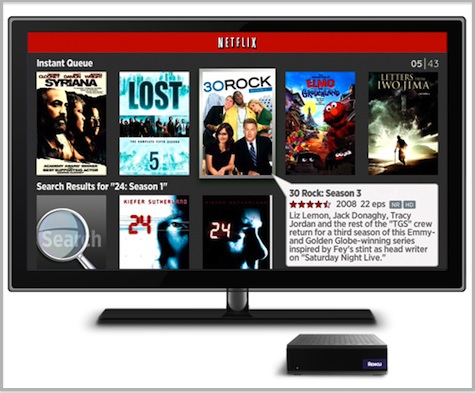
Currently users are first required to do all of these things online in their Netflix account, and then go to the Roku when ready to play their selections. This 2-step process has always felt a bit clunky to me and the new features obviously simplify the experience a lot. Roku spokesman Brian Jaquet told me he believes Roku is the first to offer the search function of the many CE devices Netflix is integrated with. I know Xbox introduced the browsing function last fall and I believe that at least PS3 and Wii (and possibly others) offer this as well.
Netflix has been hitting it out of the park recently with subscriber additions, with streaming an increasingly important drawing card. Things that Roku and others do that improve the TV-based experience are valuable, especially for more mainstream users.
What do you think? Post a comment now (no sign-in required).Categories: Aggregators, Devices
-
Digging into Adap.tv's New Real Time Bidding Interface for Online Video Ads
Yesterday video ad management provider Adap.tv introduced a "real-time bidding" (RTB) interface for users of its video ad marketplace, which itself was launched this past February. I'm a big believer that innovations in online video advertising, plus massive online video viewership growth and adoption of convergence devices are together causing big future shifts in brands' ad budgets. RTB is another innovation that over time will help shift budgets. To learn more I spoke to Teg Grenager, Adap.tv's founder and VP of Product last night and have also spent some time reading up on how RTB is working in the display ad sector.
As background, ad exchanges give publishers the ability to expose their content and inventory to interested buyers who can use analytical tools in conjunction to allocate their budgets to better reach their targeted audiences. Exchanges are able to offer more pricing transparency to both publishers and advertisers, with the goal of improving ad performance and ROI. With exchanges, buys are placed in thousands of impressions sizes and in advance, based on anticipated targeting parameters.
As Teg explained, Adap.tv's new RTB feature improves its recently-launched marketplace by allowing ad buying at the impression level with dynamic pricing. The goal is to drive ad effectiveness even higher for advertisers, while still allowing publishers to retain control over their inventory. Teg likened RTB in the marketplace to a next-generation spot market. To use Adap.tv's RTB, the buyer (typically an agency) needs to integrate Adap.tv's API into their own trading desk technology, which as this article suggests are well underway at large firms like Publicis, Havas, The Media Kitchen and others. Once the Adap.tv API is integrated the buyer makes requests to connect with desired publishers for RTB, who in turn can accept or deny access. If accepted the buyer is then able to start bidding on available inventory, alongside other accepted buyers, creating the dynamic pricing environment.
Obviously all of the above is only worthwhile if a large number of publishers are offering inventory to the exchange in the first place and are subsequently willing to allow RTB. Teg said that 700 different properties are currently offering in-stream ad inventory to Adap.tv's marketplace, with hundreds of millions of available in-stream video impressions per month. Though this is only a fraction of the online video market, it seems like a solid start with lots of room to grow ahead. Teg noted that the buy side is in flux, with increasing pressure to be accountable to clients for targeting and ROI (things search marketing has excelled at). RTB caters to these needs.
Longer term the idea of both exchanges and RTB seem like very useful tools to further unlock online video ad spending and shift dollars over from TV. Still, with estimated total online video ad revenue around $1 billion/year, it is clearly early days for many agencies and brands. Many are still just dipping their toes into online video advertising to learn how it performs and will not yet be ready for such hands-on granular bidding. But as these brands and their agencies get more sophisticated, and for others who are already deeply immersed in the market, the idea of a robust ad exchange with RTB will likely be intriguing.
What do you think? Post a comment now (no sign-in required).Categories: Advertising, Technology
Topics: Adap.TV
-
ABC Unveils "The VIEWer's Choice," Powered by Gotuit
Late yesterday, ABC unveiled "The VIEWer's Choice" an online library of video clips of every single topic, co-host, guest and segment from the popular daytime talk show "The View." Clips can be searched, and are also organized by playlist topics such as Celebs & Entertainment, Sex & Relationships, Mom's View, etc.
For fans of The View, the clips offer unparalleled access to the show's most memorable moments, which can also be shared easily through a dozen social media sites. For example, here you can see last Friday's episode featuring guest Melissa Etheridge. I played around with it a bit and was quickly able to find all the relevant clips with Tiger Woods and discussions about American Idol.
The VIEWer's Choice is powered by Gotuit Media Corp, a company I've written about in the past. Producers use Gotuit's Video Metadata Management System to set up the "virtual clips" from the source broadcast, based on time-based metadata. The metadata is used to both categorize the video clips into the playlists, to power search and to define ad inventory. Gotuit is used in other key sites like NBA.com's "Inside the NBA," ESPN's "Pardon the Interruption" and SI's "The Dan Patrick Show."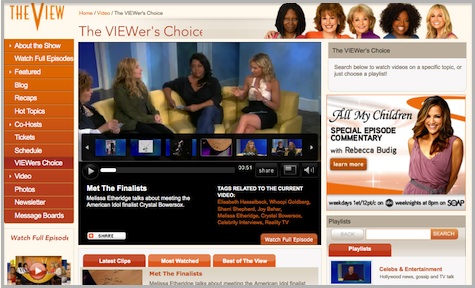
Almost 2 years ago I wrote a post "Non-Linear Presentation + Long-form Premium Video = Big Opportunity," in which I explained how deconstructing full-length programs into searchable clips offers big opportunities to drive fan engagement and new ad inventory. With the explosion of social media like Twitter and Facebook since, the opportunity to leverage clips to promote specific moments in programs is even higher now. Looking around the web though, I'm still surprised at how many full-length programs don't take advantage of this. As "The VIEWer's Choice" demonstrates, talk shows, news and sports programming are probably the most natural fit.
Engagement is the big idea behind The VIEWer's Choice; it is exactly the kind of initiative that bridges broadcast to the Internet, where more interactivity, choice and personalization are expected. As a side-note, I think it picks up nicely on what Martin Nisenholtz, SVP of The NYT's digital operations said in a recent speech at Wharton: "we've begun to view (engagement) as the essential moat around which our defenses are based; it is the emotional connection that our users have with us."
I think that point is right on the money - since Internet users are always just 1 quick click from moving on, the need to immerse them in the content experience is stronger than ever. The traditional metrics of ratings points, circulation, box office gross, etc will still be important, but going forward, measuring how solid the bonds are with audiences and users will become a key new currency when measuring a brand's value.
What do you think? Post a comment now (no sign-in required)
(Note - we'll be talking in-depth about engagement at the VideoSchmooze breakfast in LA on June 15th, where our topic is "How Hollywood Succeeds in the Digital Distribution Era." Among our panelists will be Albert Cheng, EVP of Digital Media at Disney/ABC Television and Ben Weinberger, CEO and co-founder of Digitalsmiths which is powering metadata creation and management for many studios. Please join us - early bird discounted registration is now available).Categories: Broadcasters, Technology
VideoNuze Posts

Connect with VideoNuze
Exclusive News Roundup
- Google commits to video generation, announces Veo 3.1 Lite 9to5 Google
- Roku launches a standalone app for Howdy, its $2.99 streaming service TechCrunch
- Spectrum TV App to Launch on Amazon Fire TV Devices TV Tech
- Netflix, Eager for More NFL, Is Looking at a Four-Game Package WSJ
- Ampere: Global Subscription Streaming Video Revenue Topped Record $150 Billion in 2025 Media Daily News
- What Is YouTube’s Dominance Doing to Us? We Asked Its C.E.O. NY Times