-
5 Conclusions from Broadband Ad Webcast
Yesterday's Internet TV Advertising Forum/Maven Networks webcast "Pre-Roll vs. Overlay: Consumer Reaction to New Online Video Advertising Formats" yielded a lot of interesting usability information about various broadband video ad formats. For any content provider or aggregator who's relying on advertising as their business model of choice, it's clear that there are some significant opportunities and challenges ahead.

Below is a summary of the 5 key usability conclusions I heard in the webcast along with my take on each:
1. Users hate pre-rolls. Respondents overwhelmingly agreed that video ads are annoying and have developed the same kinds of coping techniques (tuning out, bailing out, etc.) they use to avoid TV ads.
My take: Yes, but unfortunately for users, I don't see pre-rolls going away any time soon. They're easy to execute, fit media buying habits well, are selling strongly especially for high-quality long-form video and best for advertisers seeking a tonic from DVR behaviors, pre-rolls can't be outright skipped by users. Given all this, let's all hope that targeting improves and publishers use them with some discipline, so users don't preemptively turn off to the broadband video medium.
2. Overlay ads' effectiveness is correlated to content fit, not demographics. Testing showed that users welcomed ads for products that were highly related to the content itself, and lost interest the less related the two were. Demos were less important.
My take: This point reinforces the importance of contextual targeting, which of course has worked well on the Internet as a whole. Yet as Bob Kernen at Maven says, a lot of content is "non-endemic" (i.e. doesn't lend itself to specific products or ads), so my guess is that this correlation opportunity is going to be lost for many content providers. Network programs in particular seem non-endemic and therefore will need to rely mainly on demo-based and possibly behavioral targeting.
3. Overlay ads need better execution to work well. Jeff Rosenblum from Questus summarized 8 best practices for executing overlay ads, such as appropriate frequency and duration, user control, calls-to-action, navigation and the like. For anyone looking to run an overlay campaign (and even for those who have), these serve as a great roadmap of do's and don't's.
My take: As always, executing right can make the difference between a campaign's success and failure. If you're planning to run an overlay campaign, I highly suggest you review this checklist against your plans to make sure you haven't overlooked anything.
4. It's difficult to engage an audience. The testing again showed how hard it is to engage online audiences, regardless of approach. Bob laid out a handy engagement hierarchy, Impression, Interaction and Immersion (from least to most engaging). Knowing what level of engagement your campaign aspires to must guide specific tactics and execution.
My take: Getting the consumer's attention and prompting them to act is the ad industry's oldest goal. It's even harder in the broadband sector. People have shorter attention spans than ever, so grabbing them and getting them to do what you hope gets more difficult all the time. Fortunately video offers emotional appeal unlike any text or graphical ad in the Internet world, so broadband offers new engagement techniques previously unavailable.
5. More research needed. While this first round of usability testing from the Internet Ad Forum shed a lot of new light on the broadband ad opportunity, it's clearly just a first step. The Forum has ambitious goals to keep researching and testing, continuously educating the market.
My take: As I mentioned in my remarks at the beginning of the webcast, everyone has a vested interest in solidifying the ad model as soon as possible. The enthusiasm around broadband will soon dry up if participants don't earn an acceptable ROI for their efforts.
Categories: Advertising, Events
Topics: Internet TV Advertising Forum, Maven Networks
-
MTV Networks Dips Toe Into Syndication Waters
I was very happy to see news today of MTVN striking a big video syndication deal for its multiple networks' content with AOL Video.

Recently I praised Comedy Central's launch of TheDailyShow.com, but I took it to task for what appeared to be a destination-centric strategy, which was further supported by some executives' remarks. In this age of syndication, I thought that was a wrong-headed approach. Coupled with Viacom's misguided lawsuit against Google/YouTube, it felt like further evidence that MTVN was falling out of step with key broadband opportunities.
Today's news shows renewed hope that this may not be the case. I know these deals don't get done in a day, but I'd really like to see more syndication momentum from MTVN (and other content providers for that matter) to spread its content far and wide. Broadband Internet users don't expect to have to go to destination sites to get their favorite videos, they want them accessible where they already frequently visit. Hulu and CBS, to name two content providers that are solidly focused on syndication understand this, as do many others.
Categories: Cable Networks, Partnerships, Portals
Topics: AOL, CBS, Google, Hulu, MTVN, TheDailyShow.com, Viacom, YouTube
-
Broadband Video on TV is a Mirage
In yesterday's WSJ, Nick Wingfield wrote a lengthy article outlining the 5 key challenges encountered by the myriad devices aimed at bringing broadband video to TVs. He lists them as: consumer resistance to adding another box, complications in setting them up, cost, lack of content and slow downloads.
The article has a generally optimistic tone, posing "solutions" to each of the challenges. You're left with the impression that mass-scale broadband video on TV could actually happen sometime soon.
At the risk of being the "skunk at the picnic," I have recently come to believe that broadband video on TVs is a mirage, tantalizingly close yet in reality nowhere on the horizon. Unless there is some new box or approach I've yet to hear about, I've regrettably concluded that broadband video will be tied to computers, and select mobile devices, for a long time to come.
The minority of consumers who will actually see broadband video on their TVs will either (1) shell out big bucks to buy a broadband appliance such as Vudu or Apple TV, (2) tackle the challenge of connecting their TVs via wireless networks (3) use a device built for another primary purpose, such as Xbox 360 or TiVo, to selectively augment their viewing with broadband-delivered choices or (4) use a service provider that has decided to throw in a few morsels of broadband video.
Those of you with good memories will remember that in a Broadband Directions newsletter at the end of 2007 I wrote bullishly about Apple TV's ability to become the breakout convergence device, if only Apple opened up the box to all broadband content. Instead Apple has kept the box closed, available for iTunes downloads and selected YouTube videos. Consequently it has been a flop.
To help explain why products succeed or not, I tend to reach for Prof. Clayton Christensen's abiding lesson that people "hire" products to do "jobs" they have to be done. In other words, products that meet the buyer's true desires are the ones that succeed.
For me, the "job" that consumers increasingly want "done" is to be presented with an integrated, easy-to-access service (not just a new box) that offers all video programming they value in an on-demand manner and priced appropriately. That's a tall order, but ultimately one which will drive wide-spread success of any new product in this space.
Some of the possibilities include TiVo, which believes in this "seamless" philosophy, though it is still dependent on current service providers (cable, satellite, telco) to deliver programming. ICTV has a very interesting approach, though it is also reliant on existing service providers. Building B is taking a bold approach that seems to meet the full test for success, though it's still too early to know whether they can successfully execute on their vision.
But hodge-podge, costly broadband appliances just create new inconveniences while only partially addressing true consumer needs. As a result, they're not going to find a broad market. And so, barring some other new innovation, most of the world will still be watching broadband video on their computers and some mobile devices for a long time to come.
Categories: Devices
Topics: Apple, Apple TV, Building B, ICTV, TiVo, VUDU
-
blinkx Focuses on Network and Ads
blinkx, which has been around as long as just about anyone in the video search space, is steadily building out its distribution network and advertising capabilities. I caught up with Suranga Chandratillake, CEO of blinkx, who's led the company since its spinoff from Autonomy, and successfully took the company public on London's AIM earlier this year.
Suranga said blinkx is now supporting 5 million searches/day and generating 50 million unique visitors/mo across its network. Network partners featuring a blinkx search box now include Ask.com, Real, Lycos, Infospace and scores of smaller sites that use blinkx's API. Suranga says blinkx can't distinguish between traffic coming from network partners vs. at blinkx.com itself. And the revenue splits in the business deals seem to vary widely, though typically they average out to 50-50. All deals are based on advertising, with the partner usually selling the inventory.
On the ad side, blinkx took a big step forward earlier this year, launching its "AdHoc" contextual ad program. Given the analysis blinkx is doing on video to drive search, it's a natural that the company now leverages this knowledge to improve targeting for ads. In fact, Suranga sees AdHoc as a sort of AdSense for video, dynamcially matching ads with relevant content.
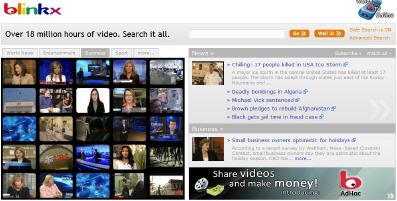
With improved targeting of course comes improved CPMs. Suranga says they've seen CPMs as high as $66 through AdHoc. blinkx is relying on the scale of its 220+ content relationships and millions of impressions to make AdHoc work. Formats can vary but the one that has been most successful so far in a mid-roll banner with an invitation for user to click and engage. As I've written before, AdHoc plays in the same space as other contextual video ad companies such as ScanScout, Adap.tv, DigitalSmiths, AdBrite, YuMe and of course YouTube, plus others.
Both the contextual ad and video search spaces are growing increasingly crowded. Players recognize these are 3 interrelated Achilles heels of the current broadband video model: users finding desired content, content providers getting paid for their work and advertisers getting sufficient and well-targeted industry. blinkx seems well-positioned to address all three.
Categories: Advertising, Video Search
Topics: Adap.TV, AdBrite, Blinkx, Digitalsmiths, ScanScout, YouTube, YuMe
-
Terrific Webcast About Broadband Video Ad Formats on Wed.
From time to time I'll take the opportunity to bring worthwhile industry events to your attention. In this spirit, there will be a terrific complimentary webcast this Wed, Dec. 12, entitled, "Pre-Roll vs. Overlay: Consumer Reaction to New Online Video Advertising Formats."
The webcast is hosted by the Internet TV Advertising Forum and Maven Networks. If you're motivated to learn about what real consumers think about different types of broadband video ad formats, then I believe this 1 hour webcast will be well worth your time.
(Note: I have no financial interest in the Forum, this webcast or Maven Networks.)
The Internet TV Advertising Forum, which was founded by Maven, includes a group of leading companies such as Digitas, DoubleClick, Fox News Digital, Microsoft, Oglivy, Scripps Networks Interactive, TV Guide, 24/7 Real Media and 4Kids Entertainment. The Forum is working to define the next generation of broadband video advertising strategies, formats and best practices.
The Forum conducted a series of usability tests in October, 2007, to study new, interactive ad formats designed for broadband video. During the webcast, Jeff Rosenblum, co-president of Questus, the market research firm that oversaw the usability testing, will share the data and conclusions.
As many of us would agree, 2007 has been marked by an increasing awareness that ad-support is going to be the primary business model for broadband video, at least in the near-term. Yet there is still much uncertainty about how best to capitalize on the advertising opportunity. So I view events like this, which further industry participants' understanding of what consumers want, as crucial to building consensus and standards necessary for the broadband video medium to succeed.
Maven has graciously invited me to share some context about the broadband video industry at the beginning of the webcast. Again, I have no financial stake in this event. Rather, I view it merely as an opportunity to share some thoughts, learn alongside all of you about the conclusions of this usability testing and participate in the follow-up Q&A session.
If you're interested in this complimentary webcast, click here to register.
Categories: Advertising, Events
Topics: Internet TV Advertising Forum, Maven Networks
-
Horowitz Study: Broadband Video Usage Jumps
At least once a week or so I try to sort through all the research-related press releases I get to see if there was any new information of note. One report that caught my eye was from Horowitz Associates, "Broadband Content and Services 2007." I haven't read the study, but there are some pretty juicy morsels in the release about how pervasive broadband video is becoming.
Below is a graph that summarizes some of the key data.
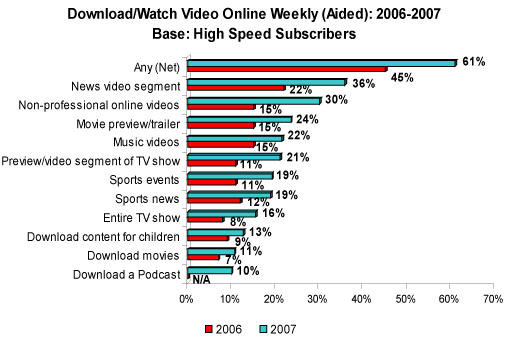
Look at the top line - a whopping 61% of high speed Internet users watch or download broadband video content at least once per week, up from 46% last year. The number jumps to 86% for users who watch at least once per month. These are very impressive numbers and they speak to how significant broadband video has become and how quickly it has gotten there.
Beyond the top line, one can see that every category of video experienced an increase in usage over the past year. Not surprisingly, news leads the way, with 36% usage, but non-professional online videos are not far behind at 30%. YouTube and the like are obviously showing ongoing appeal, even in the face of all the professional video that's come online recently.
Further down the list, how about the fact that 16% of high speed users are now watching an entire TV episode online at least once per week, double what it was a year ago? TV networks have been aggressively promoting their hit programs online, and these efforts seem to be paying off.
One of the conclusions stated in the press release is that "television is still the preferred platform for traditional TV content." I think that makes sense, but dig a little deeper and consider what happens when broadband-accessed programs can easily be viewed on TVs. I continue to say that viewers don't care how the programming gets into their house, as long as it's high-quality, available on their terms and priced correctly. Once broadband-delivered network programs can be viewed on TVs, everyone who has a stake in the status quo (local TV stations, cable & satellite operators, etc.) is going to be facing a very different landscape. See this post for more on that.
Studies like this that chart the continued adoption of broadband video are well worth following. In the past year I've heard industry executives make sweeping statements like "pay TV isn't going away" or "there will always be a place for the networks." This may be true, but as this study shows, day-after-day, week-after-week, month-after-month broadband is chipping away at how all media businesses operate.
Categories:
Topics: Horowitz Associates
-
Metacafe Drives Community-Based Programming Model
Metacafe continues to march to the beat of its own drummer and with around 30 million unique visitors/month, do quite well at it. It steadfastly refuses to be lumped in as yet another "UGC/video-sharing" site, instead considering itself an online entertainment destination that is focused on short-form programming largely selected by an elaborate community-based selection process.

Last week I caught up with CEO Erick Hachenburg to get an update on the business and more particulars about how the community acts as the site's content curator. Erick asserts that no other site does community curation as deeply as Metacafe and I'm inclined to agree with him. With this community emphasis and short-form focus, Metacafe presents yet another example of how broadband is re-shaping consumers' video choices and expectations.
Metacafe maintains a volunteer panel of about 80,000 users, a small subset of which receives alerts to review each new video submission to the site. Their opinions and behavior determine which ones make it onto the site, and get elevated to prominent positions. Metacafe's "VideoRank" algorithm takes account not only of the panel's ratings for each video, but also the specifics of each panelist's behavior with the video. This includes things like: how often was the video watched and forwarded to friends, each session's length and other factors that proxy for the video's quality.
The result of this process is that only a very small percentage of video submissions actually make it onto the site, dramatically enhancing the quality. The community is also very adept at weeding out pirated material. These two features alone distinguish Metacafe from sites in the UGC/video sharing space.
Erick believes a key driver of all behavior is the "cultural difference in the ecosystem" of Metacafe's users and producers. Since Metacafe offers payments for top producers and the process for getting approved is well-understood, there is a strong incentive for producers to put their best material forward. Between Metacafe's community-based editorial process and policy not to fund any content development, it's really a sink-or-swim environment for producers looking to succeed.
True to its short-form orientation, the average video length is just 90 seconds, and the top producers have come to understand which categories or genres perform best. For example, the top producer focuses exclusively on "entertaining how-to" videos.
Categories: Indie Video
-
Broadcast TV Stations Most Threatened by Broadband/On-Demand
Last week a journalist interviewing me for a story asked: "Which industry or industries are potentially threatened the most by the rise of broadband video and on-demand usage?"
It's a tough question to answer because there are so many different variables at play. However, if pressed, my answer would have to be local broadcast TV stations. Taking aside the current WGA strike which exposes yet another industry vulnerability, local TV stations find themselves on the short end of just about every macro trend being driven by broadband and on-demand adoption. To thrive in the future, stations are going to have to radically reinvent their business models. It's by no means an impossible task, but it is going to require savvy and aggressive strategic moves.
Consider the perfect storm local stations are up against:
1. Broadcast networks (ABC, CBS, FOX, NBC) are avidly pursuing broadband distribution of their hit shows, creating competition to the traditional model of geographic programming exclusivity for local stations. Initiatives such as Hulu and CBS's Audience Network can be thought of as 'digital replicas" of the old analog affiliate model. Networks have gotten broadband religion; notwithstanding their finessed protestations, they're only going to be increasing their digital bets, leaving their affiliates with new competition for eyeballs at every turn.
2. On demand viewing is shattering prime time viewership and the all important "lead-in" to late news broadcasts. Between DVRs and VOD, more and more of the world is habituating itself to watching programs when they want to, not when they originally ran. So appointment viewing is out and along with it the concept of audience aggregation. Strip out prime time and the local station needs to build audience for its own shows and newscasts by itself.
3. Local news, weather and sports content are the mainstays of local newscasts, yet the availability of this kind of content is becoming pervasive and conveniently accessible. Remember when you had to stay up late to find out what the scores were? Doesn't that seem quaint now? These days every spec of information about these key categories is just a click away, further undermining local newscasts' value.
4. Advertisers have more options than ever and are gradually going to move spending to approaches that are both more ROI-centric (e.g. Google) and a better match for their customers' media behavior. Think about it - if you're a Honda, Scion or Volkswagen dealer targeting younger demos, is local TV really the best way to reach this audience? The range of options for local advertisers is already robust and is only going to become more so in the future.
All of this said, however, all is not lost by any stretch. With the right leadership, I happen to believe that local stations can find ways to manage their way through the chaotic days ahead. Tops on my list would be embracing broadband as a new programming platform to leverage their local expertise, blasting their content out through every possible distribution path, radically re-training their ad sales teams to be Internet-literate, cross platform-obsessed warriors and re-creating their brands' perceptions for the broadband and on-demand era.
Broadcast TV stations need to look no further than their cross-town rival newspapers to understand the gale-force competitive winds coming their way. Hopefully with these examples plainly visible, they'll prepare themselves appropriately.
Categories: Broadcasters
Topics: ABC, CBS, CBS Audience Network, FOX, Hulu, NBC, News Corp
VideoNuze Posts

Connect with VideoNuze
Exclusive News Roundup
- Google commits to video generation, announces Veo 3.1 Lite 9to5 Google
- Roku launches a standalone app for Howdy, its $2.99 streaming service TechCrunch
- Spectrum TV App to Launch on Amazon Fire TV Devices TV Tech
- Netflix, Eager for More NFL, Is Looking at a Four-Game Package WSJ
- Ampere: Global Subscription Streaming Video Revenue Topped Record $150 Billion in 2025 Media Daily News
- What Is YouTube’s Dominance Doing to Us? We Asked Its C.E.O. NY Times