-
Report: Newspapers Lead in Off-Site Viewership Rate
When it comes to videos being viewed off of their own web sites through embedding, it turns out that newspapers lead all other verticals, according to a new Q2 '10 online video usage report from Brightcove and TubeMogul. For newspapers, 13.6% of their videos are consumed off-site, whereas for broadcasters, which had the lowest percentage of off-site viewership, it was 1.9%.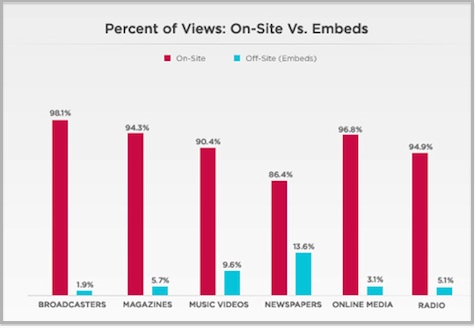
For minutes watched per view on-site vs. off-site, newspapers decline a little, from 1:25 minutes on-site to 1:10 off site, far better than broadcasters which dropped from 3:00 minutes to 1:59 minutes. Only one vertical, online media, actually increased its off-site viewership time, to 1:45 minutes from 1:32 on-site. Whether through proactive syndication or making video embeddable on other sites so that users can virally distribute video, off-site viewership is important because it helps bring content to where users already are, rather than forcing them to come to a destination site. Of course, more views equals higher monetization. With their primarily short-form video, newspapers are well-suited to off-site consumption, and from the data it looks like they understand this and are taking advantage.
Categories:
Topics: Brightcove, TubeMogul
-
5 Items of Interest for the Week of Sept. 6th
Though it was a short week due to the Labor Day holiday, there was no shortage of online video industry happenings this week. As I've been doing each of the last few Fridays, following are 5-6 noteworthy industry stories for your weekend reading pleasure.
Ooyala Raises $22 Million to Accelerate Global Expansion
Online video platform Ooyala's new $22 million round is a bright spot in what's been a pretty slow quarter for online video industry private financings. Ooyala's new funds will help the company grow in the Asia-Pacific region. Ooyala said it is serving 550 customers, double the level of a year ago.
Google TV to Roll Out World-Wide Next Year
Even though the first Google TV-enabled devices have yet to be deployed, Google CEO Eric Schmidt said this week that he envisions a global rollout next year. The connected device landscape is becoming more competitive for Google TV given the growing number of inexpensive connected device options.
Business Groups Question Net Neutrality Rules
Three pro-business trade groups urged the FCC to drop its net neutrality initiative, citing the "flourishing" broadband market and concerns that regulations will curtail new investments and hurt the economy. It seems like everyone has a different opinion about net neutrality, so the consensus needed to move regulation forward is still down the road.
ESPN, YouTube Link Up for Promo Campaign
This week ESPN and YouTube kicked off their "Your Highlight" campaign, enticing ESPN viewers to upload their own sports clips, with the best ones to be shown on SportsCenter. Then the best of the best will win a trip to ESPN's studios to watch a SportsCenter taping. It's a great promotional concept, using online video to further invest ESPN viewers in the brand. Whoever thought it up deserves a shout-out.
Life Without a TV Set? Not impossible
Another interesting data point to tuck into your back pocket: according to a 2010 Pew study, just 42% of Americans feel a TV set is a "necessity," down from 64% in 2006. Pew interprets this as a loss of status for the TV, as other devices like computers and phones have become video capable. The perception of convergence is taking root.
Categories: Broadband ISPs, Cable Networks, Deals & Financings, Devices, Regulation, UGC
Topics: ESPN, FCC, Google TV, Net Neutrality, Ooyala, Pew, YouTube
-
Vidyo Introduces VidyoCast for Broadcast Production in the Cloud
Vidyo, which has focused on high-quality videoconferencing over IP networks, is now turning its sights to the broadcast market, introducing "VidyoCast" today, which can move the entire broadcast production process into the cloud, powered by broadband delivery. Jim O'Brien, a broadcast veteran who recently joined as GM of VidyoCast, walked me through the solution earlier this week.
The primary benefits of the cloud-based approach are cost-savings and more operational flexibility, without sacrificing quality. Vidyo believes that by using IP networks instead of typical satellite transmission, broadcasters can save up to 90% of their typical costs. VidyoCast is also being positioned as a backup solution, particularly in situations where typical broadcast backup isn't feasible or is cost prohibitive. VidyoCast is meant to easily integrate into incumbent broadcast infrastructure.
Categories: Broadcasters
-
VideoNuze Report Podcast #74 - Sept. 10, 2010
Daisy Whitney and I are pleased to present the 74th edition of the VideoNuze Report podcast, for August 27, 2010. We're back after skipping last week due to me taking some time.
This week Daisy and I further discuss my post from Wednesday about the remarkable growth of the JW Player, an open source video player that is now being downloaded 15,000 times per day according to company CEO Dave Otten. Beyond JW player's success, the larger story is how broadly online video is being adopted. Far beyond the large media companies that are vigorously covered each day, there are thousands of small businesses, enterprises, education, government, non-profit and other entities that are quietly embracing online video. Daisy and I talk about the implications of all this activity.
Click here to listen to the podcast (15 minutes, 7 seconds)
Click here for previous podcasts
The VideoNuze Report is available in iTunes...subscribe today!Categories: Podcasts, Technology
-
Encoding.com Now Offering Pre-Configured Mobile Video Encoding Options
Encoding service provider Encoding.com is taking the wraps off "Mobile Made Easy" this morning, a collection of pre-configured encoding settings for mobile devices including iPhone/iPad, Android, BlackBerry, Windows Mobile and certain Samsung and Nokia phones. With the "presets," Encoding.com customers can now also select which mobile devices they want their video prepared and available for and the appropriate encoding process will be triggered.
Jeff Malkin, Encoding.com's president told me yesterday that the company has studied the video requirements for each of these mobile devices and designed the presets accordingly. Until now, the heterogeneous mobile space has meant that video providers interested in going mobile have had to test and optimize for each device, an expensive and time-consuming process which has deterred many. By simplifying the process Jeff sees many more video providers getting involved with mobile. From a pricing standpoint, files outputted for mobile use are counted the same as other files, under Encoding.com's usage based pricing plan.
While mobile video use still lags online use, it is poised to gain rapidly as the universe of video-capable smartphones and tablet computers like the iPad explode. Just yesterday, UBS forecast that the iPad alone could ship 28 million units next year. We've also seen tablets unveiled by Dell, Samsung, Toshiba and others, based on Android, which will add competition. All that means a huge new addressable market that video providers will find irresistible.
What do you think? Post a comment now (no sign-in required).
Categories: Encoding, Mobile Video
Topics: Encoding.com
-
New Flash Media Server 4 Targets Enterprise Users
Adobe is releasing Flash Media Server 4 today and an important new addition to the lineup is the Flash Media Enterprise Server, with specific features targeted to the enterprise customer segment.
These features include peer-assisted delivery using Flash's Real Time Media Flow protocol and IP multicast, the first time these have been offered. Both are meant to reduce enterprises' bandwidth expense and they can work in tandem with each other through what Adobe calls "Multicast Fusion." For the peer-assist feature, FMS works with the Flash Player 10.1 to help seed and distribute content. The enterprise focus reflects the growing use of video outside mainstream media business. Pricing wasn't released and is available for quote by Adobe reps.
IP multicast is also available in the Flash Media Interactive Server. It also supports real-time interactive applications like video chat and other social media apps. And it also incorporates HTTP Dynamic Streaming, which was previously announced in May, allowing CDNs and others to leverage their HTTP infrastructure. HTTP streaming has become a key competitive area since Microsoft introduced Smooth Streaming, for adaptive bit rate streaming to Silverlight clients over HTTP. The Flash Media Interactive Server pricing stayed constant at $4,500. Pricing for the basic Flash Media Streaming Server also stays at $995.
Categories: Technology
Topics: Adobe, Flash, Silverlight
-
JW Player is Now Downloaded 15,000 Times a Day; Being Positioned as "WordPress for Video"
Yesterday I had a chance to catch up with Dave Otten, CEO of LongTail Video, who told me that the company's JW Player is now being downloaded 15,000 times a day, and is live on 1.3 million sites globally. Dave estimates that 7-10 billion video streams are consumed via JW Player monthly, a sizable portion of the approximately 90 billion streams he estimates are delivered globally each month.
If you're not familiar with the JW Player, it is an open source video player that was developed back in 2005 by Jeroen "JW" Wijering and was used by YouTube as its first player. Dave said the player's growth has come purely through viral distribution and he thinks of it as "WordPress for video" (WordPress is the widely-used open source blogging platform). Dave believes JW Player's fast growth reflects the broadening appeal of online video beyond the traditional media industry. Many downloads are for first-time video users looking for an inexpensive solution to get them started (though few have graduated to other players even as their volume has scaled).
Categories: Technology
Topics: JW Player, LongTail Video
-
Webinar Tomorrow: Boosting VOD Revenue and Engagement Through Enhanced Content Discovery
Even as the range of new over-the-top connected devices brings consumers an explosion of new video choices, incumbent pay-TV operators have continued building viewership of their own video-on-demand (VOD) offerings. But, as Colin Dixon, Senior Partner at The Diffusion Group, a digital media research firm, argues in a new white paper, the vast majority of this viewership has been of free content, effectively leaving pay-TV operators out of the burgeoning rental and download markets. A key reason for this has been sub-optimal electronic program guides (EPGs).
In a complimentary webinar tomorrow at 11am PT / 2pm ET titled "The Social TV Guide: Boosting VOD Revenue and Customer Engagement Through Enhanced Content Discovery," Colin will lay out both the opportunity and specific tactics for how providers can improved their VOD offerings. Colin will be joined by Sefy Ariely, VP of Sales and Marketing for Orca Interactive, which makes content navigation software. The data and lessons that Colin will share is applicable not only to pay-TV operators, but to anyone offering online and mobile video options trying to drive higher usage and revenue.
Categories: Events
Topics: Orca Interactive, TDG
VideoNuze Posts

Connect with VideoNuze
Exclusive News Roundup
- Netflix Pushes Further Into Live Programming With ‘The Breakfast Club’ WSJ
- Roku builds dedicated creator content hub, expands FAST channels StreamTV Insider
- Amazon, Netflix and Google to Capture Half of CTV Ad Market by 2030 TV Tech
- YouTube's AI deepfake detection tool is now available to all creators 18 and older Engadget
- Paramount’s Warner Bros. Takeover Expected To Breach Its SkyShowtime Venture With Comcast Deadline
- Netflix Says Its Ad-Supported Tier Now Has 250 Million Monthly Viewers Cord Cutters News